36 works in this view — arrow keys or swipe to move between them.
Dance in Art · 2019
Carmencita waltz
Unknown artist
- Medium:
- Lithograph
- Dance:
- Waltz
- Era:
- Early 1800s (Waltz Revolution)
- Source:
- New York Public Library
- Rights:
- Public domain — free to use, share and adapt.
- Recorded as:
- public_domain
This image documents the commercialization of dance in the Gilded Age—how ballroom dance was packaged, branded, and sold alongside celebrity performers and consumer goods. It also reveals the cross-cultural translation of Spanish performance idioms (flamenco, theatrical costume) into American social dance, showing how a figure like Carmencita reshaped metropolitan dance culture through theatrical presence rather than formal technique alone.
What you are looking at
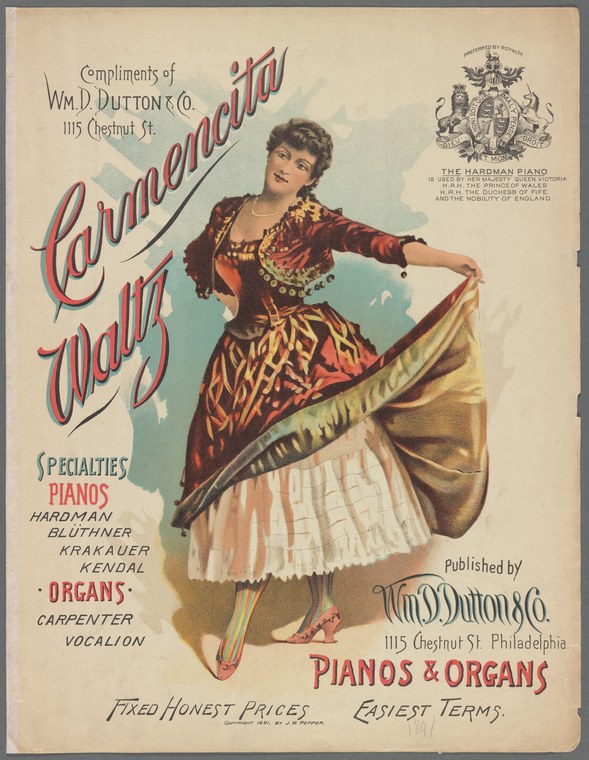
A young woman in performance dress dominates this lithographic cover advertisement. She wears a striking crimson jacket with ornate braiding over a white petticoat with deep golden-brown underskirts, the hem caught mid-swirl to reveal the layered construction. Her dark hair is swept up, and she gazes toward the viewer with a direct, engaging expression while her body twists in a lively pose. Her right arm extends outward in an open gesture; her left gathers fabric. The composition fills most of the page, with her figure set against a soft blue-grey background. Red script typography curves around her body spelling "Carmencita Waltz." In the upper left corner, text reads "Compliments of Wm D Dutton & Co., 1115 Chestnut St." — identifying this as promotional material for a Philadelphia piano and organ seller. A coat of arms appears in the upper right. At the bottom, "Published by Wm D Dutton & Co., 1115 Chestnut St Philadelphia" and "PIANOS & ORGANS" confirm the commercial purpose.
The dancing
The single figure occupies the entire composition in a dynamic three-quarter view. Her posture is upright and spirited rather than formally ballroom-constrained—the torso rotates actively, the skirt swings in a full circle with momentum, and her extended arm suggests movement through space rather than a fixed closed position. The weight appears transferred into the turn. Her expression and open arm reach toward an audience or partner outside the frame. There is no sense of the rigid frame or synchronized parallel lines of formal waltz partnership; instead, the figure conveys the exuberance and theatrical flair of a stage performer.
The dance depicted
The work depicts the Carmencita Waltz, a popular social dance that took its name from the Spanish dancer Carmencita (María del Carmen Díaz), who performed extensively in the United States during the 1880s and 1890s. Though titled a waltz, the image suggests a theatrical interpretation blending waltz with the performer's own Spanish performance idiom—the crimson Spanish jacket, the dramatic skirt catch, and the stage-facing pose all point to a professional or exhibition version rather than a parlor dance. The figure's costume and pose align with Carmencita's own fame as a performer who brought Spanish flamenco elements into American entertainment. This was a piece of commercial dance ephemera, part of the market for sheet music and promotional materials tied to celebrity dancers and popular stage acts.
How it was made
The work is a colour lithograph, a commercial printing technique ideal for promotional materials and sheet music covers of the era. Lithography allowed rapid, economical production of vivid images in multiple colours, which could be distributed widely and afforded to ordinary piano-buying households. The technique is evident in the soft gradations of the background, the clear linear definition of the figure's costume details, and the bold, integrated typography. This was a high-volume commercial art form—not a unique drawing or painting, but a work designed for hundreds or thousands of copies to circulate as sheet music covers, store advertisements, or promotional inserts. The quality of the execution and the integrated design suggest professional commercial lithography rather than a folk or amateur production.
About this work
This colour lithograph sheet music cover advertises a popular waltz titled "Carmencita Waltz" through the image of a vivacious female performer in a Spanish-inflected stage costume. It was issued as promotional material by the Philadelphia piano and organ merchant Wm D Dutton & Co., circa 1880s–1890s, to circulate the melody and the merchant's name to potential customers. The work belongs to the vast commercial landscape of dance-related sheet music covers from the Gilded Age—a moment when ballroom dances, celebrity performers, and mass-market music publishing converged. The Carmencita Waltz capitalized on the American fascination with the Spanish dancer Carmencita, whose theatrical performances blended flamenco elements into social dance forms acceptable to American polite society. Sheet music covers of this period are a primary visual archive of how ballroom and theatrical dance were understood, marketed, and consumed by the urban middle class.
How to look at it
Note the moment the artist chose: the skirt caught at its fullest swing, mid-rotation, suggesting a turn or whirl rather than a pause. The extended arm and direct gaze break the frame of formal ballroom decorum—this is performance, not parlor etiquette. Observe the costume's hybridity: the waltz was an Austrian/German form, but the Spanish jacket, the deep gathered skirt, and the theatrical pose insist on Carmencita's Spanish identity. The bright red against the white and gold creates visual excitement and signals spectacle. This is how dance was sold to sheet music buyers: not through technical precision but through personality, exoticism, and the promise of entertainment.
The period
The 1880s–1890s saw an explosion of commercial sheet music publishing in the United States, with illustrated covers becoming a key marketing tool and a major art form in their own right. The waltz, introduced to America in the early 1800s, had become the dominant ballroom form by mid-century, but it was continually refreshed by new variations, regional infusions, and celebrity associations. Carmencita's tours of the United States (particularly 1889–1891) created enormous demand for waltzes, polkas, and other dances bearing her name—publishers capitalized on her fame by issuing dozens of "Carmencita" compositions. This period also saw the rise of illustrated advertising and promotional lithography as a mass medium; piano and organ manufacturers competed fiercely for middle-class customers and used colorful celebrity-endorsed materials to build brand loyalty. The combination of theatrical modernity, commercial enterprise, and dance reflects the cultural moment when popular entertainment, consumer goods, and visual spectacle became intertwined.
Where it lives
This lithograph is held in the New York Public Library collection. It is a sheet music cover and promotional material issued by the Philadelphia piano and organ retailer Wm D Dutton & Co., typical of the mass-produced commercial materials that survive as primary sources for understanding dance culture and consumption in the Gilded Age.
Dance in this work
Questions about this work
Who was Carmencita?
Carmencita (María del Carmen Díaz, c. 1868–1897) was a Spanish dancer and performer who became a major celebrity in the United States during the late 1880s and 1890s. She performed in theatres, at private society events, and in vaudeville, bringing Spanish flamenco and theatrical performance styles to American audiences. Her fame was so significant that American composers and publishers issued numerous dances, waltzes, and polkas bearing her name, even if Carmencita herself did not compose them.
Is this a sheet music cover?
This is promotional material issued by a piano and organ dealer that accompanied or advertised sheet music. The front side features the attractive image of Carmencita; the back or interior would have contained the musical score, lyrics, or advertisement for the merchant. Such covers were given away or sold inexpensively to promote both the music and the retailer's business.
What is the difference between the Carmencita Waltz and a standard waltz?
Musically and choreographically, the Carmencita Waltz likely retained the three-beat meter and turning motion of a standard waltz, but was decorated or inflected with Spanish rhythmic elements, flamenco-influenced arm and body movement, or theatrical flair associated with Carmencita's own performances. The "Carmencita" name was primarily a marketing device capitalizing on her celebrity; many such pieces were variations or elaborations of existing waltz forms.
What does the lithography technique tell us about circulation?
Lithography was fast, economical, and allowed for vivid colour printing. This meant thousands of copies could be produced and distributed to music stores, piano dealers, and households across America. The work's survival in a major library collection suggests it was common enough that multiple copies still exist—it was a mainstream commercial product reaching a mass audience.
More Waltz artwork