31 works in this view — arrow keys or swipe to move between them.
Dance in Art
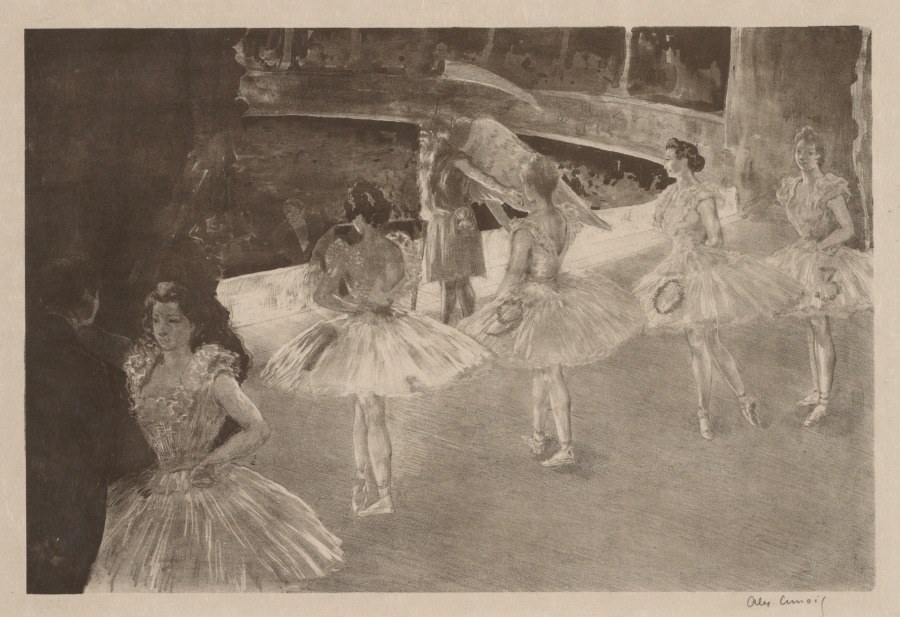
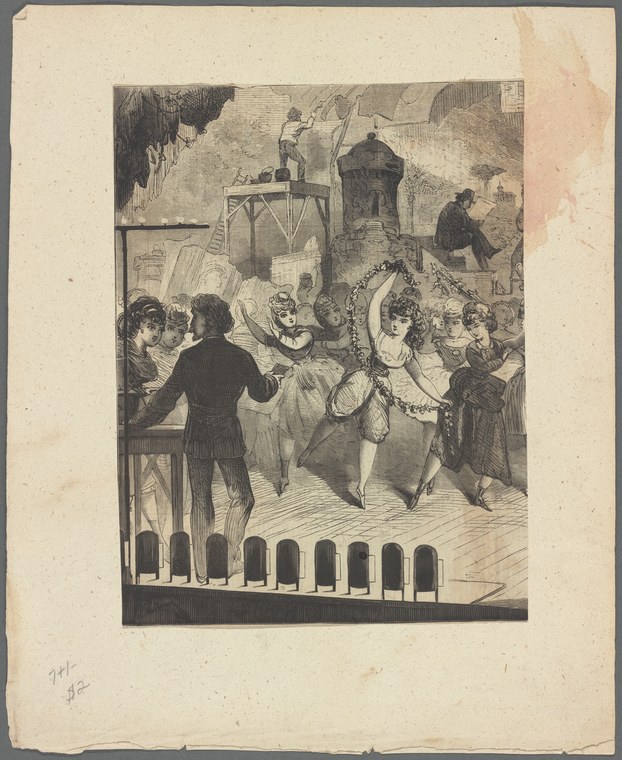
Ballet rehearsal onstage
Unknown artist
- Medium:
- Dance:
- Ballet
- Source:
- New York Public Library
- Rights:
- Public domain — free to use, share and adapt.
- Recorded as:
- public_domain
This image preserves visual evidence of how early Romantic ballet looked in rehearsal—the actual bodies, the dress, the working methods—rather than the idealized iconography of finished performances. It documents a crucial moment in dance history when ballet was consolidating its technical vocabulary and social prestige in European theaters.
What you are looking at
This engraving depicts a theatrical ballet rehearsal taking place on a stage set. The scene is crowded with figures in early 19th-century dress: several female dancers in white muslin gowns with high waistlines and bare arms, male figures in dark coats, and what appears to be stage machinery and architectural elements in the background. A large decorative arch or gateway structure dominates the upper right; wooden scaffolding and rigging are visible above. The composition is dense and busy, with figures clustered in the foreground—some watching, others in motion—while additional figures work at the machinery and scenery. The engraving technique creates strong contrasts between dark and light areas, emphasizing the theatrical setting and the energy of the moment.
The dancing
The dancers, predominantly women, wear the high-waisted, columnar white dresses and hairstyles characteristic of the Regency period. Several figures stand or move with arms raised or extended, suggesting the lifted, elongated carriage of early 19th-century ballet. The poses show upright posture and what appears to be an attempt to convey the ethereal, weightless quality of the period's aesthetic. Male observers and stage workers are scattered throughout, creating a narrative of rehearsal in progress rather than a polished performance.
The dance depicted
This is almost certainly a rehearsal of Romantic-era ballet, likely from the 1820s–1840s, the period when European ballet was defining its technical and aesthetic vocabulary. The white dresses, the female-centered composition, and the ethereal quality of the poses all align with early Romantic ballet conventions. The presence of stage machinery, the scaffolding, and the architectural set pieces point to the large-scale theatrical productions that became standard in this era. The mixture of dancers at work and figures directing or observing suggests the social and technical realities of professional ballet production.
How it was made
This is a line engraving, likely created in the early 19th century, based on the technique's characteristics and the subject matter. The engraver has used fine parallel lines (hatching and cross-hatching) to create tone and shadow, with particular attention to the contrast between the white gowns and the darker background and figures. The medium's precision and reproducibility made engravings a popular way to document theatrical scenes for a educated, middle-class audience interested in dance, theater, and the social life of Paris and London.
About this work
This engraving documents a moment of artistic labor in early 19th-century ballet. It captures not the finished performance but the rehearsal—the social and physical reality behind the ethereal illusion. The scene shows a crowded stage with dancers in Regency dress, male observers, and theatrical machinery, recording both the aesthetic ideals of Romantic ballet (the lifted bodies, the white muslin gowns) and the practical apparatus required to realize them. As a print, it circulated among an audience of theatergoers, connoisseurs, and amateurs of dance, offering insight into how ballet was understood: as a collaborative, technically sophisticated enterprise rather than a natural gift of grace.
How to look at it
Observe the engraver's choices: the clustering of figures, the prominence of the white-clad female dancers, the careful rendering of the machinery and architectural elements. The artist has frozen a working moment—mid-rehearsal—rather than a climactic stage moment. Notice how the male figures are positioned as directors, observers, and technicians, while the female dancers occupy the visual and compositional center. The technical precision of the engraving itself reflects the precision and discipline that early 19th-century ballet prized.
The period
The 1820s–1840s were the golden age of Romantic ballet in Europe. Dancers like Maria Taglioni became international celebrities; the use of pointe work became standard; and the ethereal female form in white muslin became the aesthetic ideal. Simultaneously, theatrical technology advanced dramatically: gas lighting, mechanical scenery, and new staging techniques created unprecedented visual spectacle. Prints and engravings of ballet scenes were popular commodities, satisfying public curiosity about theater and offering a form of celebrity coverage.
Where it lives
The work is held by the New York Public Library, which maintains a substantial collection of 19th-century theatrical prints and engravings documenting dance and theater history.
Dance in this work
Questions about this work
What is a ballet rehearsal scene doing in a gallery of dance in art?
Rehearsal scenes are primary historical documents. They show us what dancers actually wore, how they held their bodies, what the social and technical structure of ballet was, and how artists represented labor and collaboration. A rehearsal captured in an engraving tells us more about the lived reality of dance than a polished performance image.
Why is everyone in white dresses?
White muslin gowns became the standard costume for female ballet dancers in the Romantic era (1820s onward). The color and fabric created an ethereal, weightless visual effect that was central to the era's aesthetic ideals. Male dancers and figures in dark coats reflect the gendered conventions of professional ballet.
Can you identify the ballet or the venue?
No inscription is legible in the engraving. The scene is generic enough to represent rehearsal practice at any major European theater of the period, though the style and composition suggest a French or London production from the 1820s–1840s.
More Ballet artwork