33 works in this view — arrow keys or swipe to move between them.
Dance in Art · 2019
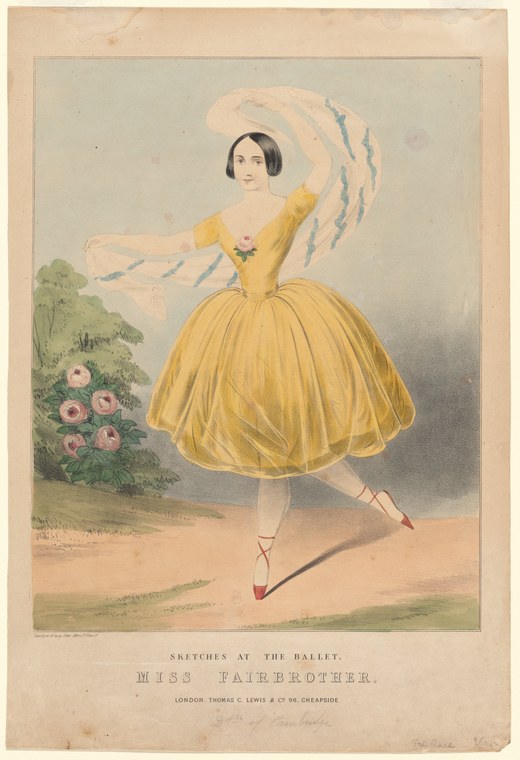
Sketches at the ballet
Unknown artist
- Medium:
- Drawing/Sketch
- Dance:
- Ballet
- Source:
- New York Public Library
- Rights:
- Public domain — free to use, share and adapt.
- Recorded as:
- public_domain
This work documents a specific historical moment—English Romantic ballet as it was performed and commodified in the 1840s—and shows how dance was communicated to the public through print culture. It is an invaluable visual record of costume, pose, and the aesthetic ideals that governed Romantic ballet performance, capturing a dancer and a dance form at a particular historical moment.
What you are looking at
A young female dancer in a golden yellow ball gown stands in a languid pose against a soft, atmospheric background. She holds a large cream-colored parasol aloft, tilted back over her shoulder in an elegant arc. Her body is caught in a moment of gentle motion—one leg appears to extend behind her in a light, floating gesture while the other supports her weight. She wears her dark hair parted in the center in the fashion of the 1840s, with small ear-rings visible. In the lower left of the composition, a grouping of pink roses with green foliage sits on a grassy foreground, providing a romantic accent. The palette is soft and muted—pale blues, warm yellows, and greens—creating an almost dreamlike quality typical of the Romantic era. The composition suggests a momentary pause in motion, as if the dancer has just finished or is about to begin a gesture.
The dancing
The dancer stands in a three-quarter pose with her weight on one leg, the other leg extended lightly behind or to the side in a relaxed, almost floating position. Her arms are asymmetrical: one holds the parasol raised overhead, the other hangs at her side. The pose suggests weightlessness and ease rather than the turned-out, controlled positions of classical technique. Her upper body leans slightly forward in a gentle contrapposto, and her head turns to face the viewer with a serene expression. There is no sense of tension or exertion—the body speaks of grace and repose.
The dance depicted
This depicts a Romantic-era ballerina, most likely performing a solo or a moment of repose within a ballet of the 1840s. The work is titled 'Miss Fauberother' and labeled as a sketch from 'The Ballet,' suggesting it may document a specific performance or performer. The pose and dress are consistent with Romantic ballet as it was performed in London during this period—the emphasis on effortless femininity, the soft tutu or skirt, and the parasol as a prop all point to the aesthetic conventions of ballets like *La Sylphide* or *Giselle*. The artist was not primarily interested in the technical vocabulary of classical ballet (no en pointe positioning is evident) but rather in capturing the ethereal, sentimental mood the dancer was meant to convey.
How it was made
This is a hand-colored lithograph or engraving, executed with a delicate wash technique in watercolor or gouache. The medium allowed for the soft gradation of color and atmospheric effects that dominate the image. The printing and hand-coloring process would have made this an affordable print for middle-class collectors—a common way for theater-goers to commemorate favorite performances or dancers. The technique is well suited to capturing the ephemeral quality of Romantic dance aesthetics; the soft edges and pale palette mirror the movement and mood of the subject.
About this work
This is a portrait of a Romantic-era ballet dancer frozen in a graceful, off-center moment. The work documents not only the appearance of a specific performer, Miss Fauberother, but also the visual and conceptual language of English Romantic ballet in the 1840s. The parasol, the ball gown, the soft landscape setting, and the emphasis on effortless feminine beauty all belong to a particular moment in dance history when ballet was understood through the lens of sentimental, otherworldly femininity rather than athletic display.
The image is a valuable record of how Romantic ballet was marketed, consumed, and remembered by the public. Theater prints like this were collected avidly; they allowed audiences to extend their engagement with performances and dancers they had seen or heard about. The work belongs in a dance history collection as material evidence of mid-nineteenth-century theatrical culture, audience taste, and the visual conventions used to represent the dancing body.
How to look at it
Notice the moment chosen: the dancer is not mid-leap or en pointe, but caught in a state of repose or gentle transition. This reflects the Romantic aesthetic's preference for ethereal calm over technical display. Observe how the parasol becomes as much a part of the composition as the body—it creates a secondary arc that echoes the curve of the figure and fills the upper half of the frame. The pose is deliberately off-center and asymmetrical, creating a sense of ease and naturalism rather than formal symmetry. The soft background and delicate color palette work together to dematerialize the figure, giving her the weightless quality that Romantic ballet audiences expected from their dancers.
The artist
The artist is not recorded in the catalogue. However, the work is credited to London publishers Thomas & Lewis at 30 Cheapside, suggesting it was produced as a commercial theater print—a form of mass-market merchandise circulating in London theaters and print shops. Such works were typically executed by theater specialists and commercial printmakers rather than fine artists; their names often went unrecorded. The style is consistent with the conventions of English theatrical portraiture of the period.
The period
The 1840s were the height of the Romantic ballet movement. *La Sylphide* premiered in Paris in 1832 and became the template for a new aesthetic: weightless, ethereal, otherworldly female dancers in tulle skirts, often representing supernatural or exotic beings. By the 1840s, this style had become dominant across Europe and England. Theaters printed thousands of portrait engravings of popular dancers, making them accessible to a broad public and turning individual performers into celebrities. These prints were collected, displayed, and traded much as theater programs or celebrity photographs would be today. The visual language of such prints—soft colors, romantic landscapes, graceful poses—was deeply aligned with the Romantic movement in visual art and literature.
Where it lives
The work is held in the New York Public Library's collection of theater prints and ephemera. It is a commercial lithograph or engraving published in London by Thomas & Lewis, indicating it was produced as a mass-market souvenir of theatrical performance—a type of object made in large quantities and distributed through print shops and theaters.
Dance in this work
Questions about this work
Who was Miss Fauberother?
The catalogue record does not identify her beyond the title. She was likely a dancer performing in London theaters during the 1840s, but without additional documentation, little more can be said. Theater prints of the Romantic era often captured now-obscure performers who were popular in their moment but left limited historical record.
Why is she holding a parasol?
The parasol functions both as a period-accurate prop and as an aesthetic element. It would have been a fashionable accessory for an upper-class woman of the 1840s, fitting the romantic, courtship narratives that often framed Romantic-era ballets. It also creates compositional balance and echoes the curves of the body.
Is she dancing or posing?
The boundary is deliberately blurred. The pose suggests a moment of gentle movement—a step, a pause, a gesture—but it is also decorative and static. This reflects how Romantic ballet was often portrayed in prints: emphasizing atmosphere and beauty over visible technique or exertion.
How do we know this is ballet and not another form of dance?
The dress, the soft tulle skirt, the title reference to 'The Ballet,' and the aesthetic conventions—ethereal beauty, romantic mood, soft colors—all align with the visual language of Romantic ballet as it was performed in the 1840s. The pose and setting do not suggest folk dance, court dance, or theatrical styles like pantomime.
More Ballet artwork