49 works in this view — arrow keys or swipe to move between them.
Dance in Art · 2019
Ancient dancing
Unknown artist
- Medium:
- Source:
- New York Public Library
- Rights:
- Public domain — free to use, share and adapt.
- Recorded as:
- public_domain
This image is crucial evidence for the moment when European dance turned toward Greece and Rome as sources of authority and beauty. It shows that dancers (and the artists who drew them) understood classical dance not as recreation of documented ancient practice, but as an imaginative reconstruction built from sculpture, vase painting, and literary sources—a fusion of anatomy, drapery study, and theatrical convention. For historians of dance and visual culture, it documents how neoclassicism shaped the female body's presentation on stage and how prints disseminated and stabilized an ideal of classical femininity that would echo through centuries of ballet.
What you are looking at
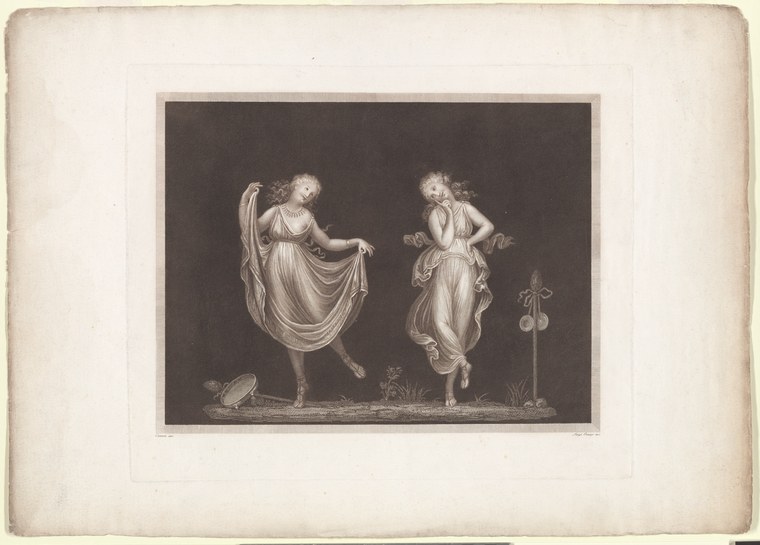
Two female figures in classical drapery are poised against a dark background in what appears to be an allegorical or mythological scene. The figure on the left wears a flowing chiton and reaches upward with one arm in an open, expansive gesture, her weight lifted and body angled as if in motion; her companion on the right stands in a more contained posture, one hand raised to her face in a gesture suggesting thought or contemplation. Between them stands a tall staff or thyrsus topped with a cross or ornament. The ground beneath them is minimal—a few scattered plants or flowers suggest an outdoor setting, but the scene is rendered almost entirely against the void of the dark ground, creating an effect of classical simplicity and timelessness. The engraving technique allows for precise rendering of the drapery's fall and the figures' anatomical grace.
The dancing
Both dancers are barefoot and wear the high-waisted, columnar drapery of classical antiquity. The leftward figure extends her right arm upward and outward in an open, almost ecstatic attitude; her body appears to move through space with the weight lifted and the torso elongated. Her companion's posture is more restrained—her body turns inward, and her raised hand is drawn toward her own face rather than projected outward. The relationship between them is one of emotional or narrative counterpoint: one open and expansive, one introspective. Neither adopts a closed ballroom hold; instead they occupy the same shallow stage space as independent but related figures.
The dance depicted
The image depicts a moment from neoclassical dance as understood in the late 18th century, when classical antiquity was the governing ideal for theatrical dance. The poses and drapery suggest the vocabulary of Greek and Roman art, and the barefoot stance was a deliberate marker of classical authenticity in that era. The two figures may represent allegorical or mythological personages—perhaps from a ballet d'action—performing a duet that contrasts states of emotion or narrative situation. The thyrsus or staff between them may indicate Bacchic or Dionysian content. The work captures the moment of neoclassical ballet's elevation of the female body as the primary vehicle of classical beauty and moral sentiment.
How it was made
This is an engraving, a printmaking technique that creates fine detail through the incision of lines into a metal plate. The print shows the hallmarks of late 18th-century reproductive engraving: precise line work, subtle tonal gradation achieved through parallel hatching, and a careful rendering of fabric texture and the fall of drapery. The dark background is created by dense parallel lines, which emphasizes the luminosity of the figures' forms. As a print, this work would have been reproducible and circulated among a educated audience interested in classical dance, theatrical fashion, or antiquarian subjects. The technique's precision and the care lavished on anatomical and drapery detail suggest this was a work of some ambition, possibly from a series or a published illustrated account of a ballet.
About this work
This engraving documents a moment in the history of neoclassical dance, a major current in European theatrical performance from the 1770s onward. It shows two female dancers in classical drapery frozen in a duet that plays contrasting emotions—one figure open and rising, the other contained and introspective. The work exemplifies the late 18th-century belief that authentic classical form could be recovered through studying ancient sculpture and vase painting, and that this recovery would yield dance of moral and aesthetic purity. The engraving's precision and tonal sophistication made it suitable for circulation among the educated public, serving both as a record of an actual performance or style and as an ideal image—an Ur-form of what classical dance could be.
How to look at it
Attend to the contrast between the two bodies: how the artist has used the classical chiton to reveal the musculature and weight of each figure, and how their gestures and postures tell a story without narrative detail. Notice the work of the staff or thyrsus in the center—it anchors the composition and may signal the scene's mythological content. Look at the drapery closely: the engraver has rendered the fall of fabric with anatomical precision, showing not just cloth but the body underneath, a hallmark of neoclassical style. The dark ground is not a landscape or interior but a void, forcing all attention onto the figures' forms and movements—a compositional choice that emphasizes purity and timelessness.
The period
This work was created during the heyday of neoclassical aesthetics in Europe, roughly the 1770s–1800s. In dance, this period saw the rise of ballet d'action—narrative ballets with a coherent plot and emotional content—and a sharp pivot away from the court dances of the ancien régime toward classical subjects and forms. Choreographers like Jean-Georges Noverre advocated for reform of ballet based on study of antique sources. In the visual arts, neoclassicism was the dominant mode across Europe, with artists studying antique sculpture and employing the classical body as the measure of beauty and virtue. Engravings of dancers in classical dress circulated widely, serving both as fashion documents and as arguments about what dance could and should be.
Where it lives
The work is held in the New York Public Library's collection and is catalogued as a print of unknown artist. It entered the collection as part of NYPL's holdings in prints and illustrated materials documenting performance and social history.
Dance in this work
Questions about this work
What dance is this?
The specific ballet or dance piece is not documented in the catalogue record. However, the style and dress indicate neoclassical ballet from the late 18th century, the period when European choreographers were creating ballets based on classical mythology and using Greek and Roman dress and pose as sources of authority. The two contrasting figures suggest a duet from a ballet d'action, likely involving mythological or allegorical characters.
Are these real dancers or idealized figures?
Likely both. The engraver was working from a drawing or painting made after a live performance or dancer, but filtered through the conventions of neoclassical art: the drapery is studied from antique sculpture, the poses emphasize classical proportion and grace, and the bodies are presented as ideal forms rather than portraits. The work is both a record of how dancers actually moved and looked, and an aspirational image of what dance should be.
Why are they barefoot?
Barefoot performance was a deliberate marker of classical authenticity in late 18th-century dance. To signal that dancers were performing as Greek or Roman figures, choreographers and dancers abandoned heeled shoes and performed in bare feet or in simple sandals. This was a radical departure from earlier ballet practice and a visual argument about returning to an imagined classical purity.
What is the staff they stand beside?
It appears to be a thyrsus, a staff carried by Bacchus and his followers in classical art and mythology. This suggests the dancers may represent Bacchic or Dionysian figures, or that the scene involves revelry, wine, or ecstatic worship—common subjects in neoclassical ballets based on classical literature.
More dance artwork