25 works in this view — arrow keys or swipe to move between them.
Dance in Art · 2017
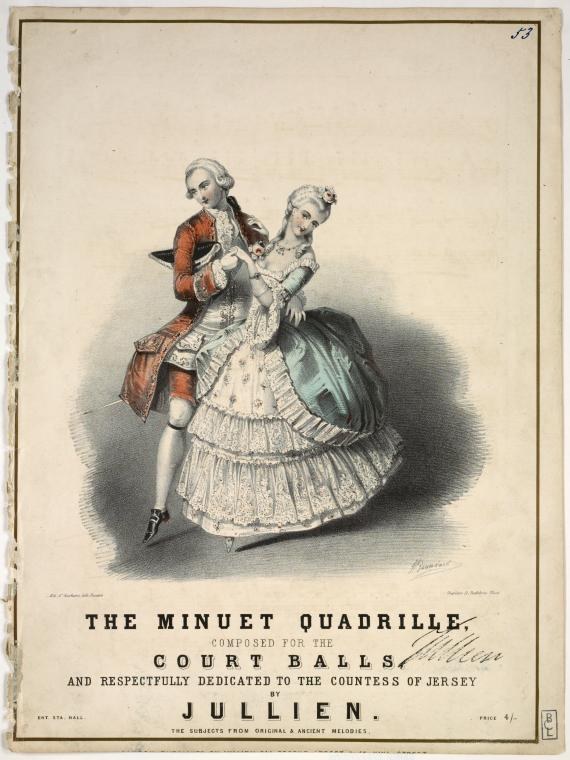
The minuet quadrille, composed for the court balls and respectfully dedicated to the Countess of Jer
Unknown artist
- Medium:
- Engraving
- Dance:
- Quadrille
- Era:
- 1700s (Enlightenment/Minuet Era)
- Source:
- New York Public Library
- Rights:
- Public domain — free to use, share and adapt.
- Recorded as:
- public_domain
This engraving is one of the few surviving visual records of the minuet quadrille in practice, making it invaluable for understanding the transition from Baroque to later 18th-century court dance. It also documents how dancing masters taught and promoted fashionable dances to the aristocracy, revealing that the visual presentation of rank, dress, and courtly behavior was as central to the dance as any step pattern.
What you are looking at
A man and woman pose in an elegant engraving depicting the minuet quadrille, a dance form that merged Baroque courtly tradition with the newer quadrille structure. The woman wears an elaborate white gown with multiple tiers of lace and pleating, her skirt gathered with ribbon trim, her hair dressed high in the style of the mid-18th century. The man, positioned behind and to the side of her, wears a russet-red coat with gold embroidery, white breeches, and a decorative sword—the full dress of a gentleman of rank. Both figures are posed in an attitude of elegance rather than captured mid-movement: the woman appears to turn slightly, her body upright and composed, while the man gestures with one hand in a courtly manner. The composition is set against a plain background with subtle shading that creates depth, and the figures are rendered with fine detail in the formal engraving technique.
The dancing
The two figures are arranged in a close spatial relationship typical of partner dances of the period, though not in a closed hold. The man's posture is upright and slightly turned away, his gesture open and demonstrative—one arm raised and extended in a courtly acknowledgment. The woman stands mostly upright, her weight centered, her body forming an elegant line. Neither figure shows the active footwork or weight transfer visible in action photographs; instead, both present poses of formal elegance. This is a presentational rather than kinetic image—the moment chosen is one of courtly deportment rather than active stepping.
The dance depicted
The title explicitly identifies this as a minuet quadrille, a hybrid form that combined elements of the minuet (the reigning court dance of the 18th century) with the structure and group formations of the quadrille, which was rapidly gaining popularity, particularly in France, from the mid-1700s onward. The minuet quadrille was performed at court balls by aristocrats and members of the upper gentry, and this engraving was created as a teaching aid or promotional image for such court entertainment. The formal dress, composed poses, and courtly setting all confirm this as a work intended to document and instruct in aristocratic dance practice of the period. The image emphasizes elegant carriage and genteel comportment over technical footwork.
How it was made
This is an engraving (confirmed by the fine lines, cross-hatching, and tonal modeling characteristic of the medium). The technique allowed for precise linear definition and fine detail in rendering costume and setting, making it ideal for instructional or commemorative purposes. Engravings were relatively expensive to produce but could be printed in multiple copies and distributed to noble households and dancing masters, making this a work designed for circulation among the educated and wealthy. The high production values and careful attention to dress and setting indicate this was intended as a prestige object—a keepsake documenting fashionable dance practice.
About this work
This engraving documents the minuet quadrille, a transitional dance form that bridged the declining Baroque minuet and the ascendant quadrille of the mid-18th century. Created for the court balls of the nobility, it presents two figures in formal dress posed to demonstrate the elegance and decorum expected of aristocratic dancers. The work is simultaneously a dance instruction manual, a fashion document, and a record of aristocratic leisure—a snapshot of how the European nobility performed gentility through partner dance. As such, it sits at a crucial moment in dance history when court dances were beginning to shift from pure Baroque tradition toward the more structured, ensemble-based forms that would dominate the later 18th century.
How to look at it
Observe the pose and the moment frozen: this is not a step in progress, but a position of rest and courtly presentation. The viewer should notice how the engraver has prioritized the rendering of costume—the expensive fabrics, embroidery, and fashionable silhouette—over any indication of footwork or technical skill. The composition also reveals the gendered spatial dynamics of 18th-century court dancing: the woman is centered and displayed, while the man is positioned in a supporting, attentive role. This tells us that at this social level, dance was as much about displaying wealth, rank, and refined manners as it was about mastering technique.
The artist
The artist is not recorded, which is typical for many 18th-century commercial engravings. The work was created by a professional engraver working in the commercial trade of dance instruction and court entertainment promotion, likely in Paris or another major European center of court culture. Such engravings were often produced as single plates to accompany printed music or dance instruction manuals, or sold as standalone images to dancing masters and noble households. The signature line at the bottom suggests this was a published work distributed through commercial channels.
The period
The minuet quadrille emerged in the 1750s–1770s at a moment when the minuet, which had dominated court dance for nearly a century, was beginning to lose ground to newer, more interactive social forms. The quadrille itself originated in France in the mid-18th century, initially as a figure dance for four couples, and rapidly spread through European court society. This hybrid form attempted to preserve the elegance and prestige of minuet performance while incorporating the novelty and group participation of the quadrille. The image dates to a period of rapid change in ballroom culture, when dancing masters and composers were actively experimenting with new forms that could sustain aristocratic interest in dancing.
Where it lives
The work comes from the New York Public Library collection and is catalogued as a published engraving from the 1700s. It was created as a standalone promotional or instructional print, likely sold to dancing masters, aristocratic patrons, or included in dance instruction manuals of the period. The dedication to the Countess of Jersey suggests it may have been created to commemorate a performance or to curry favor with a patron of high rank.
Dance in this work
Questions about this work
What is a minuet quadrille?
The minuet quadrille was a hybrid dance form of the mid-to-late 18th century that combined elements of the refined, processional minuet with the structured group formations of the newer quadrille. It was performed at aristocratic court balls as a way to preserve the prestige of the minuet while incorporating the novelty of quadrille figures. It typically involved four couples arranged in a square, performing a sequence of figures that combined minuet steps and bearing with quadrille patterns.
How do we know this is meant to teach dancing?
The title explicitly states it was 'composed for the court balls,' and the work was clearly produced as an engraving—a commercial medium used to distribute instructional images to dancing masters and wealthy patrons. The formal, posed presentation (rather than action imagery) was typical of teaching prints, which aimed to show correct posture and deportment rather than capture movement in progress. The dedication to a countess also suggests this was a prestige object created to document and promote fashionable court dancing.
What can we learn about 18th-century court dance from this image?
The engraving reveals that aristocratic dancing of this period prioritized elegance, correct dress, and refined bearing over technical virtuosity. The careful rendering of expensive textiles and fashionable silhouettes shows that displaying wealth and rank through dress was integral to dance performance. The spatial relationship between the man and woman, and the way the woman is positioned as the focal point, also reveals gender dynamics of the period: men performed in a supportive, attentive role while women were displayed and admired.
More Quadrille artwork