34 works in this view — arrow keys or swipe to move between them.
Dance in Art
The pet of the ballet
Unknown artist
- Medium:
- Dance:
- Ballet
- Source:
- New York Public Library
- Rights:
- Public domain — free to use, share and adapt.
- Recorded as:
- public_domain
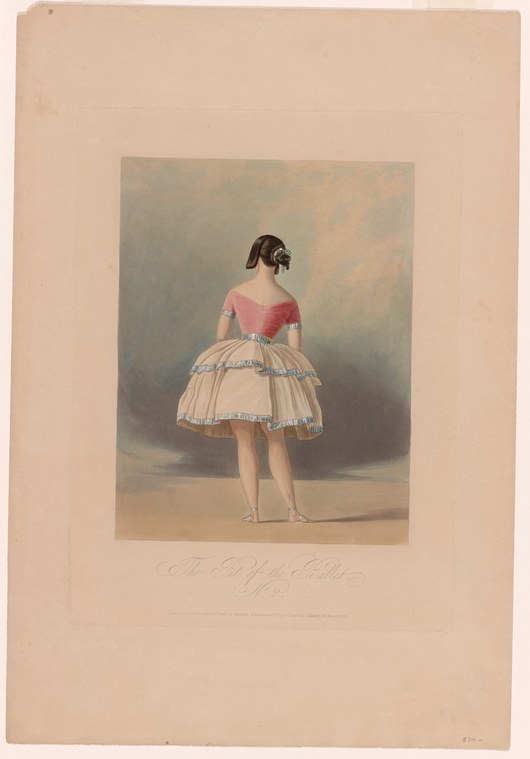
This print is essential evidence of how Romantic ballet was physically realized and consumed: it shows the actual costume construction, the theatrical conventions of female beauty and dress, and the machinery of celebrity that developed around dancers in this period. For anyone studying 19th-century ballet, costume history, or the commercialization of dance, this image is primary source material—it records not a performance captured in motion but the commodified image of the dancer as sold to the public.
What you are looking at
A young female dancer is shown standing in a shallow stage space, viewed from behind and slightly to the side. She wears a striking costume of the mid-19th century: a fitted bodice in deep rose or crimson silk, cut off the shoulders, and an extraordinarily full skirt of white tulle or gauze that extends to just below the knee, supported by multiple layers of horsehair crinoline or stiffened petticoats. The skirt is gathered and structured to create a dramatically bell-shaped silhouette. She stands on what appears to be a wooden stage floor, with a neutral backdrop of pale grey-green, the lighting cool and even. Her dark hair is pulled up in the style of the period, adorned simply. The composition is formal and staged—she is presented as a specimen or portrait, frozen in a pose of quiet attentiveness, one leg slightly advanced. The print quality and hand-coloring suggest this is a commercial theatrical portrait, likely a lithograph produced for sale to the public.
The dancing
The dancer stands in a relaxed upright posture, not in an active leap or turn but in a poised, presentational stance. Her weight appears to rest primarily on her back leg, with her front leg slightly extended forward, a position suggestive of readiness rather than active motion. Her arms hang naturally at her sides. The pose is frontal and open, making her costume—particularly the celebrated tulle skirt—the primary focus of the composition. This is not a moment of dynamic dancing but a formal presentation of the figure and dress.
The dance depicted
The work depicts a Romantic-era ballet dancer, almost certainly from the 1840s–1850s based on the costume and printing style. The enormous tulle skirt with its defined structural support (visible crinoline or horsehair framework) is the hallmark of the Romantic ballet period, when such skirts became iconic. The rose-colored bodice with off-shoulder neckline and the simple hairstyle are consistent with costume conventions of ballets such as *La Sylphide* or *Giselle*. This is not a documentation of a specific choreographic moment but rather a portrait of the dancer as theatrical commodity—the kind of souvenir print sold in theaters to admirers. The title "The pet of the ballet" suggests this was either a famous dancer of the period or a stock character type, though without attribution the specific identity cannot be established.
How it was made
This is a hand-colored lithograph, a reproductive print technique that allowed theatrical images to be produced and sold in quantity. The pale, translucent quality of the background and the subtle tonal gradations suggest skilled lithographic work; the hand-coloring (particularly visible in the rose bodice and flesh tones) was applied after printing, likely by a workshop of colorists. Lithography was the dominant method for producing theatrical portraits and souvenirs in this era, offering an accessible middle ground between expensive oil paintings and cheaper woodcuts. The survival of such prints in institutional collections like the NYPL reflects their role as ephemeral but valued cultural objects—affordable luxuries for theater-goers who wanted to own a memento of a performer or role.
About this work
This is a Romantic-era ballet portrait, a commercial lithographic print from the mid-19th century showing a dancer in the costume conventions of the period: off-shoulder bodice and voluminous tulle skirt. The work belongs to the vast tradition of theatrical portraiture—souvenir images sold or distributed to audiences—and offers a direct record of how ballet dancers were dressed, presented, and marketed in the 1840s–1850s. The formal, nearly static pose prioritizes the costume over the dance itself, treating the tulle skirt as a marvel of craft and fashion as much as a tool of movement. It is a document of Romantic ballet aesthetics, theatrical commerce, and the emerging mass production of celebrity imagery.
How to look at it
Attend to the construction of the skirt—the way the tulle holds its shape, the careful rendering of the folds and the density of the material. The artist has chosen a pose of stillness and presentation rather than a moment of active dancing, which tells us this is a portrait of the dancer as an object of visual desire rather than a record of choreography. Notice the balance of the composition: the costume occupies far more visual weight than the figure itself. The cool background and even lighting create a gallery-like effect, presenting the dancer as a specimen to be admired. The hand-coloring adds an intimate, precious quality to what is fundamentally a mass-produced object.
The period
This work dates to the era of Romantic ballet, roughly 1830–1860, when ballet underwent a decisive shift in subject matter, costume, and marketing. The Romantic ballet elevated the female dancer to unprecedented prominence: dancers like Marie Taglioni became international celebrities, and their images were reproduced and sold widely. The tulle skirt—used to suggest weightlessness, otherworldliness, and ethereal beauty—became the iconic silhouette of the era. Theatres produced and sold portraits of celebrated dancers as part of the theatrical economy; a "pet of the ballet" might be the lead dancer or the most popular performer of a given season. Lithography made such images affordable and widely distributed, contributing to the development of modern celebrity culture. The off-shoulder neckline and the formal portrait pose reflect mid-19th-century conventions of presenting the female form as an object of aesthetic contemplation.
Where it lives
The work is held in the collection of the New York Public Library, which assembled extensive holdings of theatrical prints and ephemera. Such items entered institutional collections as donations or as part of larger archives, reflecting both antiquarian interest in theatrical history and the recognition that these commercial prints document the visual culture of their era.
Dance in this work
Questions about this work
Is this a specific dancer or a generic type?
The title 'The pet of the ballet' suggests it may represent a famous dancer or celebrated performer of its era, but without attribution or additional documentation, the specific identity cannot be confirmed. The print may also depict a stock character type—a role or role-type that was popular in Romantic ballet.
Why is the dancer shown from behind?
The rear view emphasizes the costume, especially the spectacular tulle skirt, which was the visual marvel of Romantic ballet. It also creates an effect of intimate observation—we see the dancer as if we were privileged viewers backstage or at a private moment. The pose of readiness (one leg advanced) suggests she is about to enter the stage.
What is holding up that enormous skirt?
The skirt is constructed over a framework of crinoline (horsehair fabric) or layers of stiffened petticoats. This structural undergarment allows the tulle to spread into the iconic bell shape without the weight of the fabric itself collapsing. Such engineering was central to Romantic ballet costume design.
How was this print made and sold?
This is a hand-colored lithograph, a technique that allowed images to be printed in quantity and then colored by hand in a workshop. Such prints were sold at theaters, distributed to admirers, and collected as souvenirs. They were affordable luxuries—cheap enough for ordinary theater-goers but valued as mementos of favorite performers.
More Ballet artwork