35 works in this view — arrow keys or swipe to move between them.
Dance in Art
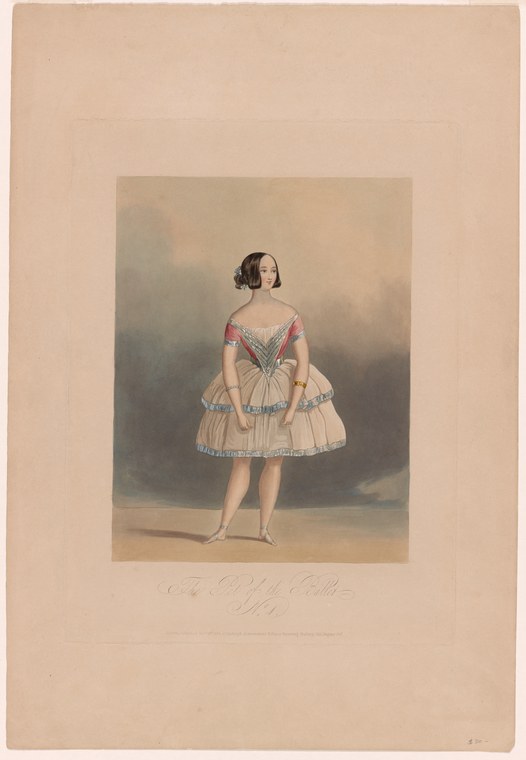
The Pet of the Ballet
Unknown artist
- Medium:
- Dance:
- Ballet
- Source:
- New York Public Library
- Rights:
- Public domain — free to use, share and adapt.
- Recorded as:
- public_domain
This print documents the emergence of the individual female dancer as a marketable celebrity in 19th-century ballet culture. It is visual evidence of how Romantic ballet was circulated, consumed, and remembered—not as choreography or technique, but as images of beautiful, costumed women. The work also illustrates the conventions of theatrical portraiture and the hand-colored print industry that served as the primary visual record of ballet performance before photography became standard.
What you are looking at
A young woman in performance costume stands in a three-quarter pose against a soft, atmospheric backdrop that suggests theatrical lighting. She wears a pale pink or cream-colored ballet dress with a fitted bodice trimmed in red or coral silk ribbon that forms a deep V-neckline, and a voluminous skirt constructed in layers of tulle or similar diaphanous material, gathered horizontally with decorative trim at the hem. Her dark hair is parted in the center and styled close to the head in the fashion of the 1840s–50s. She stands with her weight slightly favored on one leg, her posture elegant and composed, with one arm hanging naturally at her side and the other bent slightly outward. The figure is positioned centrally on the page and framed by a substantial margin of cream or beige paper, suggesting this is a theatrical print or lithograph meant for display or collection. The soft modeling of light and shadow, particularly the darker tones at the back of the figure, creates depth and emphasizes her as the focal point.
The dancing
A single female dancer is shown in a standing pose rather than mid-movement. Her weight is balanced with a slight sway, the torso upright and shoulders level, the arms relaxed and held away from the body in a position of repose or curtsy preparation. The legs appear straight and the stance is formal rather than dynamic—this is a presentation pose, a moment of stillness rather than an action. The costume and the controlled, frontal presentation suggest this is a portrait of a specific dancer or a type—a posed image meant to display the performer and her costume to the viewer rather than capture her in the act of dancing.
The dance depicted
This is a Romantic-era ballet print, most likely from the 1840s based on the dress style and the conventions of theatrical portraiture of that period. The full, layered tulle skirt, the fitted bodice with decorative ribbon, and the pose are consistent with the principal female roles of Romantic ballet—the sylphs, sprites, and ethereal characters that dominated European ballet stages in this decade. The image represents the dancer as a theatrical commodity: a beauty framed and circulated as a collectible print. The print likely depicts or was inspired by an actual performer known as 'the Pet of the Ballet,' a nickname that suggests she was a favorite with audiences and impresarios. The pose is formal and composed, emphasizing costume and silhouette over dynamic movement or character expression.
How it was made
This is a hand-colored lithograph or possibly a hand-colored engraving, executed with careful attention to the modeling of fabrics and skin tone. The base image has been printed and then colored by hand, a technique that was standard for theatrical prints of this era and allowed for wider circulation than a painting while maintaining a degree of finish and detail. The soft, diffused background and the careful rendering of highlights on the tulle skirt suggest a skilled practitioner. The large margins and the formal framing are typical of 19th-century theatrical portrait prints meant for theater-goers to purchase, collect, and frame—a precursor to the photograph but with the aesthetic control and glamour that hand-coloring allowed. This object is a print culture artifact: a mass-produced yet individually finished commodity.
About this work
This is a portrait print of a Romantic-era ballet dancer, most likely from the 1840s, circulated as a collectible theatrical image. The work represents both the aesthetic of Romantic ballet—the ethereal, costumed female form—and the culture of theatrical celebrity that surrounded it. The dancer is presented not in action but in display, her beauty and costume the subject of the print. The image belongs in a gallery of dance in art because it documents how ballet was consumed and remembered by audiences: not through documentation of choreography or technique, but through the circulation of idealized images of individual stars. The print is a historical record of what ballet meant to its public—fantasy, beauty, and the celebrity of the female form.
More broadly, this image reveals the gap between dance as practice and dance as representation. The pose tells us nothing about how the dancer moved, but it tells us everything about how she was marketed and what audiences wanted to see.
How to look at it
Notice how the artist has chosen a moment of absolute stillness: this is not a leap, turn, or développé, but a composed frontal pose. The emphasis falls entirely on the costume and the face—the tulle skirt is rendered with careful attention to its construction and volume, and the ribbon trim is depicted with precision. The backdrop is deliberately abstract and atmospheric, with no scenery or narrative detail; the focus is on the dancer as an object of display rather than as a character or a performer in action. The print is meant to be read as a glamorous commodity: the dancer as beautiful, available to the gaze, and worthy of collection.
The period
This print dates to the heyday of Romantic ballet in Europe, roughly the 1840s–50s. This was the era of *La Sylphide* (1832), *Giselle* (1841), and *La Jolie Fille de Gand* (1846)—ballets centered on ethereal, supernatural female characters. The aesthetic of the Romantic ballet—the pale tulle skirt, the emphasis on the female form, the otherworldly subject matter—was reflected in the vast amount of theatrical merchandise produced for enthusiastic audiences. Lithography and hand-colored engraving were the dominant technologies for circulating images of performers; photographs of dancers in costume would not become common until the 1860s and later. The print industry around ballet was enormous: dancers' portraits were sold at the theater, in shops, and through subscription, making them among the first mass-market celebrity images in the modern sense.
Where it lives
This work is held in the New York Public Library collections. It is catalogued as a print, likely a lithograph or hand-colored engraving, part of the vast archives of 19th-century theatrical portraiture that document the star system and celebrity culture of Romantic ballet.
Dance in this work
Questions about this work
Who was 'the Pet of the Ballet'?
The catalogue record does not identify the specific dancer depicted. The title suggests this was a well-known performer, likely a principal dancer in a major European ballet company during the 1840s–50s. The nickname 'Pet' indicates she was a favorite with audiences and possibly with the theater management. Without further documentation or inscription on the print, her identity cannot be established from the image alone.
Why is the dancer standing still instead of dancing?
This is a portrait print, not a documentation of performance. The pose is formal and composed—a presentation of the dancer as a commodity and a beauty, much like a fashion plate or a society portrait. The stillness allows the viewer to appreciate the costume in detail and the dancer's face and figure without distraction. In Romantic-era theatrical culture, these kinds of portrait prints were the primary way audiences encountered their favorite dancers between performances.
What is the dress made of?
The skirt is made of multiple layers of tulle or similar lightweight, translucent material, gathered horizontally and trimmed at the hem with ribbon or decorative braid. This construction is typical of Romantic ballet costumes of the 1840s and creates the characteristic voluminous, layered silhouette. The bodice appears to be silk, fitted closely to the torso and trimmed with a contrasting silk ribbon.
How was this print made?
This appears to be a lithograph or hand-colored engraving, printed from a stone or metal plate and then colored by hand. The soft modeling of light and shadow, especially in the background, and the careful rendering of fabrics suggest a skilled practitioner. This technique allowed for relatively wide circulation while maintaining the finish and aesthetic control that hand-coloring provided. Mass-produced yet individually finished, these prints were sold at theaters and through shops, making them among the first mass-market celebrity images.
More Ballet artwork