42 works in this view — arrow keys or swipe to move between them.
Dance in Art
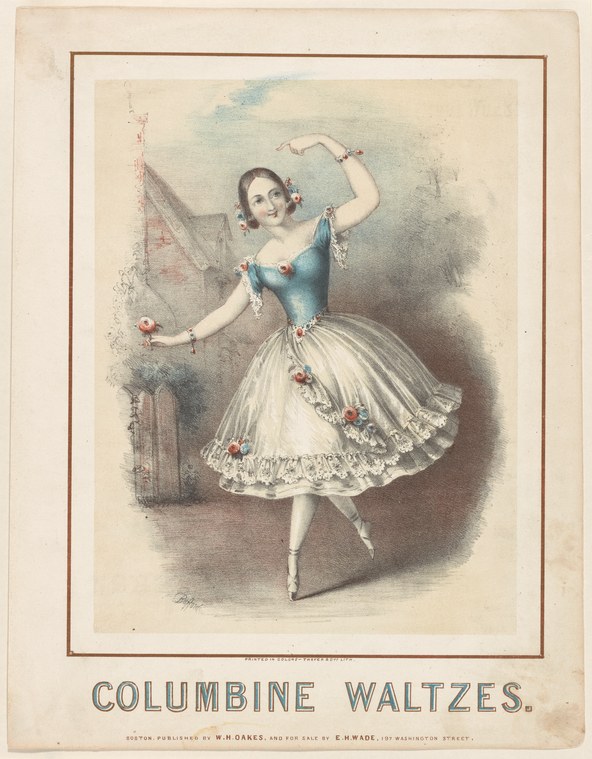
Columbine waltzes
Unknown artist
- Medium:
- Lithograph
- Dance:
- Waltz
- Era:
- Early 1800s (Waltz Revolution)
- Source:
- New York Public Library
- Rights:
- Public domain — free to use, share and adapt.
- Recorded as:
- public_domain
This is a primary document of how early American audiences encountered and understood Romantic ballet—not through live performance attendance alone, but through these widely circulated colored prints that made elite theater legible and aspirational to the broader public. The Columbine character connects commedia dell'arte tradition to 19th-century ballet innovation, showing how historical theatrical forms were constantly adapted and renewed.
What you are looking at
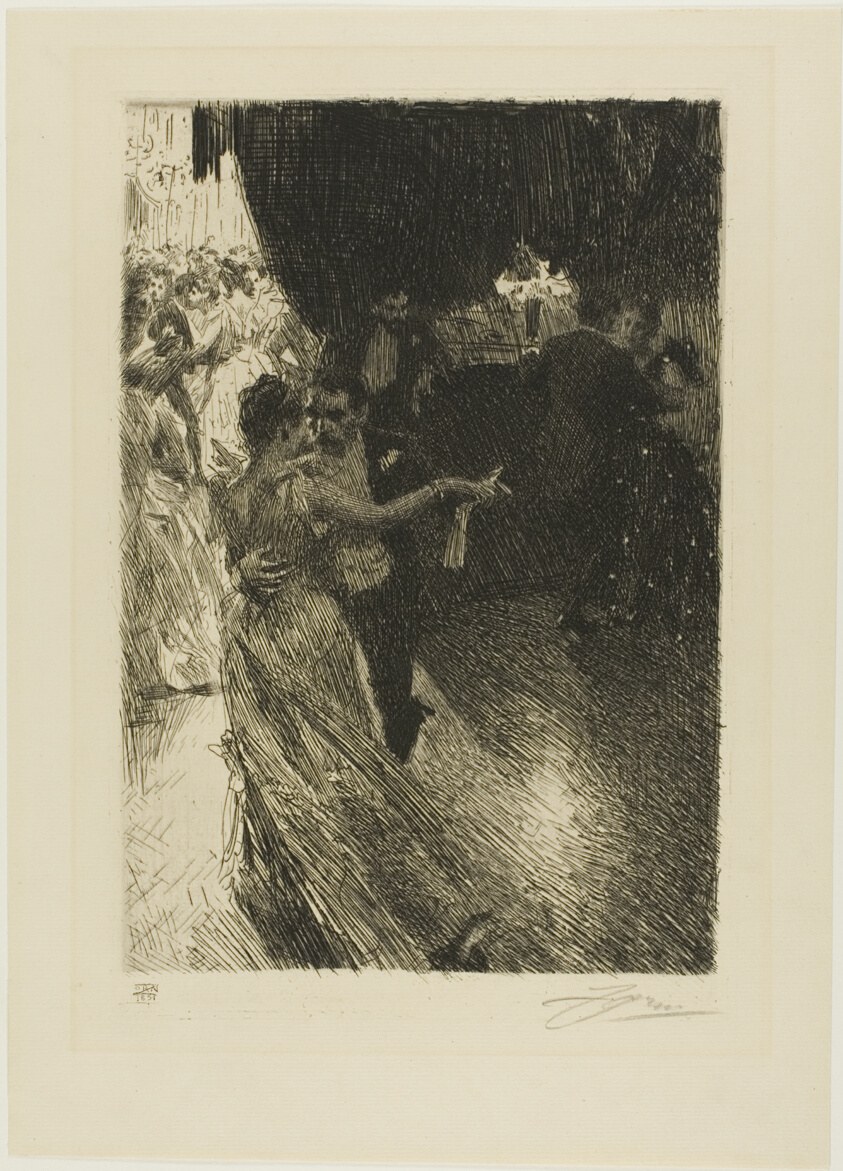
A young female dancer in Romantic-era theatrical costume stands alone against a dark architectural backdrop, caught mid-performance. She wears a fitted teal or blue-green corset-bodice trimmed with red rosettes, paired with a white tulle skirt of substantial volume that falls below the knee, its hem and lower panels decorated with red flowers. The skirt appears to be caught in motion, with its gauzy layers billowing outward. She balances en pointe or demi-pointe on her right leg while her left leg extends behind or to the side; her right arm reaches gracefully upward and outward, holding what appears to be a delicate handkerchief or scarf, while her left arm extends across her body. Her dark hair is styled with flowers. The setting suggests a stage interior, with architectural framing on the left and atmospheric shading that creates depth and focus on the figure. The pose conveys lightness and ethereal grace characteristic of Romantic ballet spectacle.
The dancing
The dancer stands alone in a poised, elongated line typical of early-to-mid 19th-century ballet technique. Her weight appears concentrated on one leg while the other extends into space, creating the illusion of weightlessness. The upper body holds an open, expressive frame with arms curved and lifted away from the torso—not held close or in a closed ballroom position. The extended arm and the delicate prop suggest a narrative or character moment rather than a purely abstract pose. The overall carriage—the lifted ribcage, the upward reach, the supported extension—indicates ballet training and aesthetic.
The dance depicted
This is Romantic-era theatrical ballet, almost certainly from the 1830s–1850s when such virtuosic female dancers performed as principal characters in works like La Sylphide, Giselle, and La Péri. The title references Columbine, a character from the commedia dell'arte tradition who was frequently adapted into the nascent ballet repertoire of this period. The costume—bodice, pointe work, tulle skirt, flowers—is signature Romantic ballet dress. The pose captures the ethereal, otherworldly quality that the period prized, emphasizing the dancer's apparent weightlessness and the narrative grace of character dancing rather than pure technique.
How it was made
This is a hand-colored lithograph, a reproductive medium well suited to theatrical promotion and popular distribution in the early 19th century. Lithography allowed artists to combine drawn line with tonal wash and selective hand-coloring, making these prints affordable enough for playbills, broadsheets, and souvenirs while maintaining fine detail. The attribution line at the base indicates this was a commercial publication, likely issued by the printer W. N. Oakes in Boston (as stated in the catalogue record source). The technique allowed theaters and dancers to circulate images of their stars to the public, making this both a document and a marketing object.
About this work
This is a hand-colored lithograph of a Romantic-era ballet dancer in character as Columbine, most likely from the 1830s–1850s when such roles were central to the growing popularity of ballet in America. The print captures the aesthetic and technical hallmarks of the period: the ethereal quality prized by audiences, the pointe work and tulle costuming that defined Romantic ballet, and the narrative grace of character dancing. The work sits at the intersection of theatrical practice and popular visual culture, representing both the artistry of the period's elite performers and the commercial machinery that brought theater to a wider public through affordable, widely distributed prints.
How to look at it
Notice the moment the artist chose: the dancer caught mid-motion, one leg supporting, one extended, arms reaching outward in an open frame that conveys both control and apparent effortlessness. The composition isolates her against atmospheric shadow, emphasizing verticality and the lift of the body. The tulle skirt is rendered with particular care—its volume and the decorative flowers speak to the period's obsession with the ethereal and the ornamental. The delicate handkerchief or scrap of fabric she holds is a narrative prop, suggesting character and story rather than pure technique. This is a moment of lyrical climax, not of spectacle or speed.
The artist
The artist is not recorded in the catalogue. The print was published by W. N. Oakes in Boston and printed for sale by E. W. Wade at the address given. This was a commercial theatrical publishing operation serving the American market during the height of Romantic ballet's popularity in the United States. Such prints were typically based on sketches made at or after performances, often working from the dancer's pose and costume rather than from sustained study.
The period
The 1830s–1850s were the peak of Romantic ballet in Europe and America. The period saw the rise of the ballerina as the central figure in ballet spectacle, with male dancers increasingly marginalized. Ethereal, otherworldly roles—sylphs, spirits, odalisques—dominated the repertoire. Simultaneously, lithography was transforming how theatrical culture circulated: printed images of famous dancers became collectible, affordable objects that extended the reach of theater beyond the playhouse. American theaters imported European ballets and dancers, and these prints were key to building an audience.
Where it lives
The work is held in the New York Public Library collection, a major repository of theatrical prints and playbill materials. The publication line identifies it as Boston-published, indicating American theatrical distribution rather than European origin.
Dance in this work
Questions about this work
Is this the actual dancer or an idealized image?
Almost certainly idealized, though based on a real performer and costume. Theatrical lithographs of this era were promotional objects designed to flatter and immortalize famous dancers. The artist may have worked from a sketch made at a performance, but the print itself is a composed, polished image meant for sale to the public, not a documentary record.
Who was Columbine in 19th-century ballet?
Columbine is a character inherited from commedia dell'arte—a clever, flirtatious female servant or lover. In Romantic-era ballet, she appeared in ballets that blended narrative and spectacle, often paired with male characters like Harlequin. By the 1830s–1850s, she was a secondary but vivid character role, allowing for character-specific costuming (the flowers, the props) and a different quality of movement than the abstract ethereal roles.
What does the title 'Columbine Waltzes' mean?
This likely refers to a specific theatrical work—a ballet or pantomime-ballet that combined Columbine as a character with waltz music and structure. Waltzes were extremely popular in 19th-century theater and were used both as pure dance spectacle and as narrative vehicle. The work itself may not survive in records; this print may be one of the few documents of its existence.
Why are theatrical lithographs important for dance history?
Because most 19th-century dance left no record except these prints and written reviews. We have almost no video or notation of how Romantic ballets actually looked. These prints preserve costume, pose, setting, and the visual culture of dance—they show us what audiences saw and what performers wanted to be remembered as.
More Waltz artwork