49 works in this view — arrow keys or swipe to move between them.
Dance in Art
Ancient dancing
Unknown artist
- Medium:
- Source:
- New York Public Library
- Rights:
- Public domain — free to use, share and adapt.
- Recorded as:
- public_domain
This print documents the moment when ballet transitioned from pure ornament to a vehicle for narrative and allegory, using the expressive body as a form of visual rhetoric. For a dancer or choreographer, it reveals what the trained body was expected to look like and do in the late 18th century—the posture, the frame, the relationship of the arms to the torso. For a historian, it is evidence of how dance was circulated and understood: as a printed image, standardized, repeatable, and laden with meaning beyond mere movement.
What you are looking at
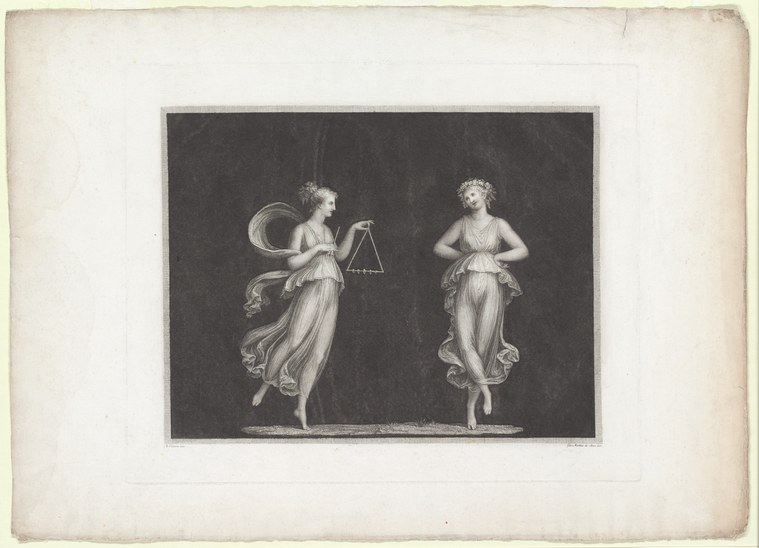
Two female figures in flowing neoclassical drapery stand on a shallow stage against a dark background, arranged symmetrically as if for comparison or allegory. The figure on the left holds a balance scale, an attribute of justice or equity, while the figure on the right stands with hands folded, in a pose of receiving or acceptance. Both wear the high-waisted, columnar gowns typical of late 18th-century neoclassical fashion, with their hair arranged in classical style. The drapery falls in soft folds that suggest movement even in stillness, and their feet are delicately pointed. The composition is spare and formal, emphasizing the bodies and their gestures rather than setting or narrative action. The print technique—likely an engraving—creates fine hatching across the dark ground, throwing the pale figures into sharp relief.
The dancing
Both dancers stand in turned-out positions with legs extended and feet pointed, a convention of theatrical dance in this period. The figure on the left shifts her weight slightly, creating an S-curve in the torso that lifts through the ribs and shoulders—a posture characteristic of the early balletic technique. The raised arm holding the scale and the counterbalancing extension of the other arm demonstrate an understanding of how the upper body adjusts for balance and line. The figure on the right maintains a more upright, frontal stance, her hands held at waist level in a composed position. Both bodies display the elongation and verticality expected of trained dancers; there is no weight dropped into the hips or knees.
The dance depicted
The image does not depict a specific named dance but rather presents two allegorical or emblematic female figures using the vocabulary of late 18th-century theatrical dance—likely the neoclassical ballet or pantomime idiom that dominated European stages after 1760. The attributes (balance, reception) and the mirror-image composition suggest these are personifications—perhaps Justice and Mercy, or comparable abstractions—rendered in the language of dance as a form of silent moral communication. The technique on view—turned-out positions, pointed feet, elongated frame, controlled arm placement—is consistent with the Noverre reforms and the development of ballet d'action, where expressive gesture replaced pure ornamentation.
How it was made
This is a black-and-white engraving or stipple engraving, a printmaking technique well suited to the delicate rendering of neoclassical drapery and the subtle modeling of the human form. The fine hatching on the dark ground and the precision of the line suggest professional execution, likely from a print shop serving an educated audience. The technique allowed for wide distribution of the design, making this the kind of image that would circulate in art books, dance treatises, or albums of theatrical representations. Engravings of this type were often used to document or promote new choreographic ideas and to standardize the appearance of dancers and movement conventions across European theaters.
About this work
This is a neoclassical allegory presented in the vocabulary of late 18th-century theatrical dance. Two female figures in high-waisted drapery stand in balletic positions against a dark void, their bodies and gestures designed to convey abstract moral or civic meaning. The work sits at the intersection of two cultural projects: the reform of ballet as an expressive art form (spearheaded by Jean-Georges Noverre and others) and the neoclassical revival in visual art and design. The print documents how dance had become an accepted medium for serious artistic and philosophical communication, not merely entertainment.
The work belongs in a gallery of dance in art as evidence of how the trained body—particularly the female body in theatrical convention—was conscripted into the service of ideas. It shows the dancer not as an individual performer but as a vessel for personification, and it reveals the physical vocabulary (turn-out, line, pointed foot, controlled arm) that defined theatrical dance at the moment when ballet was establishing itself as a major art form.
How to look at it
Look first at the posture: both figures stand with turned-out legs and pointed feet, a physical position that was still relatively novel in theatrical dance and that required systematic training to achieve. Notice how the figure on the left uses the entire length of her spine—the S-curve that begins at the tailbone and extends through the crown of the head—to balance the weight-bearing action of the scale. This is not a natural position but a constructed one, and the artist has understood and rendered the mechanics of how the body achieves it. Look also at the darkness of the background: the print isolates the figure against void, emphasizing pure line and silhouette. This compositional choice—borrowed from allegorical painting—tells us that we are meant to read these bodies as forms carrying meaning, not as people in a place. The symmetry of the composition reinforces this: these are not two dancers performing together but two ideas presented side by side for comparison.
The period
This work dates to the late 18th century, a period of profound reform in theatrical dance. Jean-Georges Noverre's *Lettres sur la danse* (1760) had established the ideal of ballet d'action—narrative ballet in which gesture and movement conveyed dramatic meaning—and this philosophy spread rapidly across Europe. At the same time, neoclassicism dominated the visual arts and design, with artists and patrons looking to ancient Greece and Rome for models of ideal form and comportment. The combination of these two currents produced a new image of the dancer: elongated, turned-out, draped in high-waisted gowns modeled on ancient dress, and engaged in expressing emotion and ideas rather than merely displaying technical skill.
Prints like this one were instruments of this reform, used to teach dancers and audiences what the new ballet looked like. They circulated in theaters, academies, and among collectors of art and dance literature, helping to standardize technique and aesthetic across national boundaries. The engraved image of the dancer became a kind of textbook page, a model to imitate.
Where it lives
This print comes from the New York Public Library collection. It is catalogued as 'Ancient dancing,' suggesting it may have been understood in its own time or by later collectors as depicting or evoking dances of classical antiquity, though the actual dress and technique are late 18th-century neoclassical theatrical idiom, not historical reconstruction.
Dance in this work
Questions about this work
Why do both dancers have such turned-out positions?
Turn-out—rotating the legs outward from the hips—became a fundamental requirement of theatrical ballet training in the 18th century. It was believed to create a more elegant line, to allow for greater freedom of movement in multiple directions, and to convey nobility and control. By the time this print was made, a dancer without substantial turn-out would have been considered untrained or deficient.
What are these figures supposed to represent?
The left figure's balance scale suggests Justice or a related civic virtue; the right figure's receptive pose suggests a complementary quality such as Mercy, Bounty, or Peace. The pairing and symmetry indicate these are allegorical personifications—abstractions rendered as female figures—rather than characters in a narrative.
Is this a record of an actual dance that was performed?
Probably not as a literal record. Instead, this is a dance-based design for expressing ideas visually. It uses the language of theatrical ballet—the trained body, the classical drapery, the refined gestures—to give physical form to abstract concepts, in the manner of the ballet d'action movement of the late 18th century.
How do we know this is from the late 18th century and not actually ancient?
The fashion is the giveaway: the high-waisted neoclassical gown, the hairstyle, and the printing technique are all consistent with the 1770s–1790s. The technique of the dancers—the turned-out positions and the frame—also reflects late 18th-century theatrical conventions, not ancient practice.
More dance artwork