49 works in this view — arrow keys or swipe to move between them.
Dance in Art · 2021
The lure of the dance
Unknown artist
- Medium:
- Source:
- New York Public Library
- Rights:
- Public domain — free to use, share and adapt.
- Recorded as:
- public_domain
For historians of social dance, this is evidence of how ragtime, jazz dancing, and one-step culture were experienced as transgressive, liberating, and modern. For art historians, it demonstrates how modernist printmaking techniques were deployed to capture the visual energy and social promise of dance culture. The work shows that by the 1910s, dance had become inseparable from modernity itself—a symbol of social change captured by serious artists.
What you are looking at
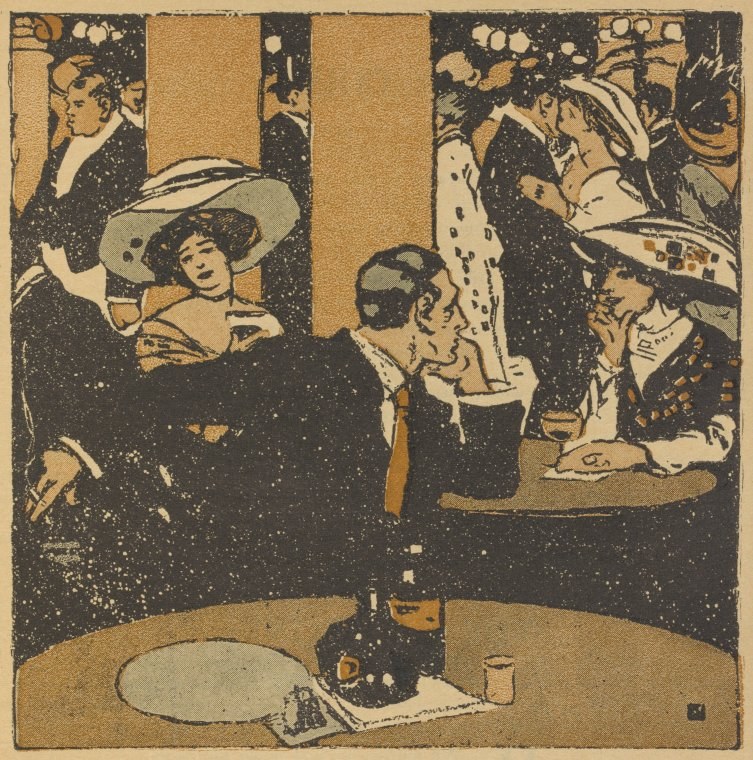
A crowded indoor social gathering, rendered in bold black lines and warm ochre tones characteristic of early modernist printmaking. The composition is divided by tall vertical panels—likely mirrors or architectural features—that create a rhythmic spatial structure. In the foreground, a table with a plate and glass sits empty, anchoring the viewer's perspective. Behind it, a dense crowd of fashionably dressed figures mills about: women in large feathered hats typical of the 1910s, men in dark suits and bowler hats. The figures overlap and interlock in a composition that emphasizes crowding and social density rather than clear sightlines. Some figures appear animated—a woman on the left gestures expansively, her extended arm creating a diagonal line of energy across the composition. The lighting is even and somewhat flattened, characteristic of the print medium, with minimal shadow work; the contrast between black lines and reserved paper creates the illusion of movement and excitement.
The dancing
The bodies are rendered with expressive distortion rather than anatomical precision; limbs elongate and curve to express animation and social momentum. A woman in the left foreground leans back with an outstretched arm, her posture suggesting exuberance or abandon. Several figures are shown in loose, ungoverned poses—not in fixed holds or frames but in the casual proximity of a crowded venue. The artist captures the informal, autonomous movement of nightclub or dance hall socializing rather than partnered ballroom technique. Weight appears distributed through the hips and torso rather than held in a lifted frame.
The dance depicted
This appears to document the social dance cultures of the early 20th-century urban dance hall or cabaret—the spaces where modern social dances like ragtime, fox-trot, and one-step were practiced by working and middle-class dancers. The title 'The Lure of the Dance' and the setting suggest syncopated, non-classical dance in a commercial venue. The lack of visible strict partnering and the emphasis on individual expressiveness and crowded informality points toward vernacular jazz-age social dancing rather than ballroom technique, though the dress and setting (not outdoor folk or ritual contexts) indicate theatrical-commercial fusion dancing. The work documents the accessibility and allure of modern commercial dance culture rather than its technical execution.
How it was made
This is a relief print or woodcut, identifiable by the bold linear work, the stark contrast between inked and reserved areas, and the characteristic flattening of form. The artist has used line expressively to suggest motion and crowd dynamics—parallel hatching and flowing curves convey movement, while the crisp black contours create visual energy without dimensional modeling. The technique's economy of means (no subtle gradation possible) forced the artist to prioritize composition, silhouette, and expressive gesture, making it ideal for documenting the visual spectacle of modern dance culture. The bold, simplified forms also suggest this was produced for wide circulation and reproduction, serving as cultural commentary accessible to a broad public.
About this work
This early modernist print documents the social spectacle and allure of modern urban dance culture in the Jazz Age. Rather than depicting any single recognizable dance, it captures the atmosphere of commercial dance halls and cabarets where new syncopated forms displaced Victorian propriety. The work sits at the intersection of documentary social art and modernist formalism—the expressionist distortions and compositional energy convey the artist's engagement with the subject's modernity and cultural significance, not detached observation.
The image belongs in a dance collection as evidence of how dance functioned in early 20th-century urban culture: not as a theatrical spectacle controlled by institutions, but as a social practice that promised liberation, pleasure, and modern identity. The crowd of bodies, the abandoned gestures, and the deliberate emphasis on social mixing and excitement make this a primary source for understanding how dancing was experienced and marketed to urban populations.
How to look at it
Attend to the artist's choice to flatten and densify the crowd rather than isolate individual dancers or couples. The vertical panels and overlapping figures create a compressed, almost claustrophobic energy that conveys the social density and excitement of the venue. Notice how the expressive distortions of the bodies—the extended arm, the tilted heads, the loose stances—work against any impression of restraint or formality. The empty table and glass in the foreground create a still point from which we view the animated social scene, inviting the viewer to imagine joining the crowd. The title 'The Lure' is key: the artist is representing not the dance itself but the powerful attraction it exerts.
The period
The print dates to the early 20th century, a moment when social dance underwent rapid transformation. The waltz and quadrille of the 19th century gave way to one-step, fox-trot, tango, and ragtime dances, which were faster, less formal, and intimately connected to jazz and African American musical traditions. These dances were controversial: they were performed in commercial venues (dance halls, cabarets, hotels), they permitted closer contact and greater hip movement than Victorian dance allowed, and they were associated with working-class and immigrant populations. Simultaneously, modernist artists (Expressionists, Futurists, and others) were deeply interested in capturing movement, energy, and modern life. This print belongs to that convergence: it treats dance not as an academic subject but as a lived urban phenomenon worth serious formal attention.
Where it lives
The work is held by the New York Public Library, which indicates it is part of a collection of printed ephemera or fine prints documenting early 20th-century urban life. The NYPL's collections emphasize New York culture and history, suggesting this may document New York's dance hall scene specifically.
Dance in this work
Questions about this work
What dance is actually being shown here?
No single specific dance. The work captures the atmosphere of early 20th-century social dance halls where one-step, fox-trot, and ragtime dances were performed. The artist prioritizes the social experience and visual excitement over technical depiction of any particular style.
Why is the crowd packed so tightly?
The density serves both formal and documentary purposes. Formally, it creates compositional energy and visual excitement. Historically, it reflects the reality of commercial dance venues, which were crowded, mixed-gender, and intense spaces. The crowding is part of the 'lure'—the promise of social contact and modern experience.
Is this a realistic representation or stylized?
It is expressionistically stylized. The elongated limbs, distorted proportions, and bold black outlines are modernist formal choices, not accurate anatomical description. However, the dress, setting, and types of gesture are documentary—the artist observed dance hall culture and translated it into modernist visual language.
Why would an artist make a print about dance?
By the 1910s, modern social dance was seen as a significant marker of contemporary life and social change. Serious artists were interested in capturing movement, pleasure, and modernity; dance halls were real sites where these were experienced. The print medium allowed for wide circulation of this commentary on urban culture.
More dance artwork