44 works in this view — arrow keys or swipe to move between them.
Dance in Art · 2019
The night dancers waltzes
Unknown artist
- Medium:
- Lithograph
- Dance:
- Waltz
- Era:
- Early 1800s (Waltz Revolution)
- Source:
- New York Public Library
- Rights:
- Public domain — free to use, share and adapt.
- Recorded as:
- public_domain
This work documents the visual culture of Romantic ballet at the height of its popularity, showing how the supernatural corps de ballet—a revolutionary choreographic and narrative concept—was disseminated and consumed. For dance historians, it reveals the conventions by which Romantic ballet was represented in commercial print: the isolation of the male protagonist, the visual uniformity and ethereality of the female ensemble, and the use of landscape and atmosphere to signal fantasy. The print's survival and circulation through a major research library shows that these images were valued by audiences as portable, ownable records of performances.
What you are looking at
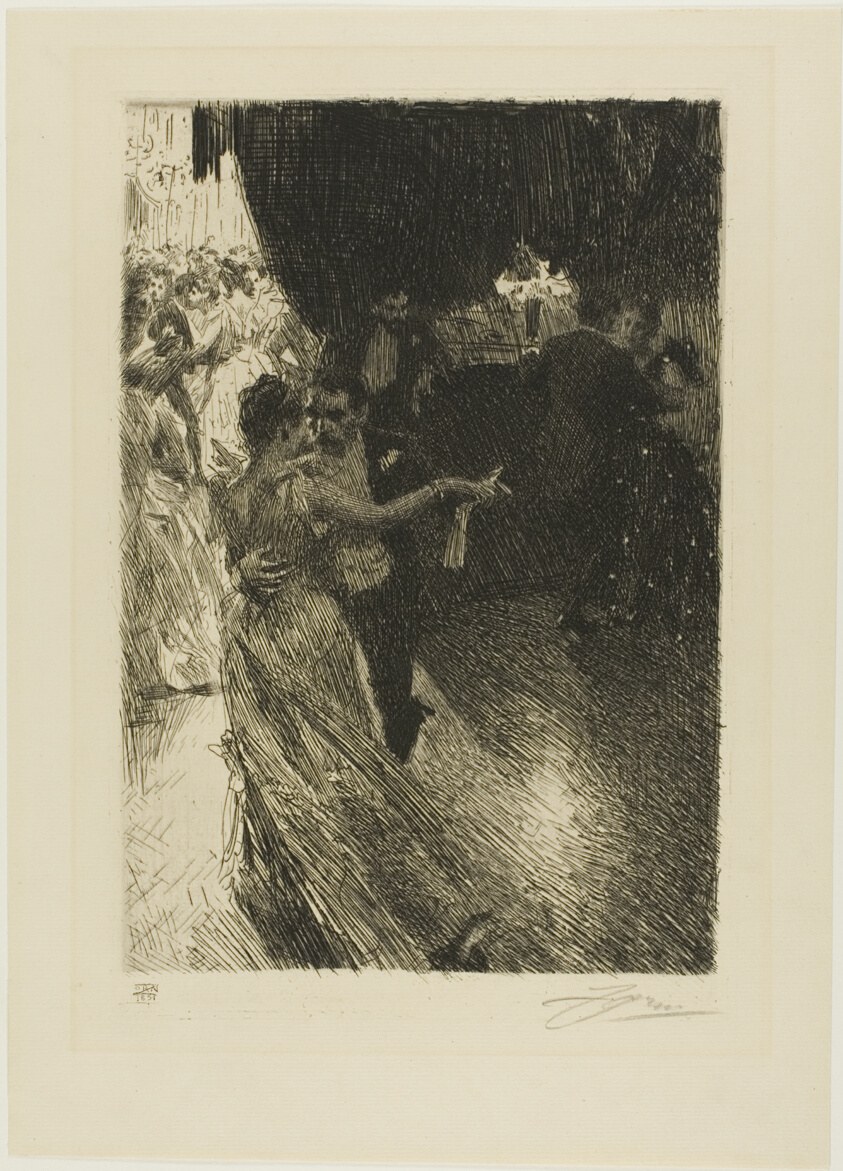
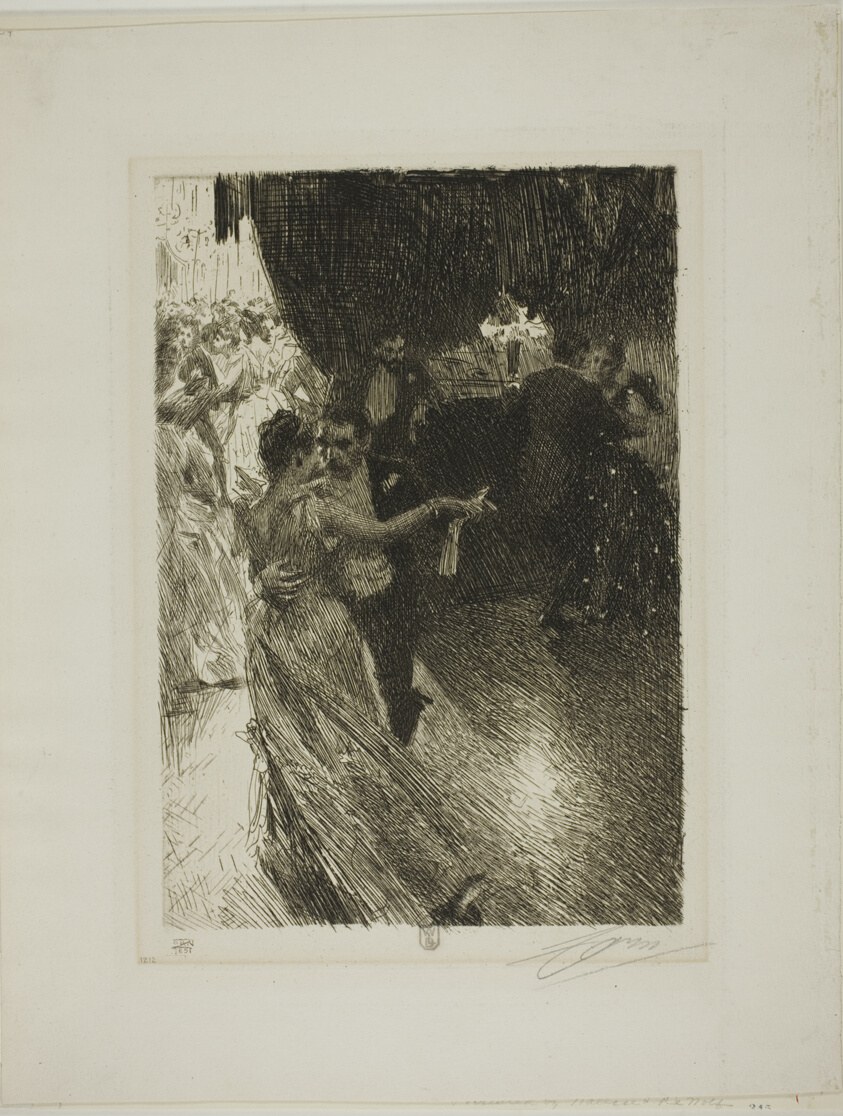
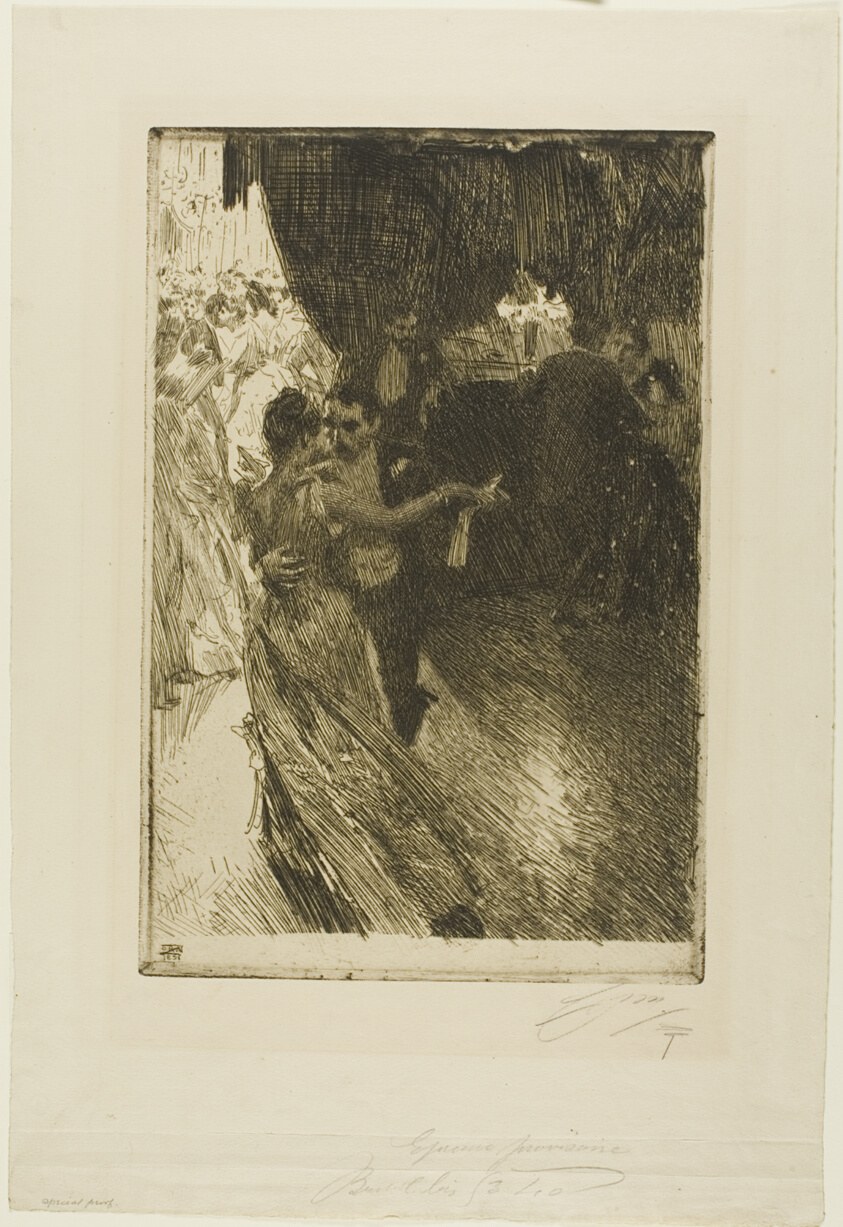
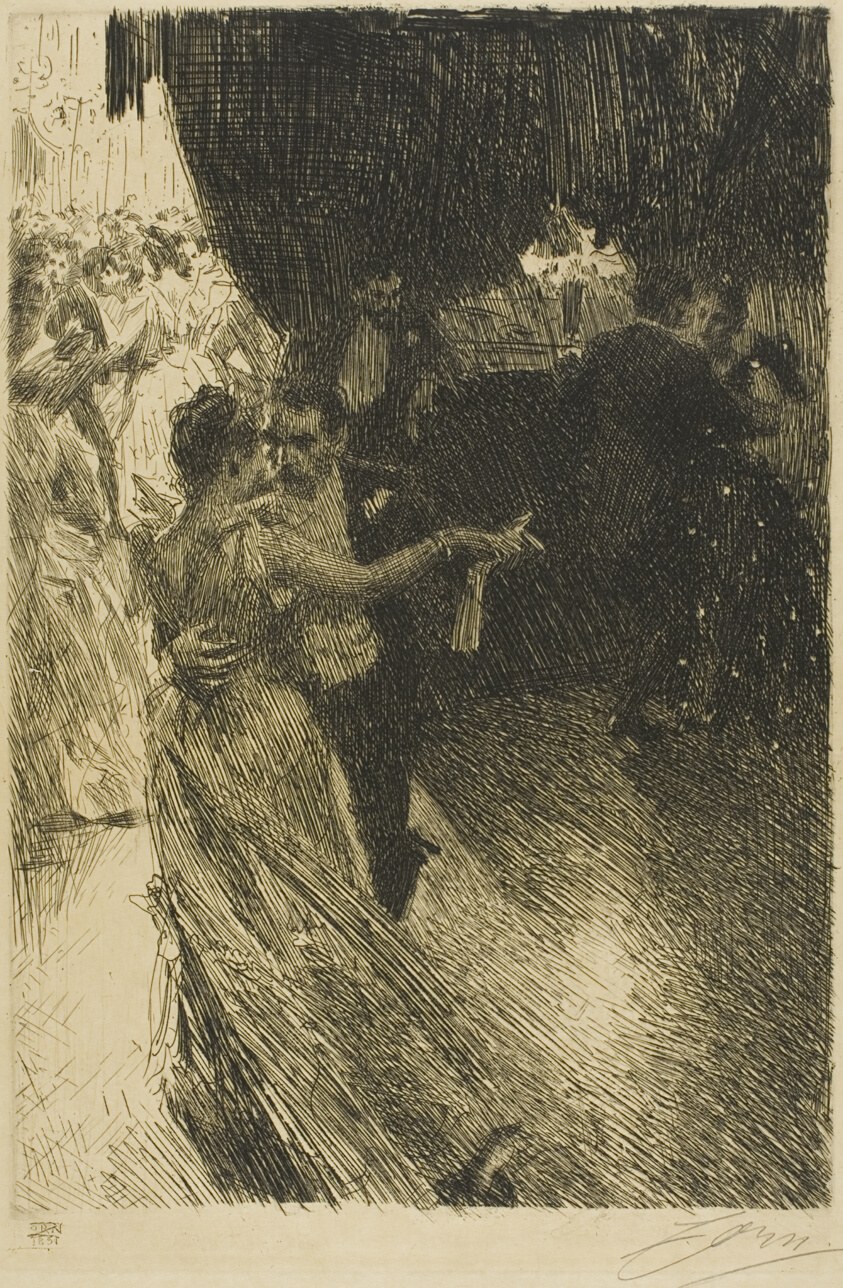
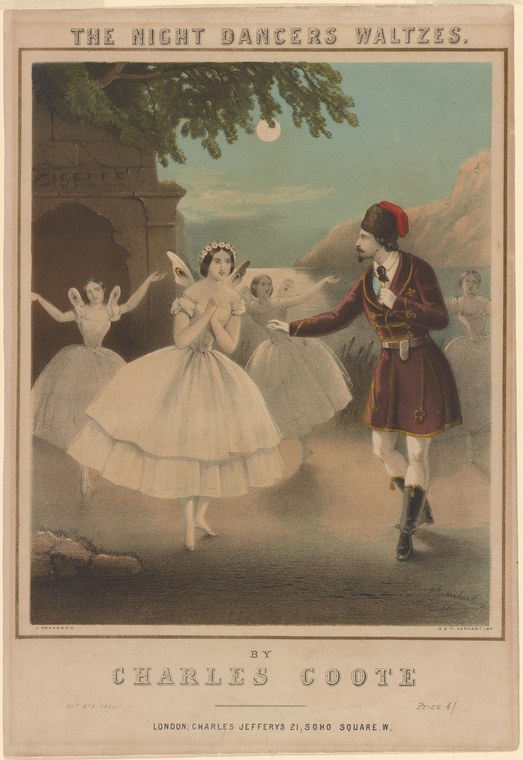
A supernatural nocturnal waltz unfolds in a moonlit landscape. A male dancer in dark Romantic-era dress—velvet jacket with ornate trim, plumed hat, and boots—reaches toward a central female dancer in billowing white tulle who turns with ethereal lightness. She is surrounded by at least three other female figures in identical white gowns, their forms luminous against the shadowed background. A stone archway or ruin frames the left side of the composition; mountains rise in the distance under a crescent moon. The ground is rendered in mist or shadow, suggesting an otherworldly setting. The scene captures the moment of courtship or enchantment—the male figure's gesture is both beckoning and reverential, while the women float rather than step, their bodies weightless and synchronized.
The dancing
The central female dancer is captured mid-turn, her torso upright and arms extended in the open frame characteristic of Romantic-era waltz; her skirt is caught in the centrifugal motion of rotation. The male dancer stands in profile, one arm extended toward her in a gesture of invitation or supplication, his weight shifted in a lunge. The surrounding female figures echo the same arabesque or turning pose, creating a visual chorus. None of the dancers appears to be in closed ballroom hold; instead, the grouping is theatrical and asymmetrical, with the male figure isolated on the right and the women forming a cluster. The postures suggest lightness and verticality rather than the grounded, partnered structure of social waltz.
The dance depicted
This is a Romantic-era ballet scene, most likely depicting the supernatural or dream sequence from a major nineteenth-century work—the composition, costume, and subject matter (the lone male suitor surrounded by ethereal female dancers in identical tutus) are the visual grammar of Romantic ballet, particularly works like *La Sylphide*, *Giselle*, or *Les Sylphides*. The dance depicted is theatrical ballet waltz, not social ballroom waltz. The title *The Night Dancers Waltzes* emphasizes the supernatural or nocturnal setting characteristic of Romantic ballet, and the visual language—the floating quality, the moonlit landscape, the pale tutus—confirms this is a fantasy rather than a representation of actual ballroom practice. The male dancer's solitary pursuit of the corps of identical women reinforces the dreamlike, melancholic tone of Romantic ballet narratives.
How it was made
This is a hand-colored lithograph, a commercial print medium that allowed for mass reproduction and wide distribution to middle-class audiences. The artist has used the lithographic process to capture fine detail in the architectural elements and foliage while relying on hand-coloring to distinguish the luminous tutus from the darker landscape. The soft tonal gradations—particularly the misty ground and the subtle modeling of the female dancers' forms—are characteristic of colored lithography; the medium allowed for both precision in the figures and atmospheric effect in the setting. This technique positioned the work as a souvenir or promotional image for the ballet itself, affordable enough for individual collectors and theaters to purchase.
About this work
This is a commercial lithographic print from the early nineteenth century depicting a scene from Romantic-era ballet. The title credits the composition to Charles Coote, who may have been the publisher or a credited artist associated with the print. The work captures the visual fantasy of Romantic ballet—the supernatural encounter, the ethereal female corps, the moonlit landscape—in the form most accessible to the urban middle class: the hand-colored theatrical print. Such images circulated as mementos of performances, publicity for new works, and expressions of the era's fascination with the otherworldly and the feminine ideal in dance. The composition draws on the iconography of published Romantic ballet scenes, translating the three-dimensional spectacle of the stage into a flat but richly detailed image.
How to look at it
Attend to the asymmetrical composition: the male dancer is confined to the right margin, reaching toward a female figure who occupies the center and is echoed by her supernatural companions. This spatial arrangement expresses the narrative of pursuit and desire that animates Romantic ballet. Notice the contrast between the male dancer's solidity and the apparent weightlessness of the women—their feet barely suggest contact with the ground, and their tutus seem to float. The artist has frozen the moment at the peak of the female dancer's turn, capturing the momentary suspension that defines the visual spectacle of Romantic ballet. The moonlight and architectural setting place this moment outside ordinary time and space, signaling that what we are watching is a dream or vision, not a ballroom scene.
The artist
The work is attributed to Charles Coote in the published imprint. Little is recorded about Coote's biography or other works. The publication details—London: Charles Jefferys 21 Soho Square W—indicate he was operating in London's theatrical print market in the early nineteenth century, producing lithographs for the popular theater-going public. If Coote was the artist rather than the publisher, he was one of many commercial print makers who specialized in scenes from ballet and opera during this period, working in a well-established genre of theatrical imagery.
The period
The Romantic era in ballet (1830s–1850s) saw the rise of supernatural narratives, the pointe shoe, and the visual dominance of the ethereal female dancer in white tulle. Works like *La Sylphide* (1832) and *Giselle* (1841) established the visual and thematic language this print reproduces. In the same period, lithography became the dominant medium for theatrical publicity and souvenir prints, making ballet imagery widely available beyond the theater itself. Romantic ballet was a urban, metropolitan phenomenon, and prints like this one were part of the infrastructure that made the ballet visible to a broad audience. The waltz itself had only recently become respectable in polite society (it was considered scandalously intimate in the 1810s), and its association with supernatural, fantasy narratives in ballet helped domesticate it as an artistic subject.
Where it lives
The work is held by the New York Public Library. It is identified as a theatrical print from their collection, likely acquired as part of their holdings of nineteenth-century printed ephemera and playbills. The publication information (Charles Jefferys, London) identifies it as a commercial theatrical print, the kind that would have been sold to audiences leaving the theater or distributed by print shops specializing in theatrical imagery.
Dance in this work
Questions about this work
Is this the same as ballroom waltz?
No. Although the title mentions waltzes, this is a theatrical ballet scene, not social ballroom dancing. The supernatural setting, the ethereal tutus, the isolation of the male figure, and the floating quality of the female dancers all belong to Romantic-era ballet fantasy narratives. Ballroom waltz was a social dance performed by couples in closed embrace in actual ballrooms; ballet waltz is a theatrical interpretation of that form, adapted for the stage and the body of the ballet dancer.
What is the story?
The print does not depict a specific narrative moment with complete clarity, but the composition is consistent with the dream-or-fantasy scenes of Romantic ballet: a mortal male encounters a supernatural female being, often a sylph, spirit, or ghost. The surrounding identical female figures suggest a corps de ballet or a supernatural chorus. The work may be derived from or inspired by a specific ballet, but the print alone does not confirm which one.
Why are all the women dressed the same?
Visual and thematic uniformity of the female corps was a defining feature of Romantic ballet. The repetition of identical white tutus created a mass effect on stage—a chorus of supernatural beings—and reinforced the idea of the female dancers as a unified, otherworldly collective. This visual language contrasted sharply with the singular, clothed male protagonist.
How was this print made?
It is a hand-colored lithograph. The artist drew the image on a stone using a greasy medium, which was then chemically treated to receive ink in the drawn areas and reject it elsewhere. The print was pulled from the stone and then colored by hand or in a workshop, giving each impression subtle variations. This method was faster and cheaper than engraving, and it allowed for the soft tonal effects visible in the sky and ground.
More Waltz artwork