37 works in this view — arrow keys or swipe to move between them.
Dance in Art · 2019
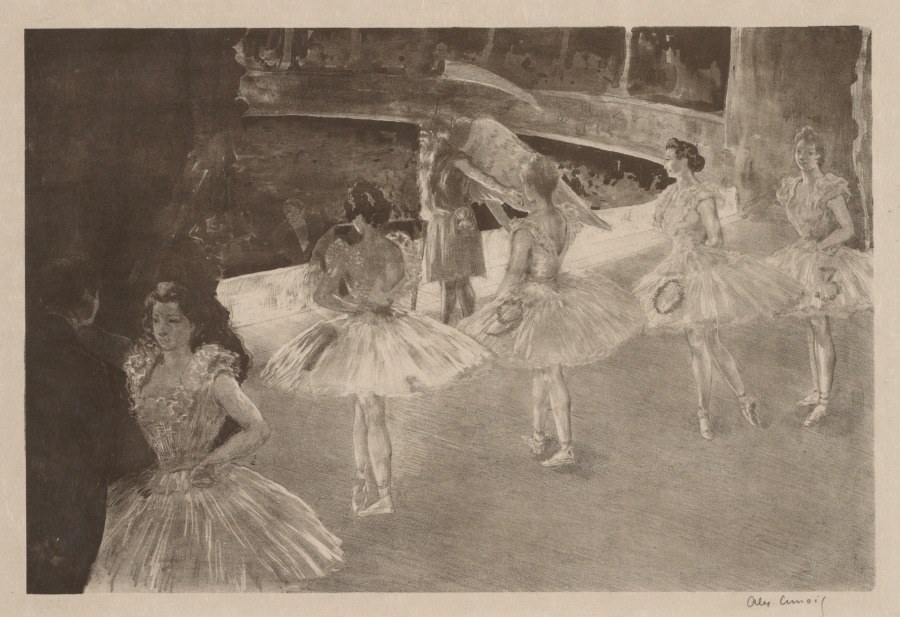
Ballet rehearsal onstage
Unknown artist
- Medium:
- Dance:
- Ballet
- Source:
- New York Public Library
- Rights:
- Public domain — free to use, share and adapt.
- Recorded as:
- public_domain
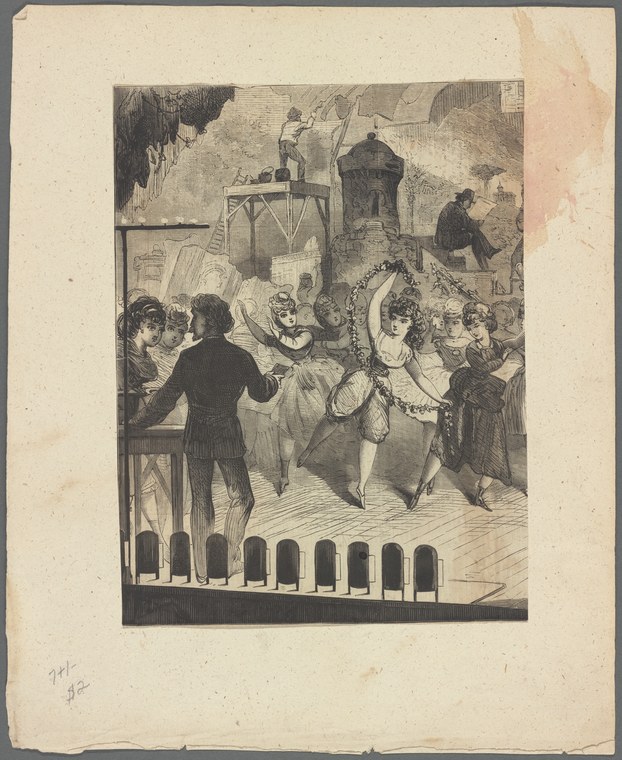
This engraving documents a backstage or rehearsal moment in nineteenth-century ballet, a subject far less commonly depicted than the finished stage performance. It offers a counterpoint to the ethereal, weightless figures in standard Romantic ballet imagery, showing instead the real bodies, costumes, and social hierarchy of the company at work. For historians of ballet practice and theatrical culture, it is a rare visual record of how dancers lived and worked when not performing the idealized roles the public saw.
What you are looking at
An engraved scene of theatrical chaos and spectacle, rendered in the linear hatching style of nineteenth-century printmaking. The composition is crowded and vertical: at top left, a figure stands on an elevated platform or stage machinery, gesturing downward; below, a large ensemble of costumed performers fills the lower two-thirds of the frame. The women wear elaborate ball gowns with low necklines, their hair dressed high in the style of the 1830s–1850s; the men are in dark tailcoats and trousers. In the center and foreground, dancers are linked or grouped closely together, some with arms raised or extended. The setting suggests backstage or onstage preparation rather than a polished performance—figures overlap, gesture animatedly, some seem to be adjusting costume or position. At the bottom of the frame, a row of dark rectangular shapes (possibly footlights or the stage apron) establishes the proscenium edge. The print's tone is one of buoyant social comedy: the scene captures a moment of preparation, flirtation, or artistic disorder just before or during a theatrical ballet.
The dancing
The ensemble comprises at least a dozen figures, with women in the majority. Their bodies are arranged in loose, overlapping groups rather than in formal balletic alignment. Arms are raised, extended toward neighbors, or held at the sides in period fashion; several women appear to be touching or linking with partners or with other women. The posture is upright but natural, not stiffly formal—this is a rehearsal or behind-the-scenes moment, not a finished line of corps de ballet. The men are slighter in number and positioned throughout; one at left appears to be conducting or directing. The engraver has rendered individual faces and the folds of fabric with care, but has not idealized the bodies into the weightless, unified form of a classical ballet company.
The dance depicted
This is almost certainly a ballet rehearsal or a backstage scene from a theatrical ballet production, most likely from the Romantic era (1830s–1850s). The costume style, the all-female focus with men in supporting roles, and the proscenium setting all point to the conventions of nineteenth-century ballet d'action. The scene does not show a moment of choreographed dance itself, but rather the social and logistical chaos of preparation—dressing, arranging, warming up, or waiting. The buoyant tone and the mingling of the sexes (unusual on the formal Romantic stage) suggest either a comic ballet, a backstage parody, or an engraver's playful commentary on theatrical life. Without an artist's signature or title inscription visible, the specific ballet cannot be identified, but the work documents a particular view of how ballet was organized and experienced behind the curtain.
How it was made
This is a black-and-white engraving or etching, likely a wood engraving given the fineness of line and the regular hatching used to model form and shadow. The print is rendered on paper and mounted or pasted onto a larger sheet of cream-colored board. The technique allowed for fine detail and wide circulation—engravings were often reproduced in periodicals, annuals, or illustrated books. The precision of line and the careful handling of spatial depth suggest this was a professional work, possibly drawn from a painting or from the artist's own observation of a theatrical scene. The date stamp visible on the sheet indicates cataloguing by a later institution; the work itself appears to be from the mid-nineteenth century based on costume and printing conventions.
About this work
A mid-nineteenth-century engraving depicting a ballet rehearsal or backstage scene, crowded with elaborately dressed dancers and theatrical personnel. The print captures not the finished choreography of the stage, but the informal, social reality behind it—the mingling, preparation, and barely organized bustle that preceded a Romantic-era ballet performance. The work sits at the intersection of theatrical documentation and social comedy, offering a view of ballet life that is rarer in formal art than the idealized stage images. It belongs in a gallery of dance in art as evidence of how artists understood and portrayed the ballet world beyond the proscenium frame.
How to look at it
Attend first to the crowding and overlap—this is not a composition of balanced figures in a formal arrangement, but a busy, almost chaotic assembly. Notice how the women's bodies are arranged in relation to one another: are they in conversation, in formation, or in a state of preparation? Look at the hands and arms, which convey gesture and interaction more clearly than the lower bodies. The engraver has chosen to freeze a moment of social and physical proximity rather than a moment of extended, soaring movement. This choice itself is documentary: it tells us that the artist (or the patron who commissioned the work) was interested in the ballet as a social and theatrical institution, not simply as an aesthetic spectacle.
The period
The costume, hairstyles, and proscenium setting place this work in the Romantic era of ballet, roughly 1830–1860. This was the golden age of narrative ballet d'action—works such as La Sylphide (1832) and Giselle (1841)—and the period when the ballerina became the central focus of the stage, supported by male dancers and a corps. Theatrically, this was also a time of expanding technical sophistication in stage machinery and lighting, evident in the elevated platform or machinery visible in the print. Socially, the theatrical world was a space of coded flirtation and hierarchical interaction; the mixing of male and female figures in this scene, and the physical closeness between them, reflects both backstage reality and period anxieties about theatrical morality and the status of dancers (especially women) in society.
Where it lives
The work is held in the New York Public Library collection. It is catalogued as a print, likely from a periodical, album, or collected series of theatrical scenes. The mounting and the institutional mark indicate it has been preserved as a discrete historical document.
Dance in this work
Questions about this work
Is this a real ballet scene or an imaginary one?
The specifics cannot be determined without a signature or inscription, but the costume and setting are authentically rendered. It may document a real theatrical moment, or it may be a composite or imaginative scene designed to represent ballet life generically. Either way, it is accurate in its period detail and social observation.
Why are they not dancing?
This is a rehearsal or backstage scene, not a performance. The artist chose to depict the ballet world as a space of preparation, socializing, and logistical work rather than as a moment of finished choreography. This choice makes the print historically valuable: it shows how ballet companies actually functioned.
What does the elevated platform at the top left represent?
It appears to be stage machinery, a raised platform, or a rehearsal space. A figure stands on it gesturing downward, possibly a rehearsal director or choreographer. This detail anchors the scene firmly in the theatrical world and suggests the hierarchical structure of a ballet company at work.
More Ballet artwork