39 works in this view — arrow keys or swipe to move between them.
Dance in Art
Morlacchi's Ballet Troupe
Unknown artist
- Medium:
- Dance:
- Ballet
- Source:
- New York Public Library
- Rights:
- Public domain — free to use, share and adapt.
- Recorded as:
- public_domain
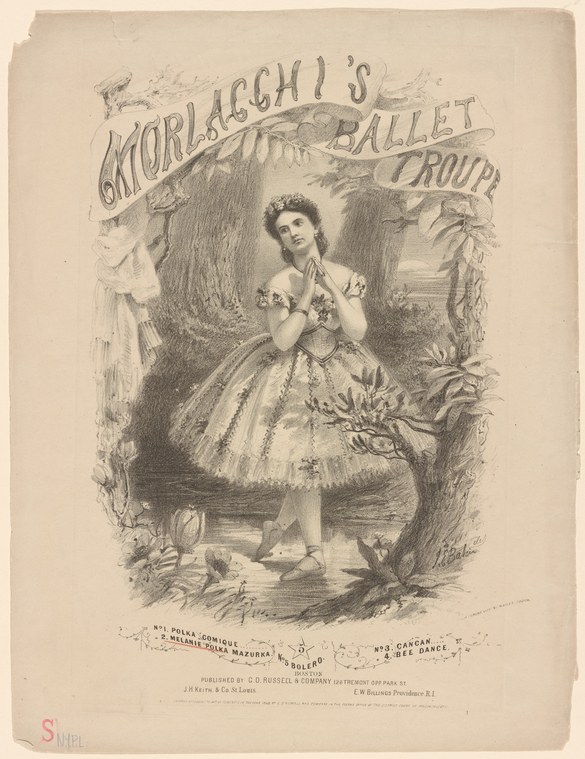
This image documents the appearance and marketing of Romantic ballet as it actually circulated in the 1830s–1840s, before photography. It shows how the tutu, the pose, the pastoral setting, and the solitary female figure were already established as the visual language of the genre—a language that remains influential in ballet today. For historians, it is evidence of how Giuseppina Morlacchi and her company shaped American audiences' understanding of European ballet at a pivotal moment.
What you are looking at
A young woman in a romantic-era ballet costume stands in a sylvan clearing, her body poised in classical fifth position with arms raised in a graceful port de bras. She wears a fitted bodice with a dramatically voluminous tulle skirt—the signature tutu of Romantic ballet—adorned with floral garlands or decorative elements. Her dark hair is styled atop her head. The setting is theatrical and picturesque: she is framed by trees, their trunks and foliage creating a natural proscenium arch, with vines or flowers draped around her. In the foreground, rocks and vegetation anchor the scene in an imagined forest or garden. The entire composition is rendered in fine engraving, with delicate cross-hatching that creates luminosity in the fabric of her skirt and shadow in the surrounding woodland. The title "Morlacchi's Ballet Troupe" appears in decorative lettering at the top; publication information is printed below.
The dancing
A single female dancer occupies the center, captured in a moment of balletic repose rather than active movement. Her posture shows the turned-out legs and upright carriage fundamental to classical ballet technique. The arms are positioned in a soft, open port de bras—neither closed nor fully extended—suggesting either a moment between steps or a held pose for display. Her gaze is directed downward and to the side, a conventional pose of modesty and theatrical grace. The figure stands alone, so there is no partnering or ensemble geometry, but the compositional balance and the care with which the artist rendered the body's alignment suggest the artist understood the codified positions of trained ballet.
The dance depicted
This is a Romantic ballet image, most likely from the 1830s–1840s based on costume and engraving style. The title identifies the subject as a member or product of Morlacchi's company—almost certainly referring to Giuseppina Morlacchi, an Italian-born ballerina who was prominent in mid-19th-century American and European dance. The image documents the visual language of Romantic ballet as it was marketed and circulated: the ethereal tutu, the solitary female figure, the pastoral or magical setting, and the emphasis on elevation and weightlessness. The engraving functioned as advertisement, allowing the dance to be seen and imagined by audiences who could not attend performance.
How it was made
This is an engraving—a fine-line intaglio print—as evidenced by the uniform clarity of line, the parallel hatching used to model form and shadow, and the tonal range achieved through density of line rather than color. The technique allowed precise reproduction and relatively inexpensive mass distribution, making it the dominant form for theater publicity and artistic commemoration in the 19th century. The quality of the engraving—the delicate rendering of fabric, the atmospheric use of line to suggest woodland depth—indicates this was a professional commission, likely created for sale to the public or for use in theatrical programs and broadsheets. The fineness of the work signals a market for high-quality dance imagery among educated urban audiences.
About this work
This engraved portrait of a Romantic-era ballerina from Morlacchi's company captures a moment of idealized grace—a young woman in tutu and ballet position, framed by a pastoral woodland setting. The work is both documentation and advertisement, a visual record of how Romantic ballet presented itself to the 19th-century public. The engraving testifies to the commercial circulation of dance imagery in an era before photography, when engravings and prints were the primary means by which non-local audiences could see and imagine performances. Morlacchi's company was an important nexus of European and American ballet in the 1840s, and this print is a artifact of that moment of interchange.
As an object, the print reveals how dance was staged for the imagination: not through narrative or action, but through idealized individual beauty, costume, and pose. The viewer gazes at a figure who seems to inhabit both the stage and an enchanted forest—a visual language that Romantic ballet cultivated to suggest otherworldliness and transcendence. The solitary female figure, the tutu, the arched trees, the downcast gaze—all were conventions by this date, yet they remain powerful. The engraving is both a historical record and an artwork in its own right.
How to look at it
Attend first to the tutu and the body beneath it: the engraver has taken pains to show both the volume and delicacy of the skirt and the controlled alignment of the dancer's body within it. Notice the pose—the feet, the carriage, the arms—which should read as composed and skillful rather than active or dynamic. The choice to place the figure alone in a woodland setting, rather than on a stage or in a ballroom, is intentional: it evokes the otherworldly or supernatural subjects that Romantic ballet loved. Observe how the engraver used line and shadow to create the sense of the tutu's weightlessness and to frame the figure within the natural architecture of the forest. This is a marketing image, meant to convey beauty, refinement, and a kind of transcendence—look for how every formal choice serves that aim.
The artist
The artist is not recorded in the catalogue, but the quality and style of the engraving suggest it was made by a professional urban printmaker working in the mid-19th century in either Europe or America. The inscription at the base indicates publication details that may yield attribution with further research. Such theatrical engravings were typically commissioned by theaters, dance companies, or print publishers and executed by specialized reproductive engravers rather than the artists who designed the original composition. The work is part of a now-vast corpus of 19th-century dance portraiture that has survived primarily in institutional collections.
The period
The 1830s–1840s were the height of Romantic ballet in Europe and the beginning of its establishment in the United States. The period saw the canonization of works like La Sylphide (1832) and Giselle (1841), both of which established the figure of the ethereal, otherworldly female dancer as the center of the ballet aesthetic. This was the era of the cult of the ballerina as a kind of muse—idealized, distant, often depicted in solitude in natural or magical settings. In visual culture, engravings like this one were the principal means of disseminating images of famous dancers; they appeared in theater lobbies, in newspapers, and as collectibles. Giuseppina Morlacchi was one of the Romantic era's most celebrated dancers, and her tours brought this European aesthetic to American audiences. The engraving is thus both a portrait of an individual and a document of how an entire art form represented itself.
Where it lives
The work is held in the New York Public Library collection, which is one of the world's largest repositories of 19th-century theatrical ephemera and dance imagery. It is catalogued as a print from an unknown date and by an unidentified artist, suggesting it entered the collection through a general accretion of dance-related materials rather than as part of a documented provenance. Such theatrical engravings were often produced in quantity and distributed widely, so institutional collections like NYPL's acquired them both as historical records and as part of broader collecting efforts in the early and mid-20th century.
Dance in this work
Questions about this work
Who was Giuseppina Morlacchi?
Giuseppina Morlacchi (1809–1886) was an Italian-born ballerina who achieved fame in Europe and America in the 1830s and 1840s. She was one of the leading Romantic-era dancers and appeared in major American cities, helping to establish European ballet among U.S. audiences. She was known for both her technical skill and her dramatic presence, and her name became synonymous with the highest standards of the era.
How do I know this is Romantic ballet and not another era?
The costume—specifically the tutu, the fitted bodice, and the overall silhouette—is the primary clue. Romantic ballet emphasized the ethereal tutu and the visual lightness of the female dancer. The pastoral setting, the solitary figure, and the emphasis on grace rather than spectacle are also hallmarks of Romantic aesthetics, which dominated ballet from roughly 1830 to 1860. Earlier styles used different costumes and settings; later styles moved toward different ideals.
Why is this an engraving and not a photograph?
Photography existed by the 1840s but was not yet practical for theatrical portraiture or mass reproduction. Engravings were faster to produce, allowed artistic idealization (the engraver could enhance or compose as well as copy), and could be reproduced in quantity. Photographs of dancers began to supplement engravings by the 1860s but did not replace them until much later. This engraving represents the dominant visual technology of its era.
What does this tell us about how Romantic ballet was advertised?
This image shows that Romantic ballet was sold to audiences through idealized, often solitary portraits of female dancers in costume, often in fantastic or natural settings rather than realistic theaters. These engravings were inexpensive to reproduce and distribute, appearing in theater lobbies, newspapers, and as collectible prints. They marketed ballet as an art form centered on individual female beauty, grace, and otherworldly presence—rather than on narrative or ensemble spectacle.
More Ballet artwork