40 works in this view — arrow keys or swipe to move between them.
Dance in Art · 2019
Unidentified ballet
Unknown artist
- Medium:
- Dance:
- Ballet
- Source:
- New York Public Library
- Rights:
- Public domain — free to use, share and adapt.
- Recorded as:
- public_domain
This work is essential evidence for understanding the material practices and aesthetic values of Romantic ballet. It shows us not what a choreographer wrote down, but what an audience saw: the actual costume, the held positions, the body type and carriage that defined the era. For dancers and historians, it is a direct window into the physical training and presentation that shaped classical ballet vocabulary.
What you are looking at
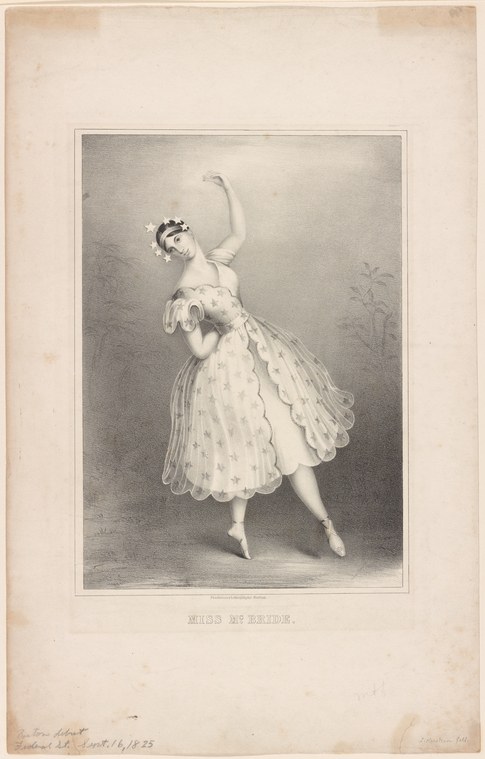
A young female dancer stands alone against a neutral gray background in a three-quarter pose, captured mid-movement. She wears a white romantic tutu—the skirt composed of multiple layers of tulle arranged in the characteristic bell shape of mid-nineteenth-century ballet, with scalloped or dagged edges creating a decorative hem. Her bodice is fitted and white, her arms raised gracefully with one extended upward and the other at a complementary angle. She stands en pointe on her right leg, her left leg extended behind her in an arabesque or similar lifted position. Her hair is styled in the fashion of the 1840s–50s, arranged close to her head in curls or waves. The pose suggests the moment of a leap or sustained elevation—a display of the ethereal, weightless quality that romantic ballet prized. The print has the refined, delicate tones characteristic of a hand-colored lithograph or engraving of this period, with fine hatching to suggest shadow and volume.
The dancing
A single dancer in near-perfect vertical alignment, balanced on the supporting leg with controlled turnout from the hip. The extended leg is held high and appears to be in a true arabesque—turned out at the hip, the working leg extended straight back with the heel leading. Her arms frame an upper body held upright and open, the lifted arm reaching elegantly upward in a line that extends the axis of the body. The overall frame suggests both strength and an apparent effortlessness; this is technical virtuosity presented as weightless grace, the hallmark of romantic ballet vocabulary. The weight is clearly centered, the posture aristocratic and refined.
The dance depicted
This is unquestionably romantic ballet of the mid-nineteenth century, most likely from the 1840s or 1850s. The pose, costume, and presentation are consistent with the canonical vocabulary of Romantic ballet—the pointe work, the delicate tutu, the ethereal arm port de bras, and the arabesque itself, which had become a signature line of the era. The artist has chosen to depict a moment of sustained elevation or transition, freezing the dancer in a position that conveys both technical accomplishment and the otherworldly quality central to Romantic aesthetics. The work likely documents either a named dancer in a famous role, or represents the type generically—a study of Romantic ballet beauty and technique.
How it was made
This is a print, most likely a hand-colored lithograph or possibly an engraving, based on the fineness of the line work, the subtle gradation of tone in the background, and the warm cream tone of the paper. The delicate hatching used to model the body and the controlled, even application of pigment in the costume are consistent with lithographic printing, which was the dominant medium for theatrical portraiture in the 1840s–50s. The hand-coloring is precise but economical—the tutu and bodice rendered in white and gray, the background a neutral wash. This type of print was distributed widely in theater lobbies and sold to the public, making it a mass-circulated theatrical document and record of performance practice.
About this work
This is a mid-nineteenth-century print depicting a single female dancer in the Romantic ballet idiom, likely from the 1840s or 1850s. The image is a canonical record of the aesthetic and technical vocabulary that dominated European ballet in this period: the ethereal tutu, the pointe work, the arabesque, and the lifted, refined carriage that were markers of Romantic style. The dancer's isolation on the page, the neutrality of the setting, and the focus on bodily line and pose suggest this is both a documentation of a specific performer or role and a celebration of the ballet vocabulary itself. The print circulated as a theatrical souvenir and record, making it a crucial historical witness to how dancers of this period understood and displayed their technique.
How to look at it
Attend to the moment chosen: the dancer is not in a moment of arrival or repose, but suspended in a clear geometric pose that displays both turn and lift. The artist has frozen not a narrative instant but a technical statement—a pure display of the vocabulary and the body. Notice the relationship between the supported leg (perfectly vertical, all weight settled through the center of the body) and the extended leg (clean line, turned out from the hip, the leg and torso aligned). The raised arm is not decorative but structural, part of the compositional balance. This is a portrait of technique as grace.
The period
The 1840s and 1850s were the apex of Romantic ballet in Europe. Marie Taglioni, Fanny Cerrito, Lucile Grahn, and Carlotta Grisi dominated the stages of Paris, London, and St. Petersburg, and their images were reproduced in prints, engravings, and lithographs by the thousands. The pointe shoe was becoming standard; the tutu had evolved into its characteristic Romantic form—a skirt of layered tulle that reached mid-calf and moved with the body. Choreographers like Jules Perrot and Jean Coralli created roles designed to showcase ballerinas in positions of apparent weightlessness and elevated calm. The print was a primary medium of theatrical publicity and fan culture, allowing images of celebrated dancers to circulate far beyond the theater.
Where it lives
This print is held in the New York Public Library collection. It is a theatrical souvenir or promotional print of the type widely circulated in the 1840s–50s. No artist is recorded, which was not uncommon for commercial theatrical prints of the period.
Dance in this work
Questions about this work
Is this a famous dancer or a generic 'type' of Romantic ballerina?
The print does not carry a printed attribution or name visible in the image, and the catalogue record does not identify the sitter. It is impossible to say from the image alone whether this depicts a specific celebrated dancer (such as Taglioni or Cerrito) or is a generic study of the Romantic ballet ideal. The refined execution suggests it was drawn from a live performer or a well-known role, but the work may represent the type rather than the individual.
What is the artist's technique here, and what does it tell us?
The print appears to be a lithograph or engraving, hand-colored with precision. The medium allowed for rapid reproduction and distribution, which is why such prints were so abundant in this period. The delicate line work and subtle modeling suggest a skilled commercial artist, likely working from a live study or from another artist's drawing. This was how theater images circulated to the public.
Why is she standing like that—is that a real movement from ballet?
Yes. The pose is an arabesque, one of the foundational positions of classical ballet vocabulary. It is both a static pose and a moment in many movements (jumps, turns, sustained extensions). What the artist has done is isolate and display the pose, emphasizing the line of the body and the technical clarity the dancer achieves—the apparent ease with which she holds a position that requires significant strength.
More Ballet artwork