46 works in this view — arrow keys or swipe to move between them.
Dance in Art · 2019
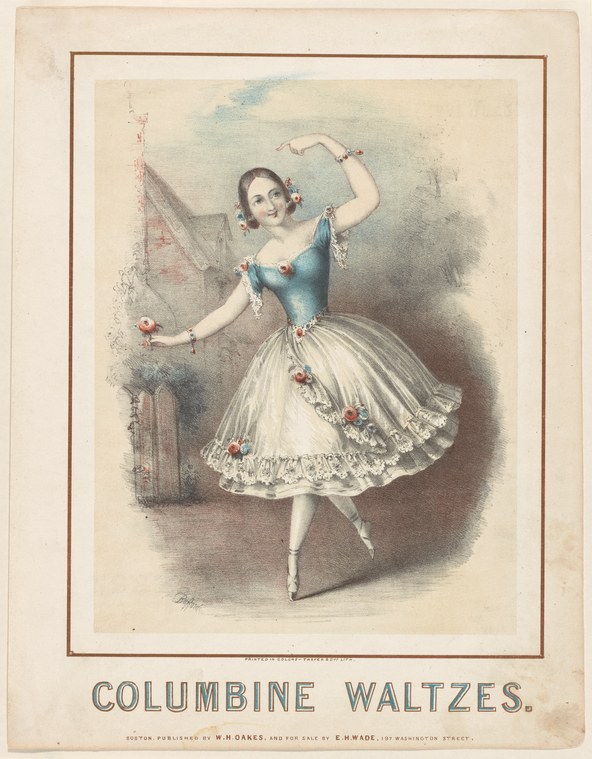
Columbine waltzes
Unknown artist
- Medium:
- Lithograph
- Dance:
- Waltz
- Era:
- Early 1800s (Waltz Revolution)
- Source:
- New York Public Library
- Rights:
- Public domain — free to use, share and adapt.
- Recorded as:
- public_domain
This print is crucial evidence for understanding Romantic-era theatrical character dance and the persistence of commedia dell'arte figures in European performance. It shows how the waltz craze influenced theatrical costuming and promotion, and how a single named dancer or character could be merchandised through prints, reaching audiences far beyond the theater. For dance historians, it demonstrates the blurred boundary between social dance and theatrical spectacle in the early 1800s.
What you are looking at
A young female dancer in theatrical costume stands in a classical contrapposto pose against a softly rendered architectural background. She wears a fitted turquoise or teal bodice with short sleeves, trimmed with coral-colored roses or pom-poms, paired with a voluminous white skirt gathered high at the waist with deep, regular pleats that fall to mid-calf. The skirt is decorated around its hem with the same coral flowers in a scattered pattern. She holds a gossamer veil or shawl in her raised right hand, which billows above her head; her left hand rests near her corseted waist. Her dark hair is styled close to the head and adorned with coral flowers. The setting is minimally defined—a draped grey-brown curtain or architectural element behind her provides depth without distraction. The lithograph's soft shading and flesh tones create an ethereal, romantic quality. She is posed as if mid-performance or mid-gesture, the lifted veil suggesting movement even in stillness.
The dancing
The dancer stands in an upright but relaxed position with her weight distributed evenly, one leg extended slightly in front, suggesting either the pause between movements or a moment of presentation. Her right arm is raised and extended, manipulating the transparent fabric in an arc above her head. Her left arm is held low and slightly away from her body, creating an open, frontal presentation to the viewer. The pose shows no evidence of the turned-out positions or rising onto demi-pointe that would characterize ballet technique; instead, the stance is grounded and presentational, consistent with early 19th-century theatrical dance where the body remained largely vertical.
The dance depicted
The work is titled *Columbine Waltzes*, identifying the figure as Columbine, the clever female servant character from the commedia dell'arte tradition who became a stock figure in European pantomime and ballet d'action of the early 19th century. The costume—the fitted bodice, decorative flowers, the airy veil—is the theatrical dress of a Romantic-era dancer. However, the pose and the lack of ballroom positioning or closed holds with a partner suggests this is not a depiction of actual waltz dancing but rather a theatrical portrayal of Columbine, likely a solo or feature moment within a larger comic or romantic action. The flowers and veil align with the sentimental, decorative vocabulary of Romantic ballet. The 'waltzes' in the title may refer to the musical accompaniment or to the danced segments within a dramatic scene rather than to the work as a whole being a waltz in the ballroom sense.
How it was made
This is a hand-colored lithograph, a print technique that allowed for relatively inexpensive mass production while maintaining delicate detail and soft tonal gradations. The artist used lithography's characteristic soft edge and subtle shading to render the dancer's form, fabric textures, and atmospheric background. The medium's capacity for color—evident in the turquoise bodice, coral flowers, and flesh tones—made it ideal for theatrical promotion and for circulation among ballroom dancers and theater patrons. The publisher credit at the foot indicates this was a commercial print intended for a broad audience, not a fine-art print for collectors.
About this work
This lithograph documents a moment of Romantic-era theatrical dance, specifically a performance by or representation of the character Columbine. The image conflates commedia dell'arte tradition with the conventions of early 19th-century European ballet and pantomime, capturing the decorative, sentimental aesthetic that defined the era. Columbine, typically the witty female servant, is here presented as a romantic theatrical figure—costumed, flowered, and posed for visual pleasure. The work is significant as a record of how character and comic roles were visualized and marketed during the Waltz Revolution period, when ballroom dance and theatrical dance were deeply intertwined in popular imagination and performance. It reveals that 'Columbine Waltzes' was likely a theatrical suite or scene, not a ballroom work, and that the character was central to early 19th-century popular entertainment.
How to look at it
Observe the careful balance between theatrical presentation and dance movement: the veil is caught in a moment of flight, suggesting that the dancer has just lifted or is about to manipulate it, yet her body remains upright and composed. Notice the absence of the closed-hold partnership or the forward-moving trajectory typical of ballroom waltz. Instead, this is a solo figure in repose or presentation, inviting admiration. The flowers scattered on the skirt and adorning the hair are not incidental decoration—they were a signature element of Romantic-era theatrical costuming, signifying youth, romance, and charm. The artist chose to freeze a moment of stillness within performance, allowing the viewer to admire both the dancer and the costume, rather than to read a narrative action.
The period
This work dates to the early 19th century during the height of the Waltz Revolution—the period when the waltz transformed from a folk dance into the dominant social dance of European courts and ballrooms. Concurrently, Romantic ballet was emerging as a major art form, characterized by ethereal heroines, magical settings, and a new emphasis on the female dancer. Commedia dell'arte, while rooted in Renaissance and Baroque tradition, remained a vital strand in European pantomime and theater, especially in comic roles and interludes within larger works. Columbine, like Harlequin, was a figure audiences recognized and loved. Theatrical prints like this were produced in the thousands and circulated widely, making dance accessible to people who could never attend a live performance. The soft, romantic aesthetic of this lithograph—the gentle coloring, the graceful pose, the decorative flowers—reflects the Romantic sensibility that dominated the visual arts, music, and dance of the period.
Where it lives
This is a commercial theatrical print, held in the New York Public Library collection, indicating it is a piece of popular visual culture rather than a fine-art work. Such prints were typically published in small editions, sold to theater patrons, and displayed in print shops, making them accessible to a broad urban audience. The inclusion of a publisher's mark (W. H. Oakes, Boston) indicates it was distributed in the United States, testament to the transatlantic circulation of Romantic-era dance imagery.
Dance in this work
Questions about this work
Who was Columbine and why would she dance a waltz?
Columbine was a stock character in commedia dell'arte—the clever, witty servant girl, often Harlequin's love interest. By the early 19th century, she had become a fixture of European pantomime and theatrical dance. The 'Columbine Waltzes' likely refers to a theatrical scene or suite set to waltz music, not to ballroom dancing. Columbine was a vehicle for comic, acrobatic, and sentimental performance, and the Romantic era loved to dress her in decorative, flowered costumes.
Is this actually a waltz, or just a character pose?
This print shows a solo moment of presentation rather than an actual waltz dance. There is no partner, no closed hold, and no forward momentum. The 'waltzes' in the title likely refers to the musical accompaniment or to danced sections within a larger theatrical action. The pose is too upright and composed to represent the bodily engagement of ballroom waltz. This is a promotional image celebrating the character and costume, not a technical study of waltz technique.
Why is this a lithograph and not a painting?
Lithography was the ideal medium for theatrical promotion in the early 19th century. It allowed artists to produce multiple copies quickly and cheaply, making images affordable for theater patrons, dancers, and collectors. The soft tones and delicate hand-coloring possible in lithography were perfect for the sentimental, romantic imagery that audiences craved. This print was mass-produced merchandise, not a unique artwork.
What does the veil tell us about the dance?
The veil is a theatrical prop, not a ballroom accessory. In early 19th-century theatrical dance, veils and scarves were used for dramatic effect—to create silhouettes, to extend the line of the body, and to suggest magic or otherworldliness. The way this dancer lifts and manipulates the veil shows it as central to her performance vocabulary, a tool for creating visual spectacle.
More Waltz artwork