41 works in this view — arrow keys or swipe to move between them.
Dance in Art
Unidentified ballet
Unknown artist
- Medium:
- Dance:
- Ballet
- Source:
- New York Public Library
- Rights:
- Public domain — free to use, share and adapt.
- Recorded as:
- public_domain
This work documents the visual culture of Romantic ballet and the star system that made prima ballerinas into celebrities. It shows how ballet dancers were marketed and remembered—not through images of extreme virtuosity, but through costume, beauty, and an almost sculptural presentation of the ideal ballet body.
What you are looking at
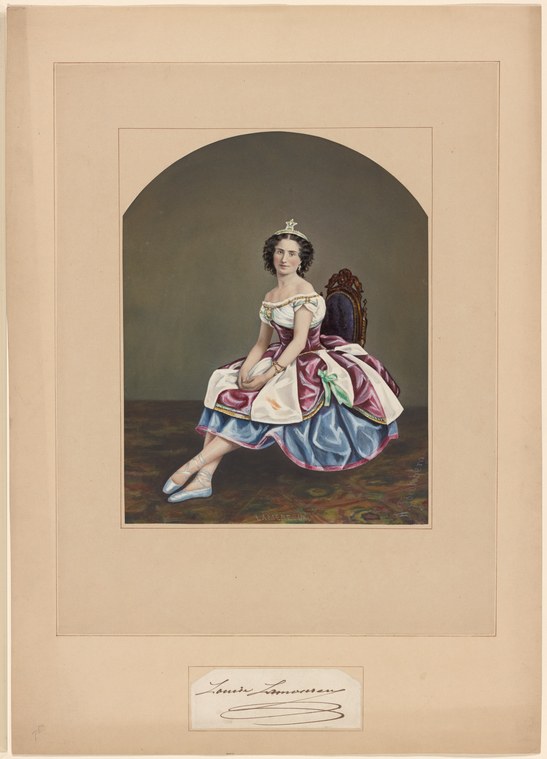
A young woman in a romantic-era ballet costume sits on the floor in an arched alcove, her body angled in a relaxed, contemplative pose. She wears a white off-shoulder bodice and a voluminous skirt of pale blue and mauve silk with a deep pink or burgundy underskirt visible as the fabric billows around her. A jeweled tiara crowns her dark hair. Her left leg extends along the floor in a soft tendu position; her right knee is bent, her foot tucked beneath her. Behind her stands a carved wooden chair with a deep burgundy upholstered back. The setting is spare—a dark polished floor contrasts with the pale architectural alcove, and a handwritten signature appears at the base of the composition.
The dancing
A single female dancer is depicted in a moment of repose rather than active movement. Her posture shows the turned-out leg carriage and postural alignment characteristic of ballet training—the extended left leg displays the turnout from the hip. Her upper body is relaxed and slightly inclined, creating an intimate, almost portraiture-like quality rather than a dramatic pose. The positioning suggests she is between movements or at rest, allowing the costume and the delicate proportions of her frame to be fully appreciated.
The dance depicted
This is a Romantic-era ballet image, most likely a portrait of a principal dancer from the mid-19th century. The costume—white bodice, voluminous tutus with colored silk underskirts, jeweled headdress—is entirely consistent with the sylphs and ethereal heroines of the Romantic period. The relaxed seated pose is unusual for action scenes and suggests this may be a portrait commission or a posed study rather than a theatrical moment; such images often commemorated celebrated dancers of the era. The style of dress and the printing technique place this firmly in the 1850s–1870s.
How it was made
This is a hand-colored lithograph or engraving, based on the fine line work, the characteristic rendering of fabric and shadow, and the application of pigment. The technique allowed for precise detail in costume and facial features while achieving the soft tonal gradations visible in the background alcove. The inclusion of a signature space suggests this was a commercial print—likely sold as a souvenir or collector's item celebrating a performer or a famous role. The quality of production and the careful costume rendering indicate a substantial investment in the image, typical of portrait prints aimed at theatregoers and ballet enthusiasts.
About this work
This is a mid-19th-century portrait of a Romantic-era ballet dancer, rendered as a hand-colored print. The image captures not a moment of dance itself but a formal presentation of a celebrated performer in costume, posed as if for a society portrait. The Romantic tutu, the jeweled headdress, and the languid, graceful seated posture all encode the ideals of Romantic ballet—ethereality, refinement, and a carefully cultivated femininity. The print belongs to a major commercial tradition of theatrical celebrity portraiture that made famous dancers into collectible images.
How to look at it
Pay attention to the costume: the palette of pale blue, white, and deep pink was the signature Romantic tutu color scheme, distinct from later classical tutus. Notice the artist's choice to show the dancer seated rather than in an attitude or arabesque—this was a deliberate choice to present her as a person of elegance and cultivation rather than as an acrobat. The alcove and chair situate her in a genteel interior, reinforcing the idea that a prima ballerina was a woman of refinement, not merely a performer.
The artist
The artist is not recorded. The work bears a signature at the base, but it is not clearly legible in reproduction. The printing and coloring are of professional commercial quality, suggesting either a well-established ballet print publisher or a lithographic firm with theatrical expertise. Such firms existed in major European and American cities and were significant businesses in the mid-19th century.
The period
The Romantic era in ballet (roughly 1830–1870) elevated the ethereal, otherworldly female dancer to the center of theatrical spectacle. Ballets like La Sylphide and Giselle made famous certain roles and certain dancers, and the public appetite for images of these performers was immense. Lithographic print technology had made such portraits affordable and widely circulated, transforming dancers into secular icons. This image dates to the height of that commercial phenomenon.
Where it lives
The work is held in the New York Public Library collection and was acquired from an undisclosed source. It is an example of the theatrical celebrity print tradition that flourished in the 19th century and is now preserved in institutional collections as evidence of dance history and popular culture.
Dance in this work
Questions about this work
Is this a portrait of a specific famous dancer?
The catalogue record does not identify the subject. The signature at the base may name her or the artist, but it is not clearly legible in the available image. Without archival documentation, it cannot be attributed to a known performer.
What is the significance of the seated pose?
Seated or resting poses were common in Romantic-era theatrical portraiture because they allowed the costume to be fully displayed while presenting the dancer as a refined, composed person. It was a deliberate choice to show elegance and culture rather than virtuosity or dramatic action.
When was this print made?
The costume, printing technique, and stylistic conventions place it in the mid-19th century, most likely between 1850 and 1870. Precise dating would require archival research or identification of the signature.
How were such prints made and sold?
These were hand-colored lithographs or engravings produced by commercial theatrical print publishers. They were sold to theatregoers, collectors, and admirers of particular dancers, much like photographs of film stars in the 20th century. They were often bound into scrapbooks or displayed in homes and dressing rooms.
More Ballet artwork