42 works in this view — arrow keys or swipe to move between them.
Dance in Art · 2019
Unidentified ballet
Unknown artist
- Medium:
- Dance:
- Ballet
- Source:
- New York Public Library
- Rights:
- Public domain — free to use, share and adapt.
- Recorded as:
- public_domain
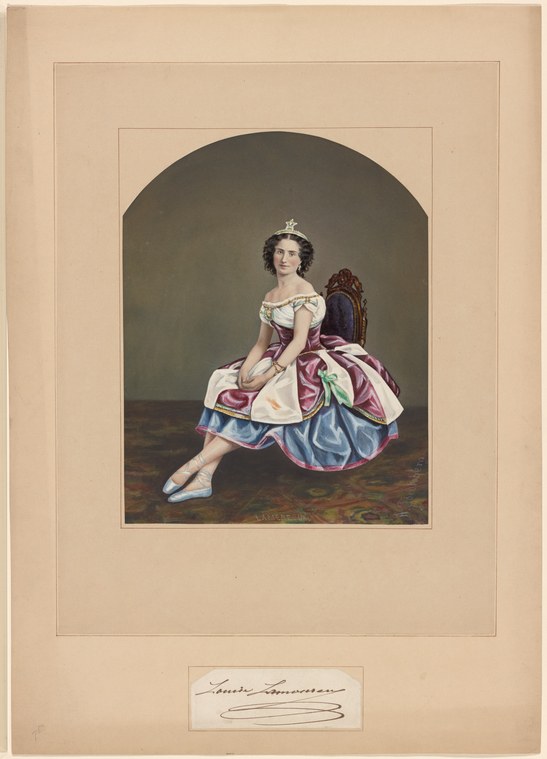
This print preserves visual evidence of Romantic ballet costume, pointe work, and the public image of the 19th-century prima ballerina at a moment when ballet was a dominant theatrical form across Europe and America. The choice to show the dancer in an informal, seated pose—rather than in an active step—offers a rare glimpse of the person beneath the role, humanizing the abstract ideal of the Romantic ballerina.
What you are looking at
A young female ballet dancer sits alone on a wooden stage floor, framed by a simple arched alcove. She wears a Romantic-era ballet costume: a pale pink or cream bodice with off-shoulder sleeves, a voluminous tulle skirt in layers of white, pink, and pale blue, and pointe shoes. A tiara or coronet sits atop her dark hair. She is seated in a relaxed, informal pose—one leg extended, the other bent—which is unusual for formal ballet portraiture of the era. Her posture is graceful but candid, as if she has paused during rehearsal rather than striking a formal pose for the viewer. The arched setting is spare and neutral, emphasizing the figure against a soft green-gray background. A signature is visible below the frame.
The dancing
The dancer's body is entirely at rest, not captured mid-movement. Her weight is supported on her hands and seated position; her extended leg is pointed but passive. The informal sitting pose—an almost naturalistic moment of repose—is striking for a formal print of this period, where dancers were typically shown in active arabesque, pirouette, or other recognizable ballet positions. The pose suggests intimacy and ease rather than demonstration of technical skill.
The dance depicted
This is undoubtedly a Romantic-era ballet dancer, identifiable from the costume: fitted bodice, full tulle skirt in the characteristic silhouette of the 1840s–1860s, pointe shoes, and tiara. The print depicts a ballerina at rest rather than in action, a choice that shifts the image from technical demonstration toward portraiture of the person. The tiara and formal tunic suggest a role of status—a prima ballerina or a character of rank. Without identification of the dancer or inscription naming a specific ballet, the work cannot be tied to a particular performance or story role, though the costume quality places it squarely within the Romantic ballet tradition.
How it was made
This is a hand-colored print—likely a lithograph or engraving—in which the dancer's figure has been rendered in color while the background remains monochromatic. The technique allows for soft modeling of the fabrics, particularly the translucency and volume of the tulle skirt, which was a central preoccupation of Romantic-era ballet imagery. The hand-coloring process was labor-intensive and expensive, indicating the work was made for a literate, affluent audience interested in ballet as a cultural pursuit. The presence of a signature below the frame suggests this was a published commercial work rather than a private sketch.
About this work
This is a portrait print of a Romantic-era ballerina in full costume, seated in a moment of rest or rehearsal. The work exemplifies 19th-century ballet imagery, which celebrated both the ethereal aesthetics of the Romantic tutu and the public persona of the prima ballerina. The informal seated pose distinguishes it from more conventional action-based ballet prints of the period, which typically froze the dancer mid-leap or turn. The work sits at the intersection of theatrical portraiture and dance documentation, serving both as a souvenir of a celebrated performer and as a record of how the Romantic ballet costume appeared in practice.
How to look at it
Attend to the contrast between the dancer's formal, expensive costume and her informal, off-duty posture. The tiara and voluminous skirt signal her status as a principal dancer in a prestigious role, yet she sits in a relaxed, almost ungraceful position that contradicts the ethereal ideal the costume is meant to embody. This tension—between the public image and the private person—is the work's central visual and psychological interest. Notice also the careful rendering of the tulle skirt's layers and translucency, which was the supreme technical challenge for artists depicting Romantic ballet.
The artist
The signature visible below the frame indicates this was a named work, likely by a commercial print publisher or lithographer specializing in theatrical imagery. The artist's identity cannot be determined from the image alone, though the quality of rendering and the hand-coloring suggest professional publication of the mid-to-late 19th century.
The period
This print dates from the height of Romantic ballet in Europe and America, when the ethereal female dancer in a tulle skirt became a central cultural icon. The 1840s–1860s saw the dominance of works like *La Sylphide*, *Giselle*, and *Swan Lake* (in its various forms), all of which featured the ballet costume seen here. Theatre prints and lithographs of dancers were mass-produced and collected as souvenirs, making ballet imagery accessible to the middle class. The informal domestic pose in this image—a dancer at rest—reflects a 19th-century interest in the private life and personality of celebrated performers, not merely their technical feats.
Where it lives
This work is held by the New York Public Library, which holds extensive collections of 19th-century theatre prints and dance imagery from its circulating collections and special collections. It is catalogued as a print without further attribution or dating information in the current record.
Dance in this work
Questions about this work
Is this a specific dancer or character?
The catalogue record does not identify the dancer or the ballet. The costume and tiara suggest a principal or noble role in a Romantic-era ballet, but without an inscription or known provenance, the specific identity cannot be determined from the image alone.
Why is she sitting rather than dancing?
The seated pose was an artistic choice, reflecting a 19th-century trend toward intimate, informal portraits of dancers. Rather than showing off technique, the print presents the dancer as a person at ease—a shift from the earlier convention of depicting dancers in active, recognizable steps.
How do I date this print?
The costume—particularly the silhouette of the tulle skirt, the fitted bodice, and the tiara—is consistent with Romantic-era ballet from the 1840s–1860s. The printing technique and hand-coloring also suggest mid-to-late 19th-century commercial production, but without a date on the print itself, only an approximate range can be inferred.
What is the signature at the bottom?
A signature or artist's name is visible below the frame, though it is not clearly legible in reproduction. This indicates the work was professionally published and the artist's identity was considered important to its sale and circulation.
More Ballet artwork