43 works in this view — arrow keys or swipe to move between them.
Dance in Art
Unidentified ballet
Unknown artist
- Medium:
- Dance:
- Ballet
- Source:
- New York Public Library
- Rights:
- Public domain — free to use, share and adapt.
- Recorded as:
- public_domain
For dancers and historians, this print is invaluable evidence of how Romantic ballet actually looked and was performed—the posture, the line, the relationship between body and costume. It also testifies to the celebrity culture surrounding mid-19th-century ballet and the role of reproductive prints in creating and sustaining that fame, long before cinema or mass photography. The survival of Pittieri's name linked to this single image raises important questions about how dance history is preserved and which performers are remembered.
What you are looking at
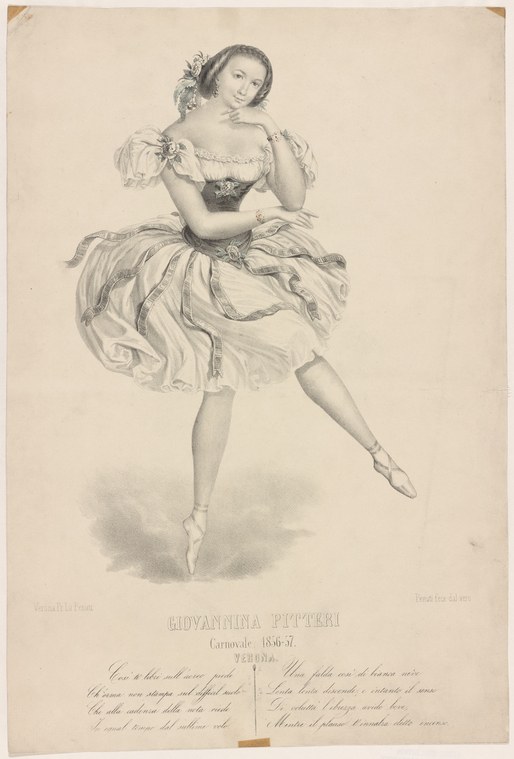
A single female dancer in an attitude derrière, captured mid-performance against a plain background. She wears a Romantic-era tutu—a fitted bodice with puffed sleeves and a skirt of layered gauze that falls to mid-calf—typical of early-to-mid 19th-century ballet costume. Her head is tilted gracefully, adorned with flowers or a floral wreath. She stands en pointe on one leg, the other raised behind her in a classical ballet position. The delicate line work and subtle shading suggest this is a lithograph or engraving, rendered in the refined graphic style of the 1840s–50s. Text beneath the image identifies the dancer as Giovannina Pittieri and gives a date of 1848–51, with Italian verse below. The composition is elegant and formal, designed to document or celebrate a notable performer of the period.
The dancing
The dancer is alone, posed in perfect equilibrium en pointe on her right leg, left leg raised and bent behind her in a classical attitude. Her arms are gently rounded—one hand raised near her shoulder, the other at her waist—with the soft, floating placement typical of Romantic ballet. Her torso is upright, her neck extended, creating the elongated line valued in the period. The pose captures an instant of poised control rather than dynamic motion, suggesting a moment of stillness or a formal studio or stage position. Her weight appears fully committed to the supporting leg, and the line from her extended leg through her tilted head is fluid and unbroken.
The dance depicted
This depicts Romantic ballet as performed in the mid-19th century, the period's dominant theatrical dance form. The attitude position, the pointe work, and above all the costume—the tutu, the bodice, the leg line—are unmistakable markers of this genre. Giovannina Pittieri was a professional dancer of this era; the inscription suggests this may commemorate a specific performance or tour in 1848–51. The pose emphasizes the ethereal, weightless ideal of Romantic ballet, where the dancer appears to float rather than exert physical effort. The artist has captured the vocabulary of the form with accuracy: pointe shoes are visible, the position is anatomically correct for a trained dancer, and the silhouette matches surviving photographs and descriptions of Romantic-era technique.
How it was made
This is a lithograph or engraving (most likely lithograph, given the soft tonal gradations and the period), a commercially produced print designed for circulation among theatre-goers, dance patrons, and the broader public. Such prints were the photograph of the era—the primary means of recording and distributing images of celebrated performers. The technique allowed for fine detail in the costume and face while maintaining the idealized proportions valued in ballet imagery. The use of italicized text and verse beneath suggests this is a commemorative or biographical print, possibly part of a series. The quality and finish indicate it was produced by a professional studio or publishing house rather than as a unique artwork.
About this work
This is a mid-19th-century lithograph or engraving commemorating the Romantic ballet dancer Giovannina Pittieri, captured in a classical attitude en pointe. It documents the aesthetic and technical vocabulary of Romantic ballet at its height—the ethereal line, the pointe work, the tutu, the idealized body—and preserves the image of a performer whose name survives in the print but whose career is otherwise largely lost to history. The work exemplifies how dance was recorded, celebrated, and circulated in the era before photography became commonplace: through the skilled hand of the graphic artist and the reach of the printing press. It belongs in a dance history gallery because it is both a work of art in its own right and a primary historical document of how 19th-century audiences understood and remembered the dancers who moved them.
How to look at it
Notice first the silhouette: the line from the top of her head through her extended leg is continuous and fluid, embodying the Romantic ideal of weightlessness. Look at the technical detail—the angle of her pointe foot, the position of her supporting leg, the relationship of her torso to her raised leg—all accurate to ballet training of the period. Observe the costume as a whole: the bodice emphasizes a narrow waist and lifted torso; the tutu skirt, relatively short by later standards, displays the leg line and footwork. The artist has used light shading to suggest the texture of gauze and to model the body beneath; this technique celebrates the dancer's form while maintaining the ethereal quality central to Romantic aesthetics. The pose itself is a moment of balance and control, not a moment of action or narrative—this is a dancer presenting herself, or being presented, as an ideal.
The period
This print dates to the height of Romantic ballet in Europe, roughly 1840–1860. The period was dominated by the aesthetic of the ethereal, supernatural woman—the sylph, the spirit, the impossible ideal. Dancers like Marie Taglioni (who famously danced en pointe from the 1830s onward) and Carlotta Grisi became international celebrities, and their images were reproduced and sold as widely as prints allow. The tutu in its modern form—the short skirt that allowed visibility of pointe work—had recently become standard. Lithography and engraving were the primary media for distributing such images; they were affordable enough for middle-class consumers yet refined enough to satisfy aesthetic standards. The inscription in Italian suggests Pittieri was an Italian dancer or performed in Italy, placing her within the important Italian and European networks of mid-century ballet.
Where it lives
The work is held in the New York Public Library collection, one of the major repositories of 19th-century dance iconography in North America. It is catalogued as a print (lithograph or engraving), part of the Library's broader holdings of theatre and performance ephemera from this period.
Dance in this work
Questions about this work
Was Giovannina Pittieri a famous dancer?
She appears to have been a professional performer in the mid-19th century, likely known in Italy or across Europe during the height of Romantic ballet. This print, which commemorates a performance or tour in 1848–51, is often the only surviving record of her; many dancers of the era, despite international success, are now known primarily through such prints and occasional newspaper notices. The survival of her image speaks to her standing at the time, even if wider historical memory has not preserved her.
What is an attitude derrière?
Attitude is a classical ballet position in which one leg is raised and bent behind the body, the foot roughly hip-height or higher, the knee turned outward. 'Derrière' means 'behind,' distinguishing this from an attitude devant (raised in front). It is one of the foundational positions taught in ballet and appears frequently in 19th-century dance imagery because it displays the turned-out line and the dancer's control and grace.
Why is she en pointe?
Pointe work—dancing on the tips of the toes in specially reinforced shoes—became standard in ballet from the 1830s onward and was central to Romantic ballet. It allowed dancers to appear weightless and ethereal, to rise above the stage, and to emphasize the elongated line from foot to head. By the time Pittieri performed, dancing en pointe was an essential skill and a key marker of a trained ballet dancer.
How was this print made and why?
This is almost certainly a lithograph, a process in which an image is drawn on stone and then printed. It could be produced in multiple copies and distributed widely, making it an affordable way for theatres, dance studios, and fans to own images of celebrated performers. Such prints functioned as promotional materials, souvenirs, and historical records; they were the primary means by which dance performance was visually recorded and circulated before photography became standard.
More Ballet artwork