44 works in this view — arrow keys or swipe to move between them.
Dance in Art
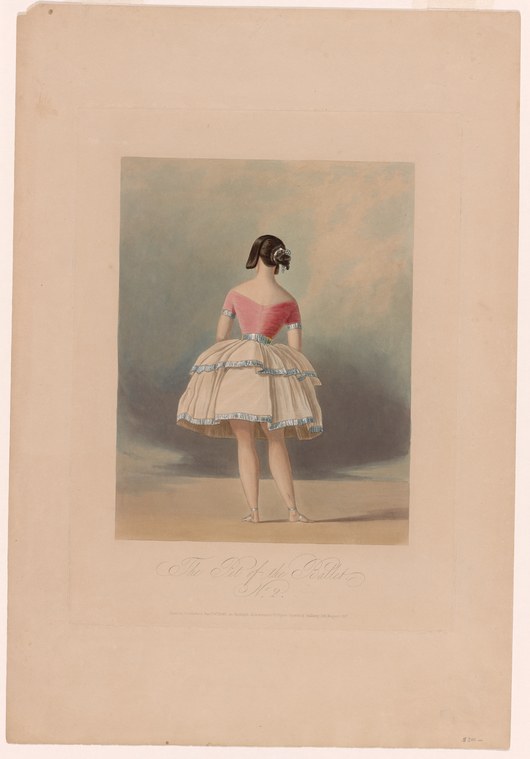
The Pet of the Ballet
Unknown artist
- Medium:
- Dance:
- Ballet
- Source:
- New York Public Library
- Rights:
- Public domain — free to use, share and adapt.
- Recorded as:
- public_domain
This print documents how Romantic ballet was circulated, consumed, and understood by the 19th-century public—not as movement or technique, but as costume, spectacle, and celebrity. The visible structure of the tutu shows the material engineering behind the visual illusion of weightlessness that defined the era's aesthetic. For dancers and historians, it is a primary source for the silhouette, fashion, and promotional culture of mid-Victorian ballet.
What you are looking at
A young female dancer stands alone on a shallow stage, viewed from behind and slightly to one side. She wears a coral-pink off-shoulder bodice and a voluminous white tulle skirt held out by what appears to be a structured crinoline or hoop framework—the skirt's architecture is explicitly rendered with fine curved lines showing the internal structure. Her dark hair is dressed up in the fashion of the mid-19th century. The background is a simple, atmospheric studio setting in muted greens and grays, with a neutral floor beneath her feet. The lighting is soft and even, typical of theatrical portraiture. The composition emphasizes the dancer's silhouette and the engineered geometry of the skirt, which dominates the visual weight of the image. This is a formal portrait, not an action scene; the dancer is posed rather than captured mid-movement.
The dancing
The dancer stands with feet in a neutral position, weight evenly distributed, arms relaxed at her sides. Her posture is upright and dignified, neither in active motion nor in a formal stance position. The body is turned three-quarters away from the viewer, showing the back and right side. There is no partnering, no complex arm position, no visible turnout—this is a presentational pose designed to showcase the costume and silhouette rather than demonstrate technical capacity.
The dance depicted
This is almost certainly a Romantic-era ballet dancer, probably photographed or engraved from a theatrical portrait. The mid-19th-century date, the off-shoulder corsage, the vast crinoline skirt with visible hoop structure, and the theatrical setting all point to the 1840s–1860s Romantic ballet aesthetic. The skirt's pronounced bell shape and engineered construction are characteristic of the era when tutus became increasingly elaborate and the illusion of weightlessness a central theatrical effect. The title "The Pet of the Ballet" suggests this may be a named dancer or a stock figure celebrating the star system of mid-Victorian ballet. The pose does not show step, technique, or narrative action; it is a costume portrait advertising the visual spectacle of ballet rather than its movement vocabulary.
How it was made
This is a hand-colored engraving or lithograph, identifiable by the fine line work, the tonal washes of color applied over a printed base, and the even technical finish. The medium allowed mass reproduction and wide circulation to a middle-class public who could not attend the theater. The coloring is applied with restraint and precision: the pink bodice, white skirt, and neutral background are carefully contained within the printed outlines. This technique was standard for theatrical portraiture and dance publicity in the 1840s–1860s, and the work's presence in the NYPL collection suggests it was part of a commercial series or theatrical archive.
About this work
This is a mid-19th-century hand-colored theatrical print depicting a Romantic-era ballet dancer in costume. It captures the visual and material culture of ballet in the 1840s–1860s, when the industry's star system was in full force and when the engineered crinoline skirt had become ballet's defining visual symbol. The dancer is presented as an idealized figure—young, graceful, fashionable—posed to display the costume rather than to convey motion or technique.
The work belongs in a gallery of dance in art as evidence of how ballet was marketed, consumed, and visualized by a metropolitan audience. It is not a record of what dance looked like, but of what audiences wanted to imagine about ballet: ethereal, expensive, fashionable, and fundamentally spectacle. The title's casual reference to the dancer as a pet or possession reflects the era's ambiguous status of the female performer—celebrated and commodified in equal measure.
How to look at it
Notice the explicit rendering of the tutu's internal structure—the curved lines that show the hoops or crinoline are not incidental but central to the image's purpose. The artist is drawing attention to the engineered artifice that creates the silhouette, suggesting that the skirt's form is as much of a spectacle as the dancer's body. The pose—frontal, still, costume-centered—is typical of theatrical portraiture and differs sharply from action-based dance imagery. This tells us something important: the primary purpose of this image is to sell a visual idea of ballet, not to document movement. The viewer is meant to admire the costume and the idealized beauty of the figure, not to learn how the dancer moved.
The period
This print dates to the height of Romantic ballet in Europe (1830s–1860s), when the genre had shifted from court entertainment to a commercial theatrical spectacle for urban audiences. The crinoline and hoop-skirt technology visible here was not invented for ballet but was adapted from mainstream women's fashion and became a tool for creating the illusion of the dancer's otherworldly lightness. In the same decades, lithographic printing and hand coloring made theatrical portraiture an affordable mass commodity. Stars like Marie Taglioni, Fanny Elssler, and later Carlotta Grisi were circulated through prints like this one, making them recognizable public figures across Europe and America. The print reflects the mid-century marriage of industrial manufacturing (the crinoline), commercial theater (the star system), and print media (mass reproduction) that shaped how ballet was experienced.
Where it lives
This print is held by the New York Public Library. It is part of a larger body of theatrical and dance-related prints that circulated widely in the 19th century, likely one of many such portraits published for public consumption and sale.
Dance in this work
Questions about this work
Is this a real dancer or a generic figure?
Without a legible signature or attribution, it is impossible to say with certainty. The title and the theatrical context suggest this may depict a named performer—the phrase "pet of the ballet" suggests a particular dancer's celebrity. However, it could also be a generalized type, meant to represent 'the ballet dancer' as a fashionable figure. Either way, the image tells us more about how ballet was marketed than about any individual performer.
What is the tutu made of and why can you see its structure?
Romantic-era tutus were made of layers of tulle (a light, sheer netting) sewn onto a fitted bodice and supported internally by a crinoline or structured petticoat of horsehair, whalebone, or wire hoops. The artist has chosen to render these hoops explicitly, perhaps to emphasize the material technology and cost that went into the costume. This visibility of structure is unusual and suggests a viewer's curiosity about how the silhouette was achieved.
Why is the dancer posed rather than shown mid-movement?
Costume and celebrity portraiture typically used static poses to maximize visibility of dress and physiognomy. Movement would obscure both. This reflects the commercial logic of theatrical prints: they were sold as souvenirs and publicity, meant to capture and immortalize a visual image, not to convey kinetic content. The stillness is a choice, not a limitation.
What does 'pet of the ballet' mean?
The term reflects the mid-Victorian commodification of female performers. 'Pet' suggests both affection and possession—the dancer is admired and desired but also treated as a luxury object or mascot. It is a revealing title that exposes the ambiguous social and economic position of 19th-century ballet dancers.
More Ballet artwork