49 works in this view — arrow keys or swipe to move between them.
Dance in Art · 2019
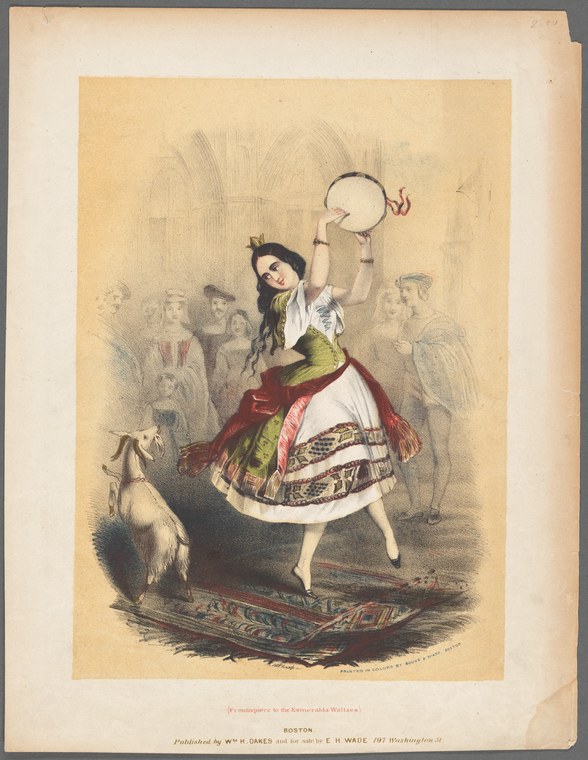
Frontispiece to the Esmeralda waltzes
Unknown artist
- Medium:
- Lithograph
- Dance:
- Waltz
- Era:
- Early 1800s (Waltz Revolution)
- Source:
- New York Public Library
- Rights:
- Public domain — free to use, share and adapt.
- Recorded as:
- public_domain
This object preserves the visual language of Romantic ballet at the moment of its greatest European influence, particularly the treatment of the female soloist in a moment of caught movement and the aesthetic of the character dance. For anyone tracing how theatrical dance moved into domestic and commercial spaces in the 19th century, the lithograph is primary evidence: it shows the work of promotion, the aesthetics that sold tickets and sheet music, and how Romantic ballet's female dancer became an icon of elegance and exoticism.
What you are looking at
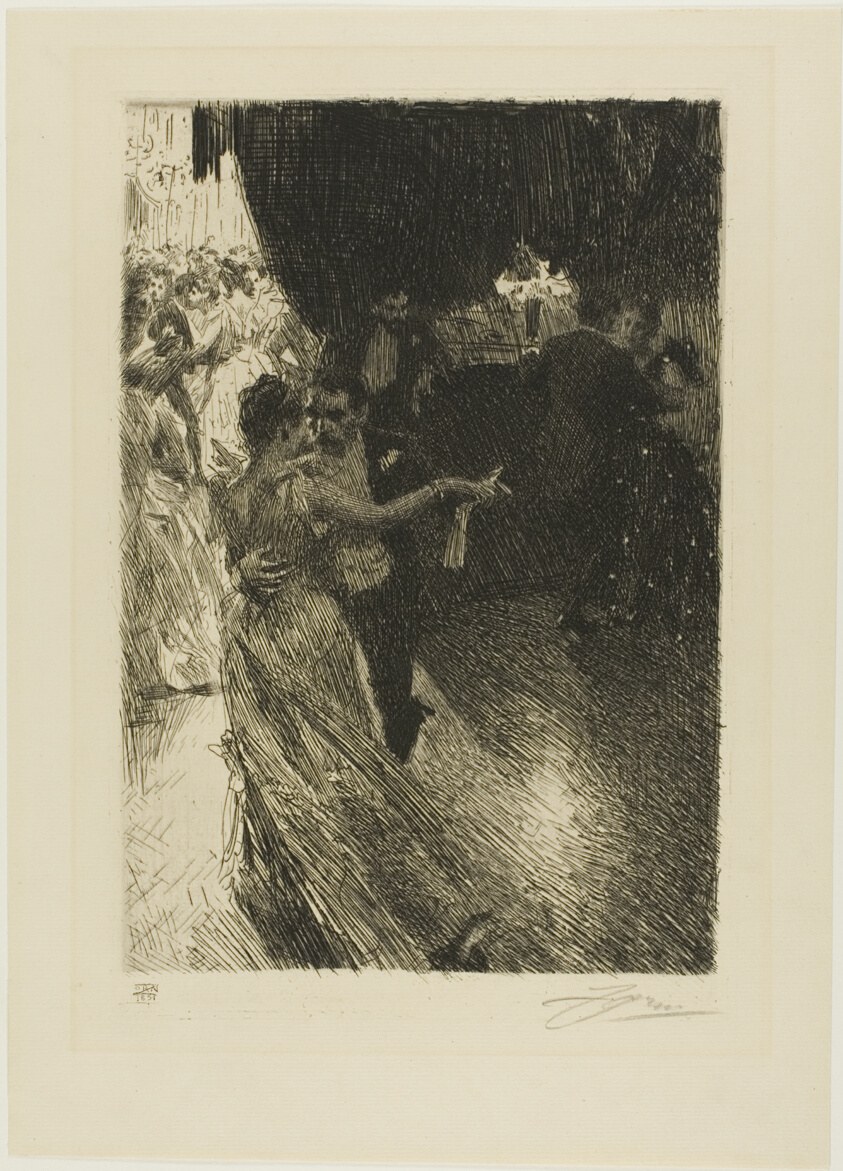
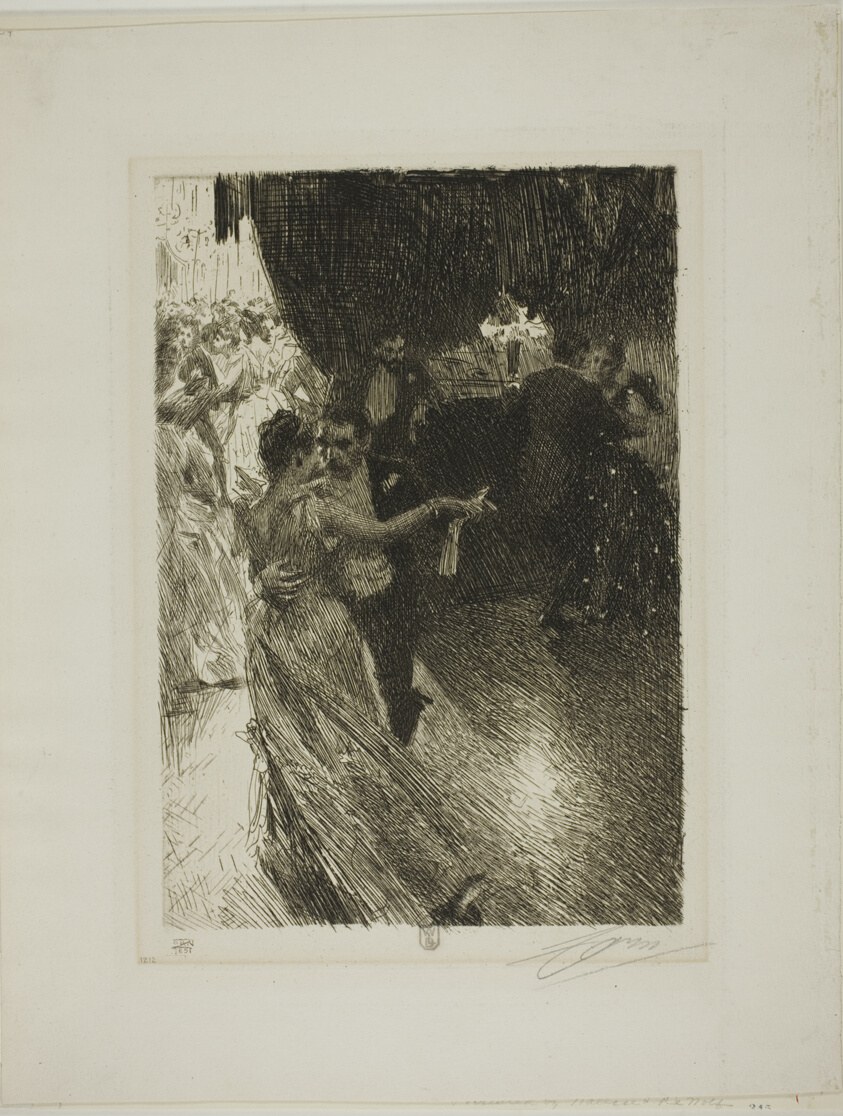
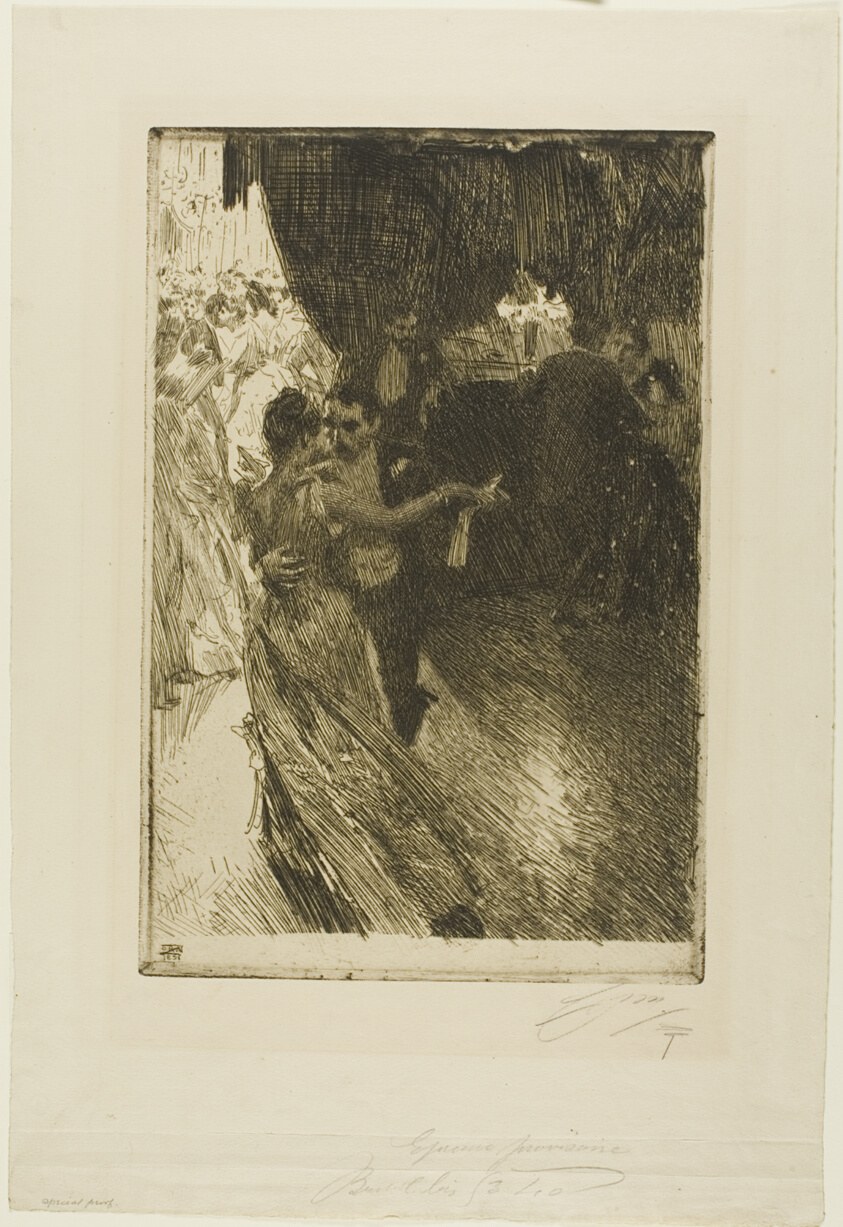
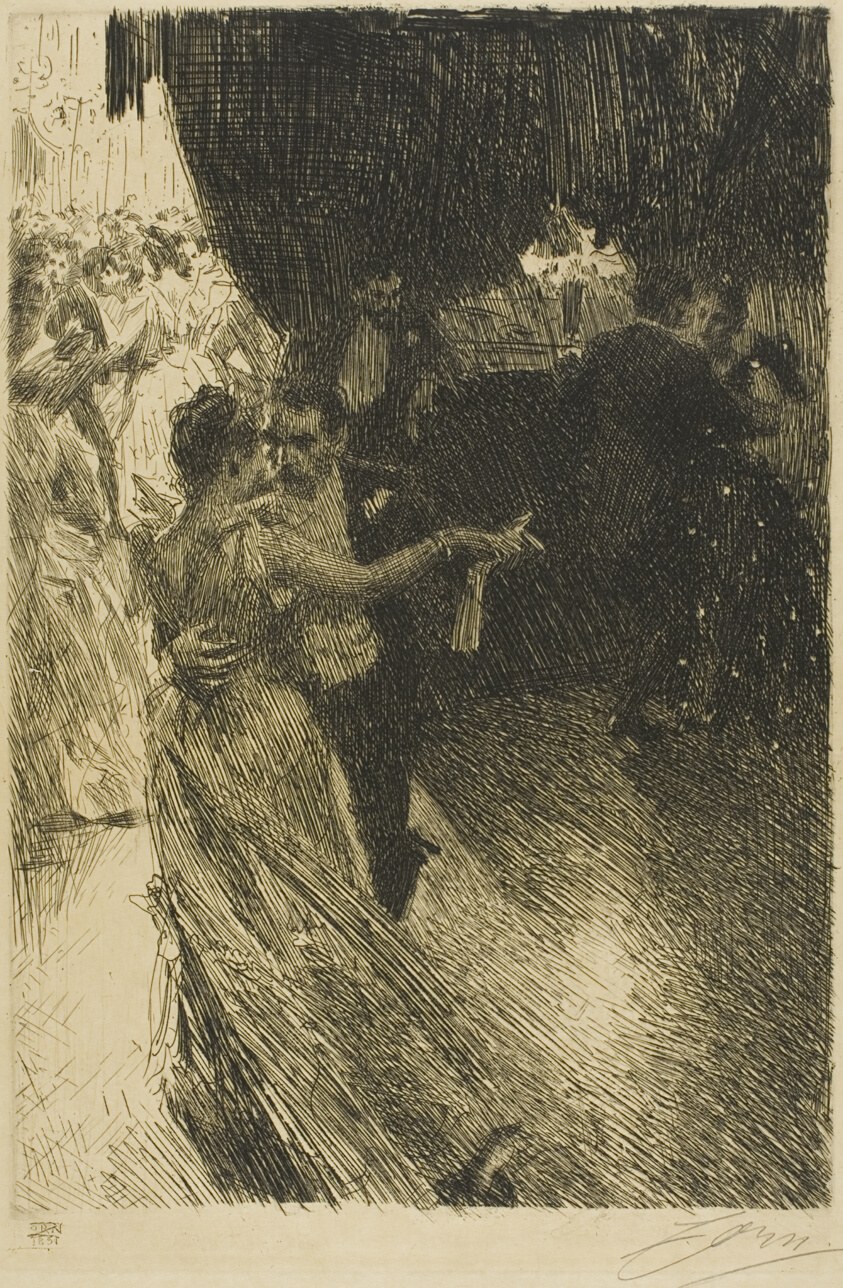
A lithograph frontispiece depicts a woman in Romantic-era theatrical costume positioned center-stage in a dramatic pose. She wears a white corseted bodice with a voluminous skirt in cream and deep red, the skirt caught mid-movement to show the silhouette. Her dark hair is crowned with a small ornament, and she holds a tambourine aloft in her right hand, arm extended upward. The figure stands en relevé on her left leg in a pose of arrested motion. Behind her, rendered in lighter tones, are shadowy figures in 19th-century dress—male and female spectators or other dancers—and architectural details suggesting a theater interior with an arched ceiling. The composition uses the lithographic technique to create soft gradations of tone, with the central figure rendered in more detail and warmer colors while the background remains atmospheric and sketchy. The overall effect is one of theatrical spectacle and the caught moment of performance.
The dancing
The central dancer stands in a graceful, asymmetrical pose with one leg supporting her full weight while the other extends or lifts slightly. Her torso twists gently, her left arm raised overhead with the tambourine, creating an open, celebratory frame. The pose suggests upward momentum and lightness—a quality associated with Romantic ballet technique, though the costume and prop (tambourine) point toward a character dance or national dance interpretation rather than classical ballet proper. The secondary figures, barely sketched in the background, are diminished in scale and definition, making them supporting presences to the soloist's moment.
The dance depicted
This depicts a Spanish or Iberian character dance—most likely a tarantella, bolero, or fandango variant—as performed in the Romantic ballet. The evidence lies in the tambourine, the Spanish-inflected costume with its deep-red and cream colors, and the title's reference to *Esmeralda*, a character from Victor Hugo's *Notre-Dame de Paris* (1831), which inspired multiple ballet productions in the 1830s–1840s. The figure is captured in a moment of vivacious, turned-out movement typical of Romantic-era character dances incorporated into full-length ballet narratives. The pose and proportions suggest a performance for a seated audience rather than social partner dancing—this is a theatrical interpretation of a folk or national dance tradition, not the thing itself.
How it was made
This is a hand-colored lithograph, a process that allowed for rapid, economical reproduction of theatrical imagery for commercial circulation among ballet enthusiasts and theatergoers. The lithographic technique permitted the softer tonal gradations and the luminous quality visible here, particularly in the treatment of fabric and the atmospheric background. The hand-coloring of the costumes—the precise coral-red and cream of the skirt—indicates this was aimed at a market willing to pay for artisanal finishing work; such colored lithographs were produced in runs of hundreds rather than thousands, making them relatively accessible to the middle-class audience for Romantic ballet. The notation at the base indicates publication in Boston, suggesting American circulation of European theatrical imagery.
About this work
This is a colored lithograph announcing a series of waltzes derived from the music of the ballet *Esmeralda*, one of the canonical Romantic ballets of the 1830s–1840s. It serves as the frontispiece to the published music, using the theater's imagery to market the work to piano players and domestic dancers. The figure—a soloist in Romantic theatrical dress, posed in a moment of vivacious character dancing—captures the visual vocabulary of early 19th-century Romantic ballet, in which classical technique was applied to nationally and culturally marked styles of movement.
The work belongs in a dance gallery because it documents the intersection of three practices: the theatrical ballet (in its subject and aesthetic), the social dance (the waltzes in the music publication), and the commercial circulation of both through prints and publications. It shows how Romantic ballet imagery penetrated domestic musical life and how theatrical dancing was commodified and democratized through mechanical reproduction.
How to look at it
Note the pose: the dancer is balanced on one leg with the other subtly extended, her torso open and her arm raised. This is not a passive moment but one of arrested motion—the lithographer has chosen the instant of maximum grace and elevation, not the beginning or end of a movement. The tambourine aloft and the Spanish-inflected costume signal that this is not classical ballet but a *character* dance within a ballet narrative—a distinction that was crucial to how Romantic audiences understood and valued different kinds of movement. The background figures, barely sketched, emphasize that this is a solo moment of display; the secondary dancers exist only to frame the principal.
The artist
The artist is not recorded. The work was published in Boston by W. H. James and Co. and E. H. Wade, indicating it was produced for or imported into the American market. The style and execution suggest a workshop production rather than a named artist's signature work—typical of mid-19th-century theatrical lithography, where designs were often adapted from European sources and executed by commercial printing houses.
The period
The *Esmeralda* ballet premiered in Paris in 1836 (choreography by Jules Perrot, music by Adolphe Adam) and became one of the most widely performed Romantic ballets of its era. The 1830s–1840s were the height of Romantic ballet's cultural dominance, characterized by the prominence of the female dancer, ethereal movements in pointe work, and the incorporation of character dances from Spanish, Italian, and Eastern European traditions. The music of Romantic ballets was rapidly published and adapted for domestic consumption—including arrangements for piano, guitar, and voice—making the ballet house an important source of commercial music for the drawing room. This lithograph is part of that larger ecosystem of adaptation and circulation.
Where it lives
The work is held in the New York Public Library. It is a commercial theatrical print, one of many such lithographs published in the early-to-mid 19th century to advertise and extend the reach of successful ballets through music publications and popular prints.
Dance in this work
Questions about this work
What is Esmeralda?
*Esmeralda* is a ballet first choreographed by Jules Perrot in Paris in 1836, based on Victor Hugo's novel *Notre-Dame de Paris* (1831). It became one of the most popular and frequently performed ballets of the Romantic era. The title character is a young Romani woman, and the ballet includes character dances in keeping with Romantic ballet's interest in exoticized national and cultural styles.
Who would have used this image?
Theatergoers and music lovers in Boston and other American cities in the 1830s–1840s. This was a frontispiece to a published collection of waltzes based on the ballet's music—meant to entice buyers of sheet music for piano performance. The image advertised both the ballet itself (for those who might attend a performance) and the music (for amateur musicians).
Is this a ballerina?
Yes, but performing as a character dancer rather than in classical ballet proper. The pose and costume indicate she is dancing a Spanish or Iberian style dance—a tarantella or fandango-derived piece—as part of the larger ballet narrative. Romantic ballet frequently included such character dances, which were performed by trained ballet dancers using turned-out positions and some pointed work, but with costumes and movements that referenced folk or national traditions.
How was this made and reproduced?
This is a colored lithograph—a print made by drawing on a stone with a greasy crayon, then using a chemical process to transfer the image to paper. Hand-coloring was then applied by hand. This allowed the image to be reproduced in runs of hundreds, making it much cheaper than an oil painting but more labor-intensive than a simple engraving. Such prints were a major form of commercial art in the 19th century.
More Waltz artwork