48 works in this view — arrow keys or swipe to move between them.
Dance in Art
Programme des Ballet Russes
Unknown artist
- Medium:
- Dance:
- Ballet
- Source:
- New York Public Library
- Rights:
- Public domain — free to use, share and adapt.
- Recorded as:
- public_domain
Parade was a landmark work that expanded the possibilities of theatrical dance beyond narrative and virtuosity into collage, spectacle, and deliberate artifice. This costume is not merely decorative—it is an actor in the drama, and understanding how the Ballets Russes deployed visual language and borrowed from non-European traditions is essential to understanding modernist dance. For historians, it is direct evidence of how orientalism and exoticism functioned in avant-garde theater; for dancers and designers, it illustrates how a single costume can define a character and establish a theatrical world.
What you are looking at
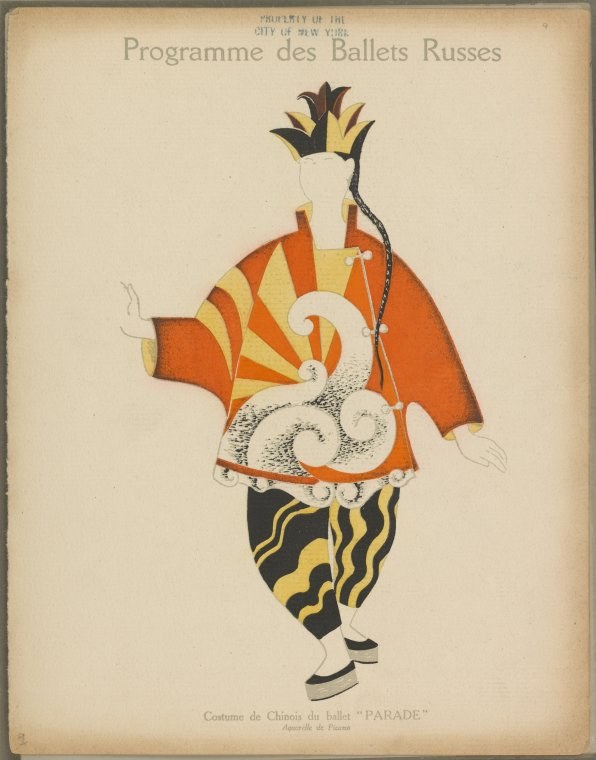
A single figure in theatrical costume stands in a dynamic pose against a plain cream background. The dancer wears a striking orange-red robe or tunic with bold yellow and orange striped geometric patterns radiating from a central spiral motif rendered in white with delicate dotted shading. A matching patterned shawl or cape drapes from the shoulders, and the lower body is dressed in black leggings with yellow wavy horizontal stripes. On the head sits an elaborate crown or headdress composed of stylized black and gold leaf or petal forms. The figure's posture is upright and frontal, with one arm raised and extended, the other at the side, in a pose of controlled theatricality. The costume is entirely symmetrical and highly stylized, suggesting a character from a non-Western theatrical tradition rather than classical European ballet.
The dancing
A single standing figure occupies the center of the composition. The dancer's weight appears evenly distributed, the body held in an upright, formal stance characteristic of court or ceremonial dance. One arm extends diagonally upward and outward from the body; the other hangs at the side. The pose is static and presentational rather than caught mid-movement, suggesting the figure is displaying or announcing itself rather than executing a traveling step. The costume is voluminous and geometric, making the actual line of the body difficult to assess, but the overall frame is vertical and controlled.
The dance depicted
This is a costume design for the Ballets Russes, as confirmed by the title and the notation 'Costume de Chinois du ballet "PARADE"' at the base. The figure represents a Chinese character from Parade, the 1917 avant-garde ballet created by Jean Cocteau with music by Erik Satie. The costume is clearly inspired by or references East Asian theatrical costume traditions, though filtered through early-twentieth-century European Modernism and Primitivism. This is not dance documentation but costume documentation—the image shows the character in a posed, hieratic stance suitable for a program illustration rather than capturing actual movement.
How it was made
This is a color print, likely produced using lithographic or chromolithographic techniques based on the style and quality of color registration visible. The palette is limited to orange-red, yellow, black, cream, and skin tone, and the application is relatively flat and graphic with selective use of dotted shading for texture. The printing technique allowed for mass production of program covers and promotional materials, making this an object of circulation within the Ballets Russes' promotional apparatus and its audience. The graphic, somewhat poster-like quality suggests this was prepared for wide reproduction rather than as a unique work.
About this work
This is a costume design illustration from the Ballets Russes, the legendary Russian ballet company that revolutionized European dance and theatrical design in the early twentieth century. The work documents the Chinese Manager costume from Parade, a 1917 Cocteau-Satie collaboration that scandalized and captivated Parisian audiences. Though not a record of movement itself, it is essential to understanding how the Ballets Russes mobilized visual spectacle, cross-cultural reference, and avant-garde design as a language parallel to dance. The costume design is a complete theatrical statement—the geometric patterning, bold color, and hieratic pose communicate character and world as fully as choreography would.
This image belongs in a gallery of dance art because the Ballets Russes understood costume, set, and movement as a unified syntax. A dancer wearing this costume in this pose, in the context of Parade's complex scenario (with its acrobats, managers, and intermingling of circus and classical idioms), carried meaning through costume alone. The image is a primary source for how early-twentieth-century modernism and non-Western visual traditions were absorbed, transformed, and deployed on the European stage.
How to look at it
Look first at the costume as a complete design: the way the geometric spiral and striped patterns create movement and depth on a flat surface, the interplay of orange and yellow against black, the way the headdress completes and crowns the total silhouette. Then observe the pose itself—hieratic, frontal, and deliberately artificial, as if the character is a puppet or icon rather than a naturalistic human figure. This is not a dancer mid-movement but a costume on display, and that choice itself is significant. Notice how the design communicates 'Chineseness' through pattern and silhouette rather than through ethnographic accuracy—this is a theatrical invention, a costume that announces itself as costume. The printed medium, the clean registration of color, and the formal presentation all signal this as a document of design intention rather than performance.
The period
Parade premiered in May 1917 in Paris, during the First World War and amid a ferment of artistic experiment. The Ballets Russes under Sergei Diaghilev had already transformed European dance through collaborations with visual artists—Picasso, Matisse, and others—who treated the stage as a canvas. Parade was explicitly modernist and anti-decorative; Cocteau's scenario mixed classical ballet idioms with circus turns, commedia dell'arte, and music-hall variety. The Chinese Manager was one of several exotic or artificial characters designed to break the illusion of classical ballet and assert the primacy of theatrical construction over naturalism. In the context of wartime Europe, this internationalism and formal experiment carried both artistic and political weight.
The costume design reflects the period's enthusiasm for non-Western aesthetics filtered through European Modernism—geometric abstraction applied to imagined 'Oriental' dress. This was Primitivism in service of formal innovation: the simplified forms, bold patterns, and flattened perspective borrowed from non-European art were being repurposed as tools for breaking with nineteenth-century realism. The program cover itself, as a distributed image, was part of the Ballets Russes' marketing and cultural authority, reaching audiences beyond the theater.
Where it lives
This is a print from the New York Public Library collections, held as part of the Library's extensive Ballets Russes archive. It is a program cover or promotional material distributed in New York, where the Ballets Russes toured extensively and exerted enormous influence on American theatrical culture.
Dance in this work
Questions about this work
Is this a painting or a print?
This is a color print, most likely produced by lithography or chromolithography, a process that allowed multiple copies to be made. It was designed as a program cover or promotional material for wide circulation, not as a unique artwork.
What is Parade?
Parade is a 1917 ballet by Jean Cocteau (text), Erik Satie (music), and Pablo Picasso (sets and costumes), premiered by the Ballets Russes in Paris. It was a deliberately avant-garde and artificial work that mixed classical ballet with circus, acrobatics, and music-hall idioms, and it scandalized conservative audiences. This costume is from that landmark production.
Who designed this costume?
The costume is attributed to the Ballets Russes production of Parade, which involved multiple artists. Pablo Picasso is credited as the principal designer for the production, though specific costume attributions are not always documented.
Why is the costume so geometric and abstract?
This reflects the modernist and avant-garde approach of the Ballets Russes and their collaborators, particularly Picasso. The simplified forms, bold geometric patterns, and flattened perspective were influenced by non-Western and folk art traditions, but deployed as tools for formal innovation and theatrical artifice rather than ethnographic accuracy.
More Ballet artwork