49 works in this view — arrow keys or swipe to move between them.
Dance in Art · 2023
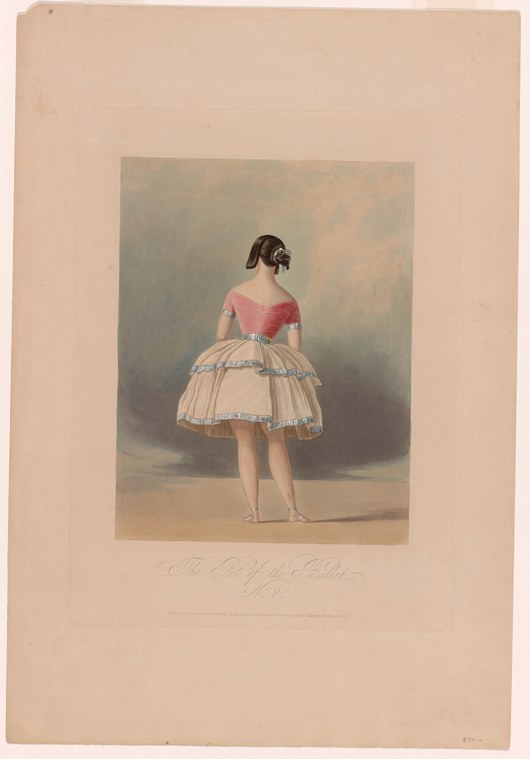
The Pet of the Ballet
Unknown artist
- Medium:
- Dance:
- Ballet
- Source:
- New York Public Library
- Rights:
- Public domain — free to use, share and adapt.
- Recorded as:
- public_domain
This object documents the visual culture of Romantic ballet and the way dancers were circulated and consumed as celebrity images. It shows the standardized costume, posture, and presentation that defined the ballet dancer as a social and aesthetic icon. For dance historians, it is evidence of how the ballet dancer's body and costume were commodified and distributed through print media—a practice that shaped the dancer's public image as much as performance itself did.
What you are looking at
A young female dancer stands alone against a muted gray-green backdrop, viewed from behind and slightly to the left. She wears a coral-pink off-shoulder bodice and a voluminous white tulle skirt supported by a framework of crinoline or hoops, the skirt lifted to reveal her legs and pointe shoes. The fabric is rendered with meticulous attention to the play of light and shadow across the pleats and layers. Her dark hair is styled close to her head in the fashion of the mid-19th century. She stands in a relaxed pose, weight on one leg, facing away from the viewer—a moment of repose or informal display rather than active performance. A pale wooden floor suggests a stage or studio setting. The composition is that of a portrait print, centered on the page with generous cream-colored margin.
The dancing
The dancer stands in profile to the viewer, weight resting on her back leg, her body upright but not rigidly posed. Her arms hang naturally at her sides. She wears pink satin pointe shoes, though her feet are not in any active position—this is not a moment of turnout or extension. Her posture is one of ease, the kind a dancer might adopt offstage or between performances. The stillness and isolation of the figure—alone, unpartnered, in a moment of display rather than action—suggests a portrait meant to show the costume and the dancer's form rather than capture movement.
The dance depicted
This is a theatrical ballet dancer of the Romantic era, identifiable by the pointe shoes, the tulle skirt (a hallmark of the 1840s–1860s aesthetic), and the off-shoulder neckline characteristic of Romantic ballet costume. The title 'The Pet of the Ballet' suggests she is a celebrated dancer, possibly a prima ballerina, whose likeness and costume were worth circulating in print. The pose and presentation—the turned-away gaze, the lifted skirt, the stillness—follow the conventions of ballet portraiture of the period, which presented dancers as objects of aesthetic admiration rather than as performers in motion. This is not a moment captured mid-performance but a formal, composed display of the dancer and her costume.
How it was made
This is a hand-colored print, most likely a lithograph or an aquatint engraving based on the soft tonal modeling and the precision of line work visible in the background and the tulle rendering. The artist has used color selectively—the pink bodice and coral tones of the shoes stand out against the monochromatic palette—a technique common in reproductive prints of the mid-19th century. The fine gradations of tone in the skirt and the careful attention to fabric texture suggest a skilled printmaker working from a drawing or painting. Such prints were commercially produced and distributed, affordable to a middle-class audience who consumed images of celebrated dancers as souvenirs and fashion references.
About this work
This is a portrait print of a Romantic-era ballet dancer, presented in the formal, isolated manner typical of theatrical celebrity imagery of the 1840s–1860s. The figure is shown in costume—the defining silhouette of Romantic ballet, with pointe shoes and a voluminous tulle skirt—but in a moment of repose rather than in performance. The work belongs to a large body of dance imagery produced for commercial circulation in this period, when the ballet was at the height of its cultural prestige and dancers were among the most famous entertainers of the age. The print preserves not only the costume and form of the dancer but also the aesthetic and conventions by which she was viewed and valued: as a vision of ethereal, feminine beauty, posed for the gaze of an absent audience.
How to look at it
Notice the artist's choice to show the dancer from behind and in profile, rather than facing forward. This pose protects a certain modesty while still displaying the body and costume to full effect—a tension between exposure and reserve that is characteristic of Romantic-era dance imagery. Observe the meticulous rendering of the tulle: the countless pleats, the transparency, the way light catches the fabric. This technical skill was a selling point of the print itself, proof that the artist had captured the texture and beauty of the costume accurately. The vacant background draws all attention to the figure; there is no narrative, no context, no partner—only the dancer and her costume, suspended in a timeless moment.
The period
This work dates to the 1840s–1860s, the height of Romantic ballet, when works like *La Sylphide* (1832) and *Giselle* (1841) had established ballet as a prestigious theatrical form. The tulle skirt shown here—often called the 'Romantic tutu'—became the defining silhouette of the era, distinct from the shorter skirts of the Classical period that followed. During this time, celebrated ballerinas such as Marie Taglioni, Fanny Elssler, and later Carlotta Grisi became international celebrities, and their likenesses were widely reproduced in prints, lithographs, and engravings for a public hungry for images of them. These prints were sold in theaters, at print shops, and through commercial publishers, making the dancer's image a commodity as important as her stage presence. The off-shoulder neckline and lifted skirt shown here conform to the conventions of how female dancers were presented in visual media—emphasizing the line of the neck and shoulders, and displaying the legs as an object of aesthetic interest.
Where it lives
This print is held by the New York Public Library, which suggests it is part of a collection of theatrical imagery or performing-arts history. The library holds extensive collections of 19th-century dance prints and playbills, which were systematically collected as records of theatrical history.
Dance in this work
Questions about this work
Why is she shown from behind?
This pose was a standard convention of dance portraiture in the mid-19th century. It allowed the artist to display the full silhouette of the tulle skirt, the line of the back and shoulders, and the pointe shoes, while also creating a sense of the dancer as an object of contemplation viewed from the audience's vantage point. The turned-away gaze adds an element of mystery and restraint to an otherwise exposing pose.
What does 'the pet of the ballet' mean?
This title suggests that the dancer depicted was a celebrated, beloved performer—a star—whose image and costume were popular enough to warrant reproduction and sale as a print. The term 'pet' reflects the era's language of celebrity and the affection audiences felt for their favorite dancers.
Why is the skirt lifted?
Lifting the skirt was a conventional way to display both the dancer's legs (an important element of ballet beauty and technique) and the construction of the tulle skirt itself—to show the crinoline hoops and the multiple layers of fabric. It was also practical for showing the pointe shoes, which were an expensive and prestigious element of the costume.
Is this a record of an actual performance?
No. This is a portrait print made for commercial sale, not a documentation of a specific moment onstage. It is a formal, composed image that presents the dancer's costume and form according to the aesthetic conventions of the time. The dancer's relaxed posture and the studio-like setting suggest it was made from a drawing or painting, not from a performance.
More Ballet artwork