27 works in this view — arrow keys or swipe to move between them.
Dance in Art
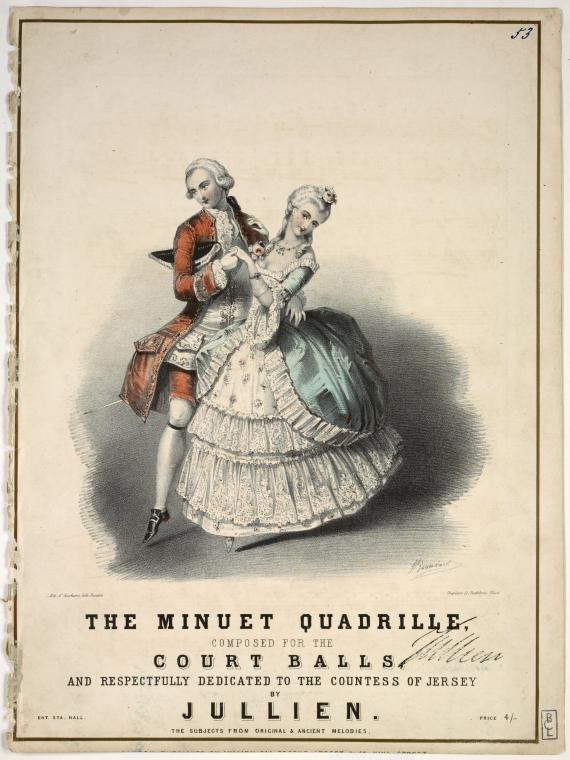
The minuet quadrille, composed for the court balls and respectfully dedicated to the Countess of Jer
Unknown artist
- Medium:
- Engraving
- Dance:
- Quadrille
- Era:
- 1700s (Enlightenment/Minuet Era)
- Source:
- New York Public Library
- Rights:
- Public domain — free to use, share and adapt.
- Recorded as:
- public_domain
For dance historians, this image is a rare window into the visual language of late 18th-century English court dance: how bodies were held, how partnership was displayed, and how elegance was performed and marketed. The minuet quadrille is now rarely danced, and this print preserves not just the title but the aesthetic ideal—the precise posture, the formality, the union of fashion and movement—that shaped how dancers of the period understood their own art.
What you are looking at
An engraved sheet music cover depicts a fashionably dressed couple in mid-performance. The man, positioned behind and to the left, wears a rust-red velvet coat with white lace cuffs and stockings, his hair styled in the period fashion with a queue. The woman, in the foreground, wears an elaborate white gown with deeply flounced skirts and decorative trim at the hem; her hair is styled high and ornamented. The two figures are shown in close proximity in what appears to be a formal interior setting, with subtle shading creating depth. The composition is intimate and theatrical—the engraver has caught a moment of physical proximity and elegance characteristic of court dance display. The title and dedication appear prominently below in large letterpress type.
The dancing
The couple stands in a close, face-to-face relationship typical of partner dances of the period. The man's right arm appears to extend toward or support the woman, while her body leans slightly toward him; both are upright and composed in the formal posture expected of court dancers. The woman's weight is carried on both feet, her frame open and receptive to her partner. The man's stance suggests controlled weight and readiness to lead. Neither figure is captured mid-leap or in dramatic extension; instead, the artist has chosen a moment of stasis and connection that emphasizes partnership and courtship.
The dance depicted
The title explicitly identifies this as a minuet quadrille, a hybrid form that combined elements of the minuet (a slow, graceful baroque dance) with the quadrille (a group formation dance in four-part structure). This print documents the English court dance tradition of the late 18th or early 19th century. The minuet quadrille was a vehicle for couples to display elegance and social standing in formal ballrooms, and the dedication to the Countess of Jersey suggests this was composed for fashionable court circles. The image captures the idealized visual presentation of such a dance—refinement, symmetry, and the carefully managed display of the body in partnership.
How it was made
This is a hand-colored engraving on paper, a reproductive technique well-suited to wide distribution as a published sheet-music cover. Engraving allowed fine detail in rendering fabric, lace, and facial features, and the artist has used careful hatching and cross-hatching to suggest volume and light, particularly in the modeling of the faces and the fall of drapery. The addition of hand-applied color—the woman's flesh tones, the man's rust coat, the delicate shading of the woman's skirt—indicates this was a luxury edition. As a cover for a musical composition, the work served dual purposes: it advertised the piece for purchase or performance and provided visual instruction to dancers on how to dress and present themselves when dancing the minuet quadrille.
About this work
This is a hand-colored engraving used as a sheet-music cover for a country-dance composition of the late 18th century, depicting a couple in the formal dress and posture of English court dancing. The work is both a musical publication and a visual record of how fashionable dancers of the period understood elegance and partnership. The minuet quadrille occupied a unique place in the dance repertoire—refined and aristocratic, yet structured as a group formation—and this image preserves the visual ideals that governed its performance. The composition, the precision of the engraving, and the care taken in coloring all suggest this was intended for a educated, well-to-do audience familiar with court dance conventions.
How to look at it
Look first at the spacing between the bodies: they are close but not touching, maintaining the formal distance prescribed by dance etiquette of the period. Notice the alignment of the shoulders and the openness of the woman's posture—this is not a turn or a display of virtuosity, but a moment of connection and mutual regard. The detail in the drapery of the woman's skirt and the articulation of the man's coat should prompt questions about what these garments allowed or constrained in movement. Pay attention to the feet: both dancers stand in a secure, weight-bearing position, neither foot extended or pointed. This is courtship made visible through the conventions of dress and formal proximity.
The artist
The artist is not recorded. The engraving is credited to 'Jullien' in the title line, a name that appears on numerous dance-related prints and sheet-music covers of the period, but without further documentation it is not possible to identify the individual artist or workshop. The print was published as 'The Subjects from Original & Ancient Melodies,' a publishing line that suggests both historical and contemporary dances were being packaged for a commercial music market.
The period
The minuet quadrille emerged during a moment of transition in dance history. The minuet itself, a baroque court dance of great refinement, was becoming historical even as it remained fashionable; the quadrille, a newer formation dance imported from France, was gaining popularity in English ballrooms. This hybrid form allowed dancers to honor the aesthetic of the minuet while participating in the more social and varied pleasures of group quadrille dancing. In the visual arts, the late 18th century saw a flourishing trade in printed dance instruction, sheet-music covers, and choreographic diagrams—all aimed at the expanding middle and upper-middle classes who wished to acquire the refinements of aristocratic behavior. The hand-colored engraving was the standard medium for such commercial work, offering both reproducibility and the luxury of color.
Where it lives
This engraving is held in the New York Public Library collection. It is a commercial sheet-music cover, one of many such publications circulating in England during the late 18th and early 19th centuries, designed for purchase by amateur dancers and musicians.
Dance in this work
Questions about this work
What is a minuet quadrille?
A minuet quadrille is a fusion of two distinct dance traditions: the minuet, a slow, graceful baroque court dance, and the quadrille, a formation dance performed in groups of four couples arranged in a square. The minuet quadrille allowed dancers to incorporate the refined posture and elegance of minuet style into the more interactive structure of quadrille choreography, making it popular in English ballrooms of the late 18th century.
Who would have danced the minuet quadrille?
The minuet quadrille was danced by the aristocracy and gentry at formal court balls and assemblies. The dedication of this particular composition to the Countess of Jersey indicates it was composed for fashionable London circles. The publication and sale of the score and this illustrated cover suggest it was also danced by aspiring members of the middle classes who purchased instruction and sheet music.
Why does the man's coat have such bright color?
The rust-red or coral velvet coat was fashionable dress for gentlemen of the late 18th century. Rich colors in coats and waistcoats were a mark of status and fashion awareness. The hand-coloring applied to this engraving exaggerates and clarifies this detail, both to make the print more visually appealing and to serve as a costume guide for dancers learning the piece.
Is this a photograph or a drawing?
This is an engraving—a print made by incising a design into a metal plate and using that plate to transfer ink to paper. The fine lines and precise detail you see are characteristic of the engraving technique. The hand-applied color has been added after printing. Engravings were the most common way to reproduce and distribute images of dance, costume, and musical instruction before the invention of photography.
More Quadrille artwork