49 works in this view — arrow keys or swipe to move between them.
Dance in Art · 2023
The waltz
Unknown artist
- Medium:
- Lithograph
- Dance:
- Waltz
- Era:
- Early 1800s (Waltz Revolution)
- Source:
- New York Public Library
- Rights:
- Public domain — free to use, share and adapt.
- Recorded as:
- public_domain
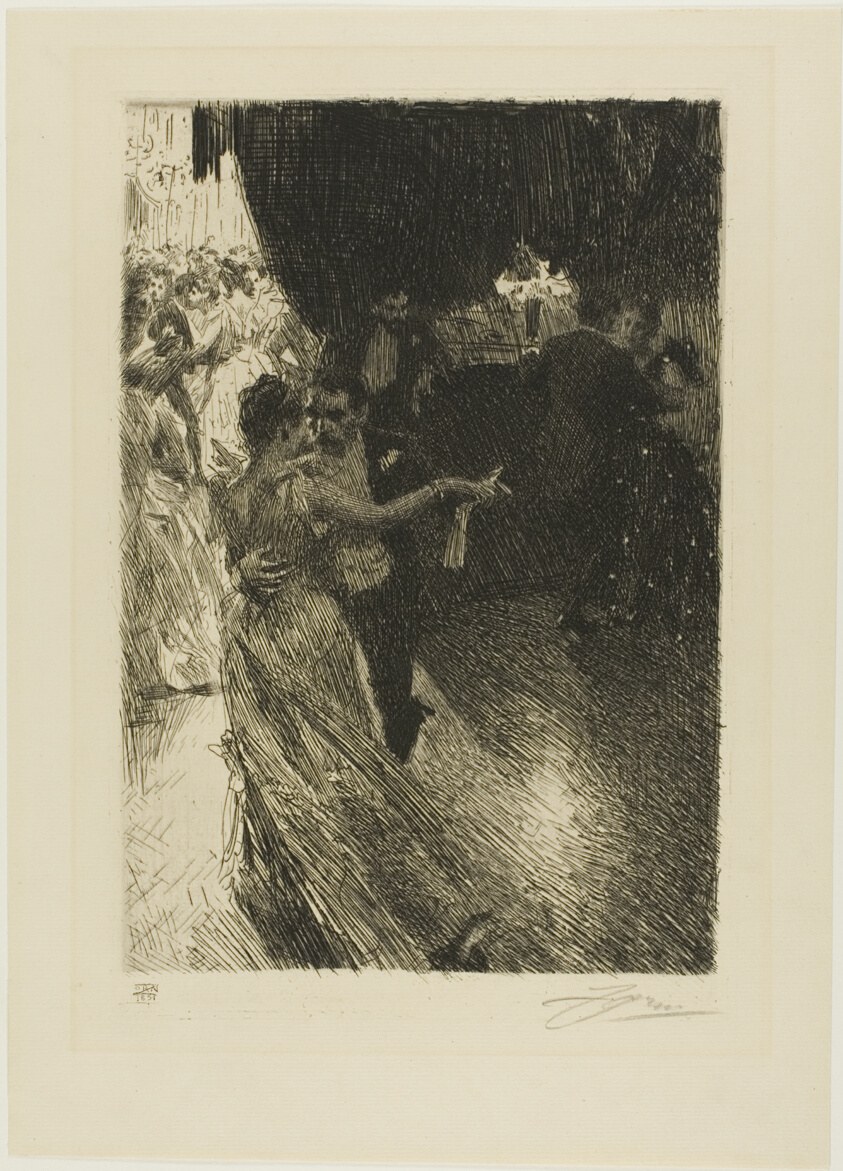
The waltz was revolutionary—a close-hold partner dance that challenged older group-dance norms and sparked moral debate about propriety. This print captures the moment when the waltz had entered elite society but was still novel enough to merit depiction as a fashionable novelty. For dancers and historians, it is material evidence of how the waltz was actually practiced and integrated into the ballroom social world.
What you are looking at
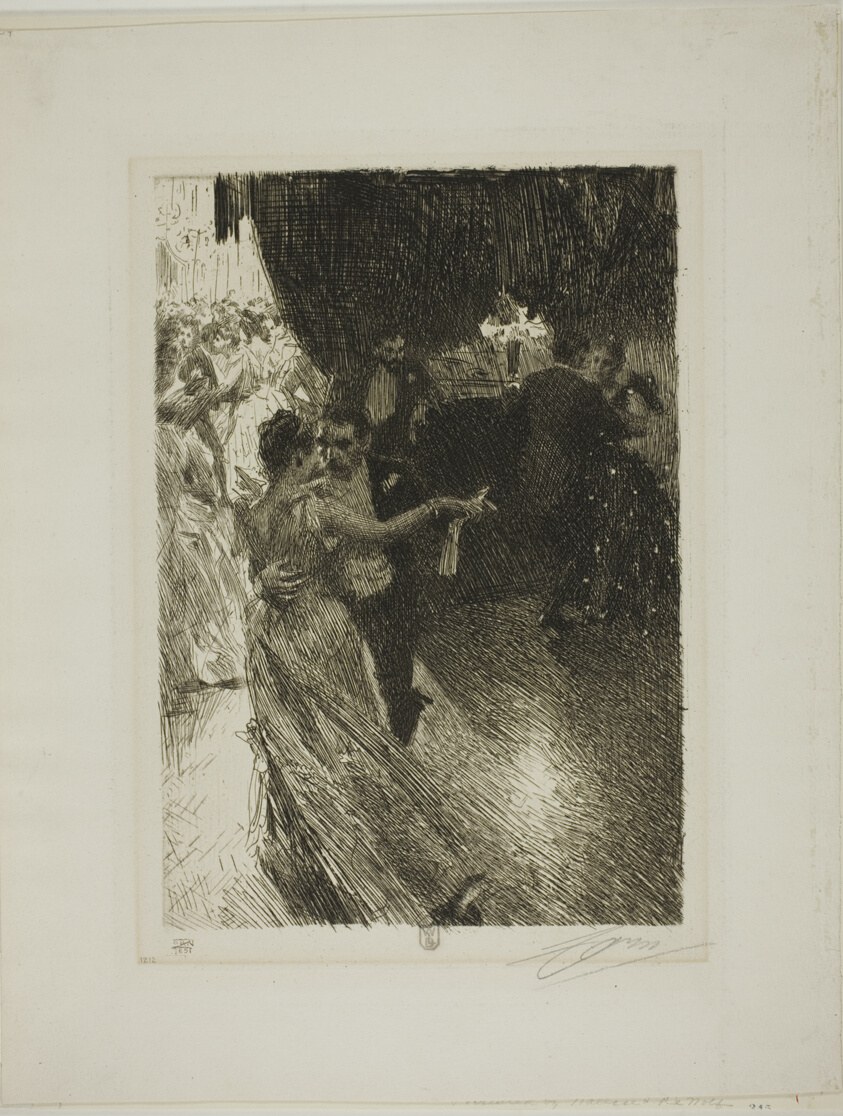
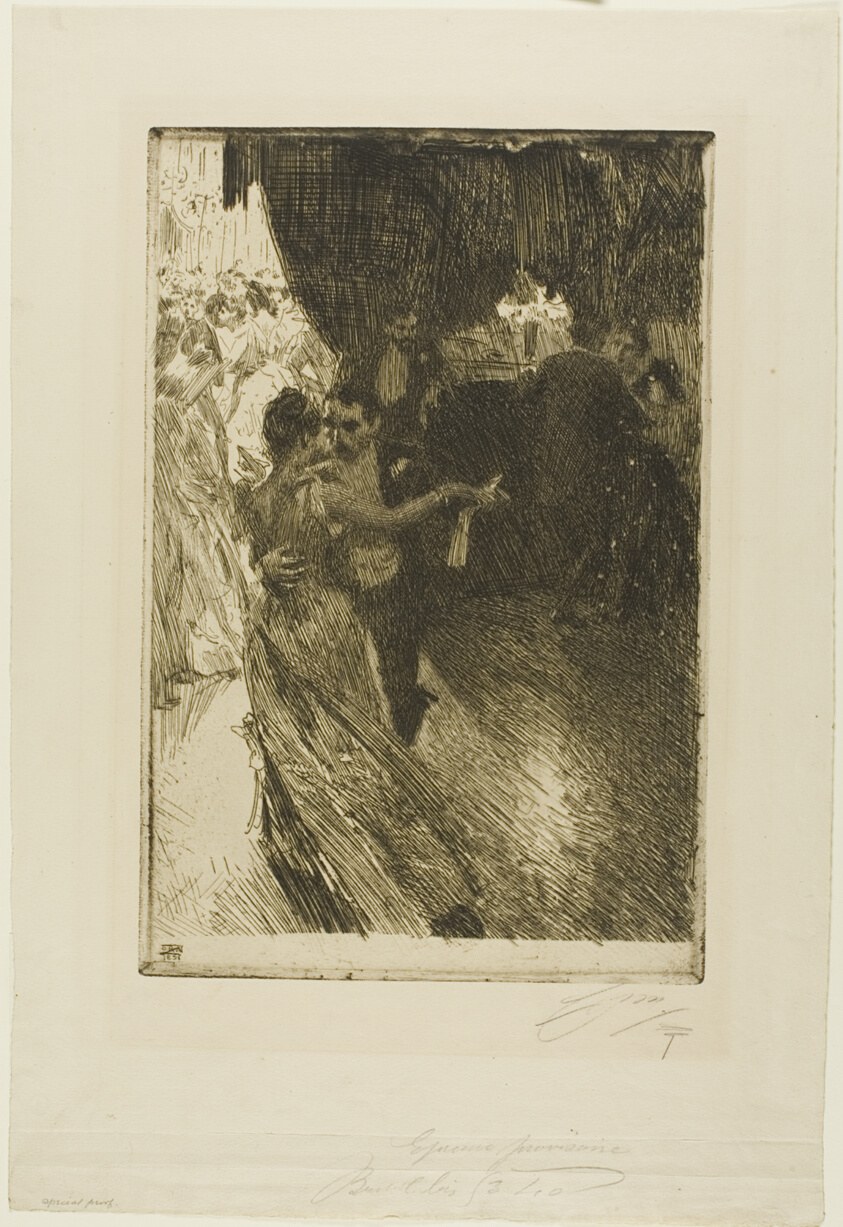
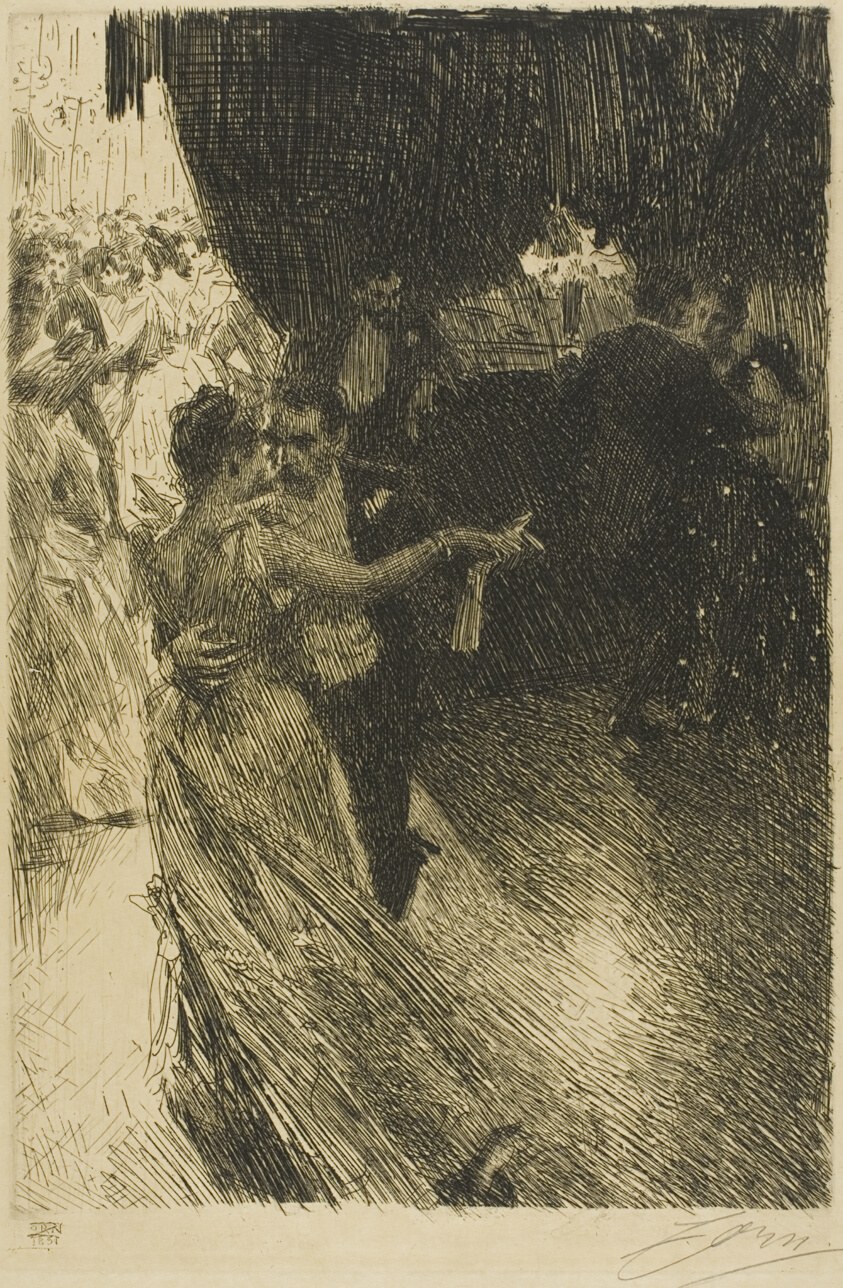
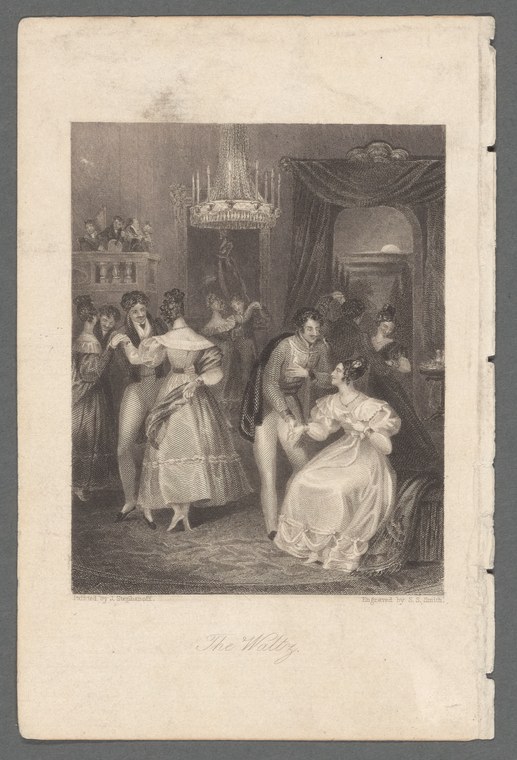
A lithographed scene of a fashionable interior dance, likely from the early 19th century. The composition shows a ballroom or drawing room with elaborate drapery and a hanging chandelier. Multiple figures in white muslin gowns populate the space; women dominate the foreground, several in conversation or observation, while couples engage in dancing toward the rear. The lighting is soft and diffused, typical of lithographic technique, with deeper shadows defining the architectural elements and creating atmospheric depth. The dress—high-waisted Empire silhouettes, bare arms, minimal ornament—and the informal but refined setting suggest an upper-class social gathering where dance is one activity among courtship, conversation, and display.
The dancing
The nearest woman stands in profile with relaxed posture, watching the dancers; others cluster in conversational groups. In the middle distance, at least two couples are visible dancing, their bodies oriented vertically in the space. The dancers appear to be in a closed or semi-closed position typical of early 19th-century ballroom practice, with upright carriage and the woman's skirt visible in motion. The lithographic medium flattens perspective and softens detail, so specific footwork or hand positions cannot be discerned, but the overall frame—torso-centered, formal alignment—is consistent with structured partner dance of the Regency or early Waltz Revolution era.
The dance depicted
The image depicts the waltz or a closely related couple dance from the early 1800s, a period when such dances were becoming fashionable in European salons and ballrooms. The setting, dress, and composition all align with the documented social context of the Waltz Revolution, when the waltz and cotillion dominated elite dancing in Britain and continental Europe. The women's high-waisted gowns and the bare-armed, corseted silhouette date to c. 1800–1820. The presence of both dancing and non-dancing figures in a single room—the 'ball-room' format—reflects how early waltzes were integrated into longer social evenings. The lithographic record preserves a moment of this cultural moment without naming the specific choreography or music.
How it was made
This is a lithograph, a planographic printing process in which an image is drawn on stone and transferred to paper via ink. The medium allows for soft tonal gradations and a more painterly quality than engraving or etching, evident here in the atmospheric rendering of the room and the delicate modeling of fabric and light. Lithography was well suited to popular reproduction and could reach a broad middle-class audience affordably; such prints were collected and displayed in domestic settings and sometimes bound into gift books or periodicals. The technique's relative ease made it ideal for recording fashionable subjects—ballroom scenes, social types, theatrical moments—of immediate cultural interest.
About this work
This early 19th-century lithograph documents the social practice of the waltz during the period when it was newly fashionable and still somewhat controversial among European elites. It captures not the dance in isolation but the broader ballroom context—a space of courtship, conversation, and hierarchical social performance in which dance played a key role. The print is a record of how dance was embedded in elite domesticity and sociability at the moment when partner dances, including the waltz, were reshaping the ballroom.
For historians of dance and fashion, the work is valuable as visual evidence of period costume, interior design, and the social composition of early 19th-century ballrooms. It shows the waltz and similar dances not as spectacle but as part of an evening's social choreography.
How to look at it
Observe the composition of the room: the chandelier and drapery establish an interior of some formality, but the dispersal of figures—some dancing, some standing, some in conversation—shows this is a social gathering, not a formal performance. Notice the women's dress: the high waistline, muslin fabric, and bare arms are precise markers of the 1800–1820 period. Look at the relationship between the dancing and non-dancing figures; the waltz was danced in pairs within a social space dominated by observation and courtship, not in isolation. The lithographic softness of the image—the lack of sharp detail—is characteristic of how popular prints rendered fashionable life as accessible, intimate, and somewhat dreamlike.
The period
The early 1800s saw the rapid ascendancy of the waltz in European ballrooms, particularly after the Congress of Vienna (1814–1815), when the dance became a symbol of cosmopolitan taste and modernity. In Britain, the Regency period (1811–1820) coincided with the height of ballroom culture, and prints depicting fashionable dancing were popular commodities. Lithography, perfected in the 1790s, became the ideal medium for distributing images of fashionable life to middle-class audiences. This print sits at the intersection of several trends: the social consolidation of the waltz, the rise of lithographic mass media, and the documentation of Regency-era elite life as a subject of popular visual culture.
Where it lives
This lithograph is held in the New York Public Library collection. The object type—a popular print intended for domestic circulation or periodical reproduction—and its subject matter suggest it was a commercial product aimed at documenting fashionable society and ballroom culture for educated readers interested in social manners and the visual codes of the ballroom.
Dance in this work
Questions about this work
When did the waltz become fashionable in ballrooms?
The waltz rose to prominence in European elite circles in the late 1700s and was fully consolidated by the 1810s–1820s. It was associated with Vienna and became a symbol of modern, cosmopolitan taste after the Napoleonic Wars. This print dates to that moment of adoption and popularity.
Why does the image show people not dancing?
The ballroom was a social space where dancing was one of many activities. Observers and participants in conversation were integral to the evening. The waltz was performed in pairs and watched by others, and women especially were expected to manage a complex social choreography of dancing, sitting, and conversing.
How do you identify the dance as a waltz?
The date (early 1800s), the formal closed-hold position of the couples, the ballroom setting, and the title all point to the waltz or a closely related dance of that period. The lithograph does not preserve enough detail to distinguish the waltz from a cotillion or other couple dances of the era, but the period and context are conclusive.
What does the dress tell us about the dancers?
The high-waisted Empire gowns, muslin, and minimal ornament indicate women of the upper middle or upper classes in Britain or continental Europe c. 1800–1820. The formal but not ceremonial setting suggests a private ball rather than a public assembly room, indicating substantial wealth and social standing.
More Waltz artwork