30 works in this view — arrow keys or swipe to move between them.
Dance in Art
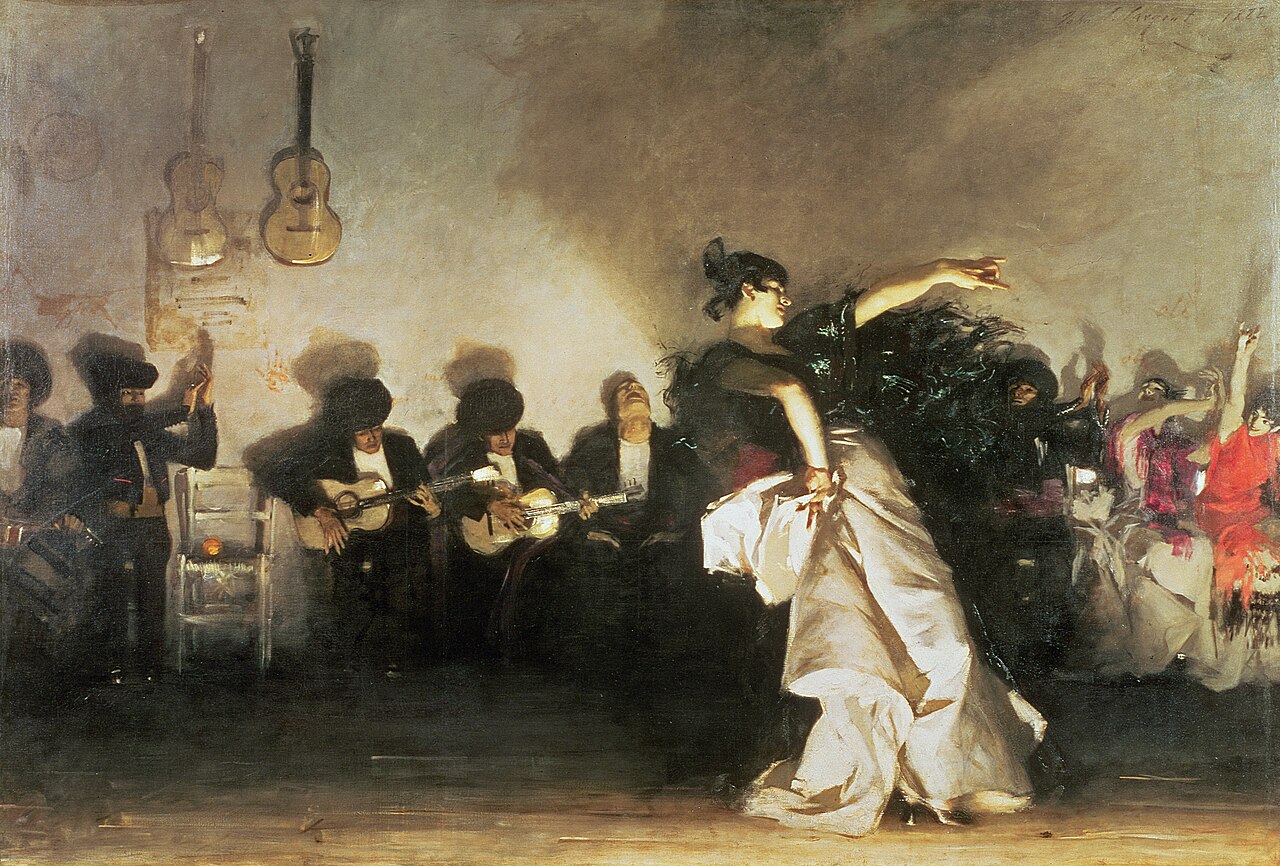
El Jaleo
John Singer Sargent
- Medium:
- oil on canvas
- Era:
- Late 1800s (Victorian Ballroom)
- Source:
- Wikimedia Commons
- Rights:
- Public domain — free to use, share and adapt.
- Recorded as:
- public_domain
This is one of the most celebrated artistic representations of flamenco from the period, created by one of the era's most prominent portraitists. It documents flamenco at a transitional moment—still a vernacular tavern practice but increasingly subject to artistic and international attention. For historians, it reveals both the physical vocabulary of flamenco performance and the social context in which it occurred.
What you are looking at
A dramatic interior scene set in warm, smoky tones captures a flamenco performance in what appears to be a tavern or café. At the centre, a female dancer in a white dress and black shawl executes an intense, arched back movement, her arm extended in an expressive gesture. She is silhouetted against the darker background of musicians and onlookers. Three guitarists dressed in dark coats sit to the left, their instruments visible and bodies angled toward the action. The crowd surrounding them—some in formal dress, others in shadow—creates a dense, energetic atmosphere. Two guitars hang on the upper left wall. The painting employs dramatic chiaroscuro, with warm golden light highlighting the dancer's white costume and the faces of the closest spectators while the background dissolves into shadow and atmospheric haze, suggesting both the heat of performance and the dimly lit venue.
The dancing
The dancer's body displays the characteristic arch and extension of flamenco: her torso is deeply arched backward, one arm raised and extended, the other gripping her shawl close to her body. Her weight appears to be in a controlled, planted stance that allows for this dramatic curvature. The guitarists maintain sitting positions, their bodies leaning inward with instruments held ready—a supportive rather than featured role. The surrounding figures are mostly obscured or partially visible, creating a sense of crowd rather than individual dancers; no other dancers execute the flamenco vocabulary the central figure displays.
The dance depicted
This is a flamenco performance, specifically depicting the dramatic, emotional intensity of styles like Seguiriya, Soleá, or similar palos that emphasize intense physical expression and emotional catharsis. The arched-back pose, extended arm, and use of the shawl (manton) are characteristic of female flamenco performance, particularly in theatrical or café settings of the late 19th century. The presence of live guitarists and the tavern setting reflect the social context of flamenco in Spain before it became fully theatricalized; this appears to document the performance tradition as it existed in live venues rather than formal theatrical stages. The composition emphasizes the solitary dancer's emotional and physical intensity rather than complex footwork or partnering.
How it was made
Oil on canvas, a major medium allowing for the rich atmospheric effects and dramatic lighting visible here. Sargent's technique employs loose brushwork and tonal masses rather than precise detail, particularly in the background and crowd, which creates a sense of spontaneity and movement suited to capturing performance energy. The warm, golden-brown palette and use of shadows build an immersive environment. The scale and formal execution suggest this is a finished exhibition work rather than a sketch, indicating the artist's serious interest in documenting the dance tradition.
About this work
Sargent's *El Jaleo* captures a moment of intense flamenco performance in a Spanish tavern or café setting, centring on a solitary female dancer in an arched, expressive pose. The work documents flamenco as a lived social practice rather than a concert spectacle, showing the close relationship between dancer, musicians, and crowd. The painting's dramatic lighting, energetic composition, and emphasis on the dancer's emotional intensity rather than technical footwork make it a key artistic record of Spanish flamenco culture in the late 19th century. The work belongs in a dance gallery both as evidence of how flamenco was performed and viewed in this era, and as a statement about the artist's fascination with passionate, non-academic dance forms.
How to look at it
The viewer should attend to the exact moment Sargent chose: not mid-footwork or in a moment of active stepping, but in an arched, extended pose that emphasizes emotional and physical intensity. This choice reflects both flamenco's actual aesthetic (which prizes expressive quality over technical display) and 19th-century European artistic taste, which valued passion and dramatic gesture. Notice how Sargent uses light to isolate the dancer and create depth—she is legible against shadow not through outline but through tonal contrast. The presence of the crowd and musicians is suggested rather than detailed, making the dancer's internal emotional state the subject rather than the technical execution of movement.
The artist
John Singer Sargent (1856–1925) was an American painter trained in Europe who became the dominant society portraitist of the Gilded Age. He was fascinated by performance, movement, and non-European cultures, and painted numerous dance and theatrical scenes alongside his primary portrait practice. His Spanish works, created during extended stays in Spain, show particular interest in Spanish regional character and vernacular culture. Sargent's loose, fluid brushwork and ability to capture gesture and energy made him well-suited to dance subjects, and his large-scale paintings of dance and performance were exhibited prominently during his lifetime.
The period
The 1880s saw growing European artistic and cultural interest in Spain and Spanish regionalism, partly driven by orientalism and partly by aesthetic admiration for Spanish artistic traditions. Flamenco was beginning to move from vernacular tavern practice toward staged theatrical presentation, though this transition was still incomplete. Simultaneously, academic art was becoming increasingly challenged by more direct, energetic approaches to composition and technique—of which Sargent's painterly freedom is an example. In dance history, this is the era when flamenco began to be documented and theorized by non-Spanish observers, contributing to its transformation from local tradition to international art form.
Where it lives
The work is recorded as oil on canvas from 1882, with no current holding collection specified in the catalogue record. It is known from Wikimedia Commons, indicating it is in the public domain or openly available digitally, though the physical location of the original is not specified here.
Dance in this work
Questions about this work
Is this a specific flamenco style?
The pose and emotional intensity suggest a serious palo such as Seguiriya or Soleá, known for dramatic, expressive performance rather than rapid footwork. However, Sargent does not provide enough specificity—through costume, setting details, or footwork—to identify a single style with certainty. The emphasis is on capturing the emotional power of flamenco rather than technical classification.
Why is she wearing a white dress instead of the colourful costumes I associate with flamenco?
Flamenco costumes were historically much more varied than the standardized theatrical dress of later stages. White or light-coloured dresses were worn in certain contexts and regions. Sargent's choice may also reflect his interest in the tonal contrast white provides against the dark setting and his fellow performers—a painter's decision as much as a historical one.
What is the relationship between the dancer and the musicians?
In flamenco tradition, the guitarist is essential to the dancer but the dancer is the central artist; the musicians follow and support the dancer's emotional and rhythmic lead. Sargent emphasizes this hierarchy by placing the dancer centrally and the guitarists in supporting positions, both spatially and in terms of light and detail.
Was flamenco really performed in taverns like this?
Yes. Before flamenco's move into formal theatres in the early 20th century, it was a vernacular art performed in cafés cantantes, small taverns, and private gatherings. These settings were central to flamenco culture, and the presence of a crowd, guitars, and dim atmospheric lighting in Sargent's painting reflects a real social context.
More dance artwork