49 works in this view — arrow keys or swipe to move between them.
Dance in Art
Unidentified ballet
Unknown artist
- Medium:
- Dance:
- Ballet
- Source:
- New York Public Library
- Rights:
- Public domain — free to use, share and adapt.
- Recorded as:
- public_domain
This work captures the aesthetic and physical ideal of the Romantic ballerina at a specific historical moment—the carriage, the costume, the composure, the social presentation of the female dancer as both trained artist and fashionable celebrity. For dancers and historians, it offers concrete evidence of what Romantic-era ballet training produced in terms of body, posture, and deportment, unmediated by later revivals or interpretations.
What you are looking at
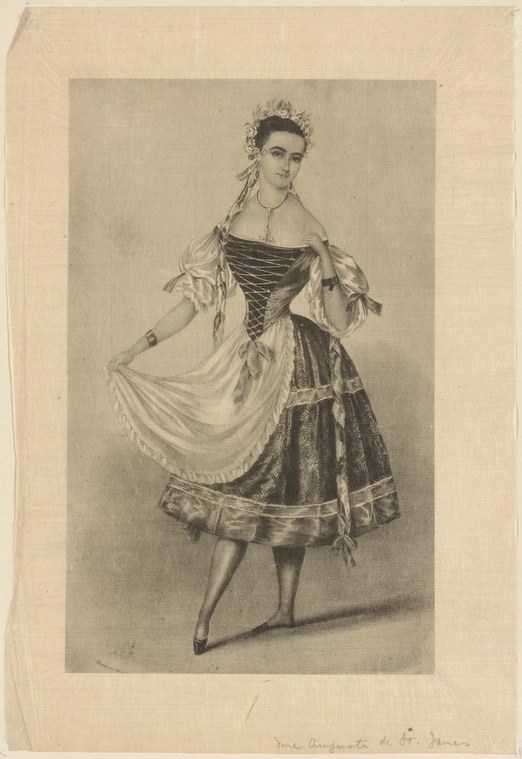
A single female dancer stands in three-quarter view against a neutral ground, posed in a moment of stillness rather than active motion. She wears a dark corseted bodice with horizontal lacing detail, paired with a full skirt in a lighter fabric—likely silk or cotton—that falls to mid-calf. A pale shawl or wrap drapes from her shoulders and across one arm, its folds caught in careful study. Her posture is upright and composed, with her weight settled on one leg, the other subtly positioned. Her hair is styled up with what appears to be a decorative comb or ornament, and she wears a simple pendant at her throat. The figure is rendered as a delicate line drawing, rendered in what appears to be an engraving or lithograph technique, with careful attention to the play of light across the fabrics and the definition of form through fine hatching and tone.
The dancing
A single dancer occupies the composition, standing in a relaxed contrapposto pose with weight shifted onto one leg. Her arms are held away from her body in an open, presentational frame—one arm extended slightly forward, the other held back, supporting the draped shawl. Her shoulders remain level and squared; her posture suggests trained deportment. There is no active leap or turn frozen mid-motion, but rather the formal stillness of a posed or momentary pause within a dance phrase, the kind of position a dancer might hold for a portrait or at a moment of transition.
The dance depicted
This depicts ballet as it was practiced in the mid-19th century, most likely Romantic-era ballet. The costume—dark bodice with full skirt, the exposed shoulders, the soft drapery—and the refined, upright carriage are consistent with the female dancer (ballerina) in the Romantic period. The absence of pointe shoes is notable; the figure appears to stand flat-footed or on demi-pointe, which was standard for much of the 19th century before the full rise of the ballerina on pointe became universal. The pose suggests a moment of repose or presentation rather than virtuosic action—the kind of image that would have been circulated to document and celebrate the dancer or the ballet.
How it was made
This is a line engraving or fine lithograph, rendered entirely in blacks and tones of gray with no color. The technique allowed for fine detail in the rendering of fabric, musculature, and expression, and such prints were the standard medium for theatrical portraiture and the documentation of celebrated dancers in the 19th century. The delicate, precise linework and the subtle modeling through tone suggest professional theatrical reproduction rather than a sketch; this would have been produced for circulation to a literate, cultured audience—theater-goers, collectors of theatrical memorabilia, and devotees of ballet.
About this work
This is a portrait engraving of a 19th-century ballet dancer, likely from the Romantic era (1830s–1850s). The figure stands in formal repose, posed to display both the refined carriage of the trained dancer and the fashionable costume of the period—a dark corseted bodice and full pale skirt with draped shawl. The work belongs to a large tradition of theatrical portraiture: prints commissioned to immortalize celebrated dancers and to satisfy the public appetite for images of the stars of the stage. The engraving technique and the formal presentation ground it in the practices of 19th-century theatrical promotion and fan culture. Although the dancer and the ballet remain unidentified in the catalogue, the image is a clear document of how ballet dancers looked, how they held their bodies, and how they were presented to the public in this period.
How to look at it
Notice the dancer's upright carriage and the precise, almost architectural way the artist has rendered the body within the costume. Observe how the pale shawl creates a counterbalance to the dark bodice, and how the folds are caught and studied with the same care as the figure herself. The pose is neither in motion nor entirely static—it is a moment of presentation, the kind of formal pause a dancer would adopt for a portrait sitting or at the threshold of an entrance or exit. This is not action frozen mid-leap, but composure and elegance offered to the viewer's gaze.
The period
This print dates to an era when ballet was undergoing profound transformation. The Romantic movement in ballet (roughly 1830–1860) shifted focus from male virtuosity to the ethereal, otherworldly beauty of the female dancer. The costume shown here—the off-shoulder bodice, the full skirt, the soft fabrics—reflects the Romantic ideals of sylphs and spirits. Lithography and engraving were the dominant media for reproducing theatrical imagery; photographs existed but were not yet the primary medium for theater documentation. Prints like this were affordable, portable, and widely collected, making them central to how ballet dancers became public figures and how audiences encountered and remembered the dancers they admired.
Where it lives
The work is held in the New York Public Library collection, which holds one of the world's largest collections of theatrical prints and illustrations. It was sourced as a print—a reproducible, circulated image—suggesting it was widely distributed and collected in its time.
Dance in this work
Questions about this work
Is this a photograph?
No. This is an engraving or lithograph, a hand-drawn and hand-printed image. Photography existed in the mid-19th century but was slow and expensive; theatrical portraits like this were still produced primarily as engravings and lithographs, which could be mass-produced and sold affordably to fans.
Why is the dancer not on pointe?
Pointe work became the dominant mode for ballerinas only toward the end of the 19th century. In the Romantic era (1830–1860), dancers danced on demi-pointe (the ball of the foot) or flat. The apparent flat-footedness of this figure is historically accurate for the period the costume and style suggest.
Who was this dancer?
The catalogue record does not identify her. Many 19th-century theatrical prints were published without the dancer's name, or the attribution has been lost. However, the quality of the engraving and the care taken in rendering suggest she was a celebrated dancer of some note.
What is she wearing?
A costume typical of the Romantic ballet: a dark, tightly corseted bodice (often boned and laced), a full skirt that falls to mid-calf or just below, and a light wrap or shawl draped across the arms. This silhouette was fashionable in both street dress and stage costume in the 1840s–1860s.
More Ballet artwork