49 works in this view — arrow keys or swipe to move between them.
Dance in Art · 2019
Unidentified ballet
Unknown artist
- Medium:
- Dance:
- Ballet
- Source:
- New York Public Library
- Rights:
- Public domain — free to use, share and adapt.
- Recorded as:
- public_domain
For dance historians and practitioners, this image is primary evidence of how a romantic-ballet character was costumed and how the body was positioned in performance. The starry tunic and celestial imagery connect directly to the fairy and sylph roles that defined romantic ballet aesthetics, making this a visual record of the period's most influential character types. The hand-colored medium itself documents how dance was circulated and monetized in the 19th century—not through photography or video, but through prints sold as theatrical souvenirs.
What you are looking at
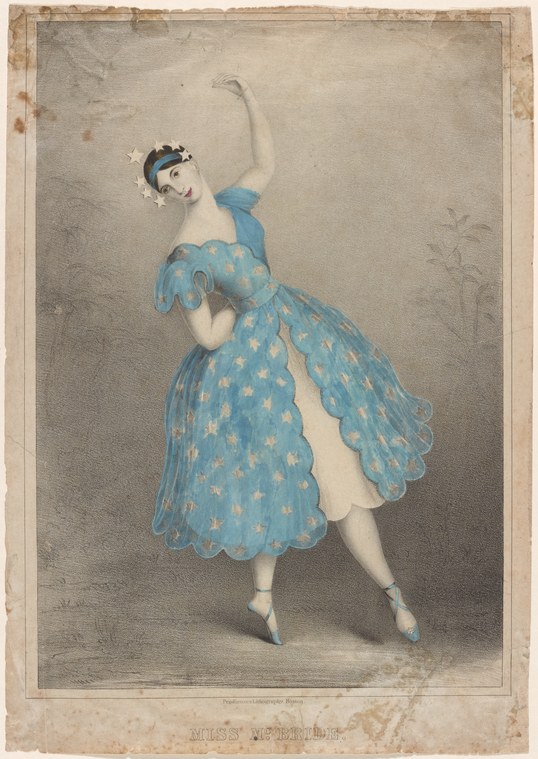
A single female dancer stands in contrapposto against a neutral, subtly shaded background. She wears a pale blue tulle dress scattered with gold stars, with a fitted bodice, short puffed sleeves, and a voluminous skirt that falls to mid-calf. The skirt is gathered at the sides, creating wing-like folds that suggest arrested movement. Her head is tilted back, crowned with a decorative diadem or circlet, and her right arm is raised in a graceful arc. She wears pale tights and soft ballet pointe shoes. The image has the character of a hand-colored print—the blue is applied translucently over engraved or lithographed lines, with careful attention to the fall of fabric and the modeling of the figure. The pose is one of studied elegance rather than dynamic action, the body relaxed into a gentle S-curve. The starry costume and celestial crown suggest a character role, possibly a fairy or otherworldly being.
The dancing
The dancer stands en relevé on the pointe of her left foot, her weight lifted and refined. Her right leg extends behind her in a gentle turnout. The right arm rises to shoulder height in a soft arc, while the left arm hangs at her side. The head position—tilted back, the gaze lifted—completes a line of elongation and lightness. Her posture shows the controlled turnout and upright carriage of ballet training. The silhouette is one of repose rather than propulsion, suggesting a moment of suspension or display within a choreographed sequence rather than a moment of active dancing.
The dance depicted
This appears to be a portrait of a romantic-era ballet dancer in character costume, likely from the 1830s–1850s based on the tulle skirt, pointe work, and ethereal styling. The starry tunic and diadem suggest a sylph, fairy, or spirit character—roles that became central to romantic ballet following the success of *La Sylphide* (1832). The dancer's name is not recorded in the available information, nor is the specific ballet identified. The image preserves the conventions of romantic ballet portraiture: the soloist posed in character dress, the emphasis on the lifted, weightless line achieved through pointe work, and the starry costume associated with magical or supernatural female characters of the period.
How it was made
This is a hand-colored print, most likely a lithograph or engraving from the mid-19th century. The image shows the characteristic techniques of theatrical portraiture of the period: careful outline work in black ink defining the figure, with translucent watercolor or ink wash applied to indicate the blue of the tulle, the flesh tones, and subtle shadows. The background is built up in grayscale, allowing the figure to advance. This method of production—originating from a stone or plate, then individually colored—allowed for affordable distribution to theatergoing public and collectors of theatrical imagery. The technique captures the texture and volume of the costume with particular skill, suggesting it was made from a direct study or an earlier oil painting.
About this work
This is a hand-colored theatrical print documenting a romantic-era ballet dancer in her stage costume. The work belongs to the 19th-century tradition of ballet portraiture—popular prints and engravings sold to audiences and theaters, recording celebrated performers in celebrated roles. The starry tunic, ethereal pose, and pointe work place it within the romantic ballet movement, a period when ballet's subject matter turned toward the supernatural and the otherworldly. Without attribution or a recorded title, the print survives as a genre witness: evidence of what romantic ballet costumes looked like, how they were worn, and how the dancing body was seen and celebrated in its own time.
The work is now held in the New York Public Library collection, where it forms part of a larger archive of theatrical and performance imagery from the 19th century. It is an ordinary object in its own period—a souvenir or advertisement—but it carries significant information for anyone studying the visual history of ballet, the conventions of female roles in romantic choreography, and the relationship between costume and movement.
How to look at it
Focus first on the costume: the starry patterning and gathered tulle are distinctive to romantic-era character dress, not classical ballet. Note the dancer's weight—lifted onto the point of one foot, the body elongated and calm. This is not a moment of action but of display and elegance: the pose is held, presenting the dancer to the viewer's gaze. The tilted head and raised arm, though graceful, are static. The artist has chosen a moment of stillness, possibly a pose struck at the end of a variation or during a moment of pantomime in the choreography, rather than the peak of a jump or turn. The hand-coloring adds immediacy and presence to the figure, making the costume and the pale flesh of the dancer stand out against the soft background.
The period
The romantic era in ballet (c. 1830–1870) brought a shift away from the classical mythologies and court dances of the earlier 19th century toward narratives of the supernatural—forests, fairies, sylphs, and spirits. This aesthetic coincided with romanticism in literature and visual art, emphasizing the ethereal, the natural, and the emotionally expressive. Female dancers rose to prominence in roles that emphasized weightlessness and otherworldliness; pointe work became standard, and the tulle skirt—as seen here—became the costume marker of the sylph and fairy roles. Theatrical portraiture of the period took the form of lithographed and hand-colored prints, affordable and widely circulated, which served both as souvenirs and as advertisements for celebrated performers. By the 1840s–1850s, when this print likely dates, such imagery was a staple of print shops and theater lobbies across Europe and America.
Where it lives
The print is held in the New York Public Library collection, catalogued as a 19th-century theatrical portrait. The record provides no accession number, artist attribution, dancer identity, or specific ballet title. It is typical of the circulating theatrical imagery of the mid-19th century—a print produced for commercial and commemorative purposes rather than fine art.
Dance in this work
Questions about this work
What ballet is this dancer from?
The specific ballet is not identified in the available record. The starry tunic and celestial crown suggest a fairy or sylph character, roles that were central to romantic-era ballets like *La Sylphide*, *La Jolie Fille de Gand*, or similar works of the 1830s–1850s. Without a title or performer name, a definitive identification is not possible from this image alone.
Who is the dancer?
The dancer's name is not recorded. The New York Public Library catalogue does not identify the performer. The print may have been made during the performer's lifetime as a souvenir of a specific performance or role, but that information has not been retained.
How was this print made?
This is a hand-colored lithograph or engraving, likely dating to the 1840s–1860s. An image was drawn or engraved onto stone or metal plate, then printed in black ink. Individual copies were then colored by hand using watercolor or gouache, a labor-intensive but economical method that allowed for affordable distribution to theaters and print shops.
What does the starry costume mean?
In romantic-era ballet, stars and celestial imagery were associated with supernatural female characters—fairies, sylphs, spirits, and enchanted beings. The costume marks the dancer as performing a magical or otherworldly role, not a human character in a realistic narrative.
More Ballet artwork