49 works in this view — arrow keys or swipe to move between them.
Dance in Art · 2021
Ballet dancer
Unknown artist
- Medium:
- Dance:
- Ballet
- Source:
- New York Public Library
- Rights:
- Public domain — free to use, share and adapt.
- Recorded as:
- public_domain
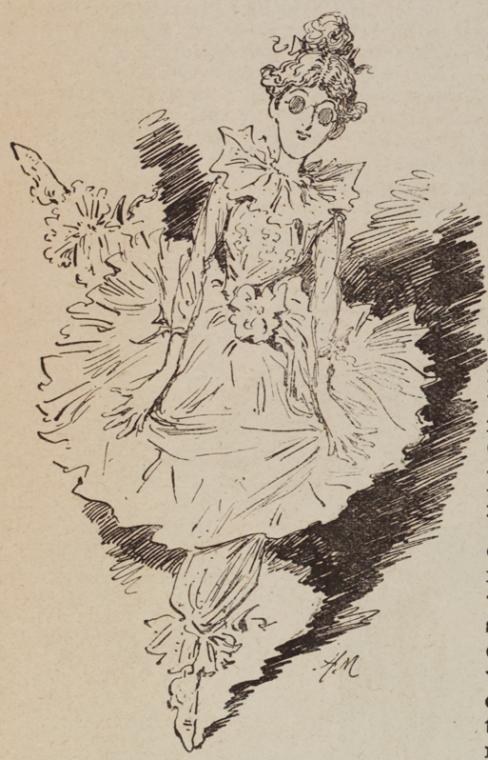
This drawing testifies to ballet's prominence in late 19th- and early 20th-century visual culture and to the skill required of theater illustrators to convey the essence of a trained dancer's body and movement in a few lines. It also documents the gendered aesthetic of classical ballet—the idealized feminine figure, the emphasis on grace and apparent effortlessness—that defined the period's stage conventions and remains influential in ballet today.
What you are looking at
A single female dancer occupies the center of this ink sketch, rendered in expressive, gestural linework typical of late 19th- or early 20th-century theatrical illustration. She wears an elaborately decorated dress with a fitted bodice adorned with floral or geometric patterning, a high neckline with a prominent bow or collar detail, and a voluminous skirt gathered at the hem. Her hair is styled up and away from her face in the fashion of the period. The figure is captured mid-movement in a pose of elegant extension: her body leans slightly forward, one arm appears lifted and curved, and her legs are positioned to suggest motion or balance. The composition frames her against a neutral ground, with areas of dense cross-hatching applied asymmetrically on the right side and lower left, creating visual weight and depth without a defined interior or stage setting. The line quality varies from fine, controlled marks defining the dress to broader, more emphatic strokes suggesting shadow and volume.
The dancing
The dancer's posture shows a refined, upright carriage with the torso slightly inclined and the arms arranged in an open, rounded frame characteristic of classical ballet vocabulary. Her weight appears centered over the supporting leg, with the free leg extended or lifted in an attitude or développé position. The raised arm and rounded port de bras suggest controlled, trained movement rather than folk or social dancing. The proportions of her limbs and the precision implied by the gestural line indicate the artist was familiar with ballet technique and the idealized silhouette of the professional stage dancer of her era.
The dance depicted
This is almost certainly a ballet dancer, most likely from the Romantic or late 19th-century classical period, based on the tutu-adjacent skirt construction, the fitted bodice, the elevated hairstyle, and the refined poses that conform to ballet's codified port de bras and épaulement. The drawing's focus on graceful extension and balanced line reflects Romantic ballet's emphasis on ethereal elevation and the illusion of weightlessness. Without inscription or signature context, the specific dancer and production cannot be identified, but the work documents the visual conventions of how ballet was represented in popular theatrical illustration of the period.
How it was made
This is an ink drawing, most likely a pen-and-ink sketch or wash drawing, executed with varied line weight and cross-hatching to suggest form and atmosphere. The technique allows for rapid, expressive notation of movement while maintaining precision in the figure's anatomy and costume detail. The asymmetrical application of shadow (the darkened right side and background) creates compositional emphasis and a sense of stage lighting, suggesting this may be a preparatory study for a theatrical print or a finished work intended for illustration or publication. The directness and fluency of the line indicate a practiced hand and a working familiarity with capturing live or posed dance movement.
About this work
This is a late 19th- or early 20th-century ink sketch of a ballet dancer in classical pose, rendered in a style consistent with theatrical illustration of the period. The work captures the aesthetic and technical ideals of Romantic or classical ballet through the dancer's silhouette, costume, and carefully composed gesture. It belongs in the history of dance iconography as a document of how the ballet body was represented in popular visual culture and as evidence of the close relationship between dance and the graphic arts during an era when theatrical illustration was a primary means of circulating images of performance. The sketch's expressive line and refined observation of the dancer's technique make it a valuable record of ballet's visual language at a moment when the form was undergoing significant artistic development.
How to look at it
Notice how the artist has frozen the dancer at the apex of a classical movement—a moment of apparent suspension rather than transition. The curved port de bras and the slight incline of the torso convey the Romantic ideal of the effortless, weightless dancer, despite the physical effort such poses require. The costume detail is secondary to the line of the body; the artist's priority is the silhouette and the clarity of the dancer's line, reflecting the period's conviction that beauty in ballet resided in elongation, verticality, and harmonic proportion.
The period
This work dates to an era when ballet was undergoing a transition from the dominance of Romantic aesthetics (emphasizing narrative, pointe work, and the ethereal female dancer) toward the more technically rigorous classical technique championed by figures such as Agrippina Vaganova and Enrico Cecchetti in Russia and Italy. Theater illustration in this period was a major cultural form, with newspapers, journals, and playbills relying on skilled draughtsmen to capture and disseminate images of popular performers and ballets. In the United States and Europe, the dance press and theatrical press made extensive use of such illustrations to promote ballet and to celebrate the celebrity of dancers.
Where it lives
The work is held in the New York Public Library collection and is catalogued as a print. The archive designation and the online publication date suggest it is part of a larger collection of theatrical or dance-related illustrations.
Dance in this work
Questions about this work
What dance form is this?
This is ballet, almost certainly Romantic or classical ballet from the late 19th century. The evidence is in the pointe-friendly skirt, the fitted bodice, the uplifted hairstyle, and the codified arm and leg positions (port de bras and attitude or développé) that are fundamental to ballet technique.
Who is the dancer?
The artist is not recorded, and there is no inscription or signature on the visible portion of the work. Without additional archival information, the identity of the dancer depicted cannot be established from the image alone.
Is this a study or a finished work?
The fluency of the line and the refined handling of tone suggest this is either a finished preparatory drawing for a theatrical print or a finished work in its own right intended for publication in a journal or playbill. The technique and presentation are consistent with late 19th-century theatrical illustration practices.
Why is half the background dark?
The asymmetrical cross-hatching likely represents stage lighting or shadow, a compositional device used in theatrical illustration to evoke the conditions of stage performance and to direct the viewer's eye toward the dancer's form.
More Ballet artwork