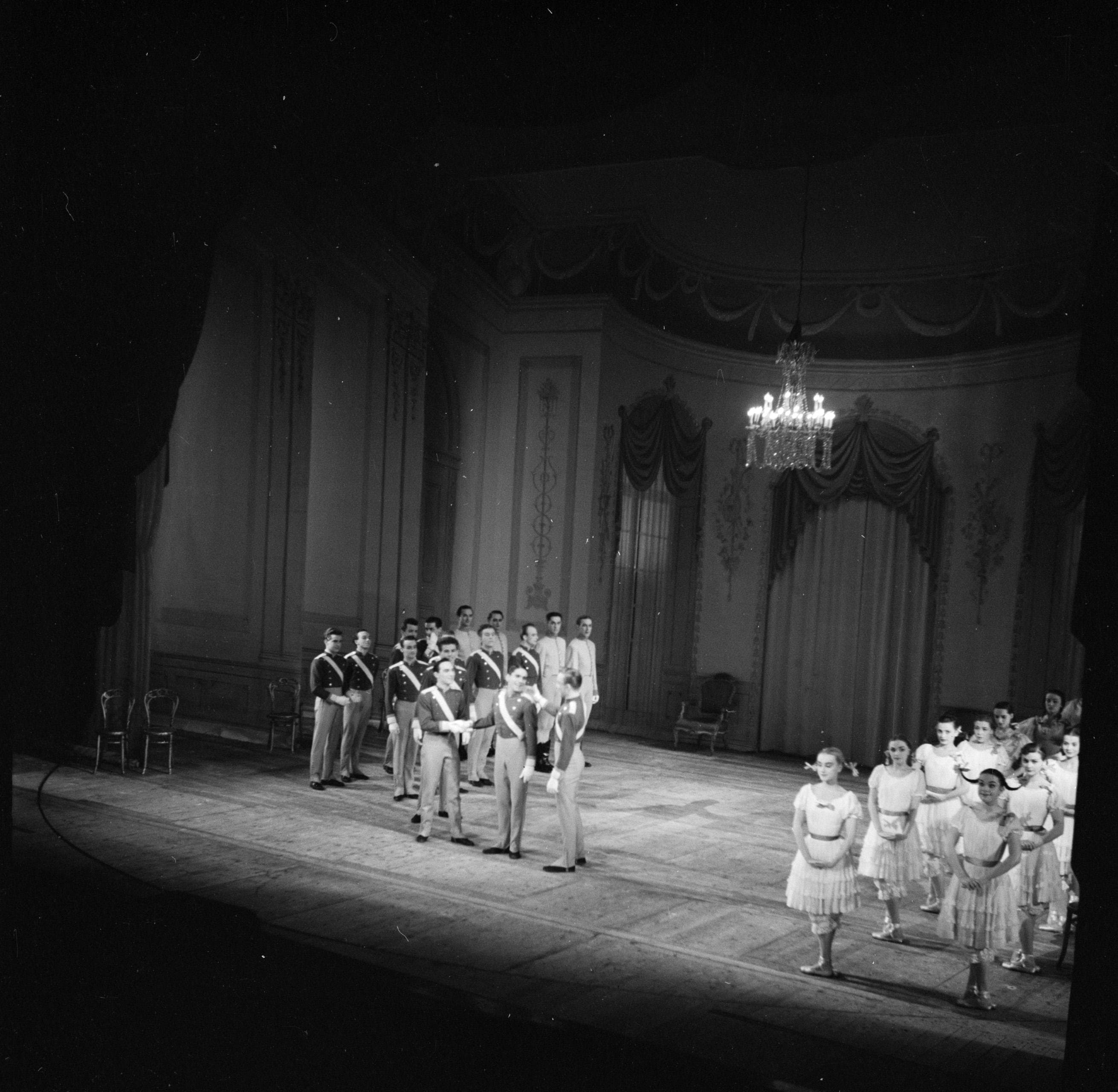
Graduation Ball is a one-act comic ballet set in a Viennese girls' finishing school of the 1840s, built around a graduation ball to which the local military cadets are invited. Devised as a light, character-driven divertissement piece rather than a dramatic narrative, it interleaves a courtship plot (a shy cadet and a romantic girl, a tomboyish 'Pigtail Girl' and her cadet, and a comic late-life flirtation between the Headmistress and the Old General) with a suite of showpiece dances performed as entertainment within the ball itself.
What it contains
- Classical Ballet — Dance-Step Competition · Dance-Step Competition duet — Single and double fouettés en tournant combined with pirouettes en attitude, à la seconde, and en arabesque with varying arm positions. Source: "single and double fouettés en tournant combined with pirouettes en attitude, á la seconde, and en arabesque, with different arm positions"
- Classical Ballet · The whole work — The work is described as a full ballet built on classical pointe technique, most explicitly in its fouetté-and-pirouette showcase duet. Source: "Graduation Ball is a ballet in one act choreographed by David Lichine to music composed by Johann Strauss II"
- Galop · Grand finale galop — The full company performs a fast group galop as the ball's climactic dance number. Source: "Everyone dances a high-spirited galop, bringing the evening to a grand finale"
- Mazurka — Mazurka Flirtation · Mazurka Flirtation — A named mazurka danced by the Headmistress and Old General as a courtship duet, staged as in-story period ballroom dance. Source: "the Headmistress and the Old General dance a "Mazurka Flirtation," revealing their attraction"
- Partner Acrobatics (Adagio) — Perpetuum Mobile · Original Perpetuum Mobile pas de deux (pre-Australia-tour version) — The original version of this pas de deux is described as a circus number for the two leads, implying acrobatic partnering later removed. Source: ""Perpetuum Mobile," which originally consisted of a circus number for Riabouchinska and Lichine, was replaced by new choreography"
- Romantic Ballet — La Sylphide and the Scotsman · La Sylphide and the Scotsman pas de deux — A pas de deux explicitly costumed and titled as a pastiche of the Romantic ballet La Sylphide, with the female dancer in a Romantic tutu. Source: "the Sylphide a Romantic tutu"
What is danced
The ballet is structured around a sequence of set-piece divertissements introduced in-story by the Mistress of Ceremony, each a distinct technical showcase: a drum solo, a Romantic-ballet pastiche pas de deux titled 'La Sylphide and the Scotsman,' a competitive duet built on virtuoso pointe technique, a comic academic trio, and a 'Perpetuum Mobile' pas de deux for the two leads. The most explicitly described choreography is the 'Dance-Step Competition,' originally built on single and double fouettés en tournant combined with pirouettes en attitude, à la seconde, and en arabesque with varied arm positions -- a display piece that later revivals softened into simpler fouetté sequences. The frame of the ballet also stages named period social dances rather than pure classical variations: the Headmistress and the Old General dance a 'Mazurka Flirtation,' and the full company closes the ball with 'a high-spirited galop.' The original 'Perpetuum Mobile' pas de deux is separately described as having begun life as 'a circus number' before being replaced with more conventional choreography, implying acrobatic partnering in its first form.
Context
Graduation Ball was created for the Original Ballet Russe, one of the touring successor companies to the Diaghilev-era Ballets Russes, and premiered outside Europe, in Sydney, at the start of the Second World War. It belongs to a wave of light, plotless-adjacent character ballets that Ballets Russes-descended companies used as accessible, comedy-driven repertory alongside their more austere or dramatic works, leaning on period pastiche (the Romantic-tutu 'Sylphide' number is a direct in-work homage to La Sylphide) and on real historical ballroom dance forms (mazurka, galop) rather than invented abstract vocabulary throughout.
Staging history
The ballet was an immediate success at its Sydney premiere, drawing twenty-five curtain calls, and toured Australia more than sixty times before reaching the United States later in 1940. Its divertissement roster was not fixed: the 'Mathematics and Natural History Lesson' trio was dropped after the Australian tour, and the original 'Perpetuum Mobile' (danced as a circus-style number) was replaced with new choreography for the same two leads plus two Junior Girls. It became a signature work of the Original Ballet Russe and has since entered the repertory of companies including American Ballet Theatre, the Australian Ballet, La Scala Ballet, Ballet Nacional de Cuba, the Borovansky Ballet, Companhia Nacional de Bailado, Les Grands Ballets Canadiens, London Festival Ballet, the Polish National Ballet, and the Royal Danish Ballet.
How to watch it
Watch the divertissement block as a series of separated technical exhibitions rather than plot advancement -- each number (drummer, Sylphide pas de deux, competition duet, academic trio, Perpetuum Mobile) is introduced formally by the ballerina acting as Mistress of Ceremony. Note how the ballet frames actual period ballroom forms -- the Headmistress/General mazurka and the closing company galop -- as diegetic social dance rather than abstract classical variation, and compare how heavily a given production simplifies the Dance-Step Competition's fouetté-and-pirouette combinations, since this has historically varied between stagings.
Structure
- The DrummerA solo divertissement for a male dancer in dress uniform.
- La Sylphide and the ScotsmanA pas de deux pastiche of the Romantic ballet La Sylphide, with the female dancer in a Romantic tutu and her partner in a kilt.
- Dance-Step CompetitionA competitive duet built on fouettés en tournant and varied pirouettes, later simplified in revivals.
- Mathematics and Natural History LessonA comic trio for two 'professors' and their pupil; later dropped from the ballet.
- Perpetuum MobileA pas de deux for the two leads, originally staged as a circus-style number before being replaced with new choreography.
- Mazurka FlirtationThe Headmistress and the Old General dance a mazurka, revealing their mutual attraction.
Structure read from an encyclopaedia article, not from a libretto or score we hold. Confirm against a programme before treating the numbering as authoritative.
Credits
- composer: Johann Strauss II
More from Johann Strauss II
Other staged works in the register connected to this one by author or lineage.
 AschenbrödelBallet · 1901Music by II · video
 Voices of SpringBallet · 1978Music by II · video
 Vienna WaltzesBallet · 1977Music by II · video
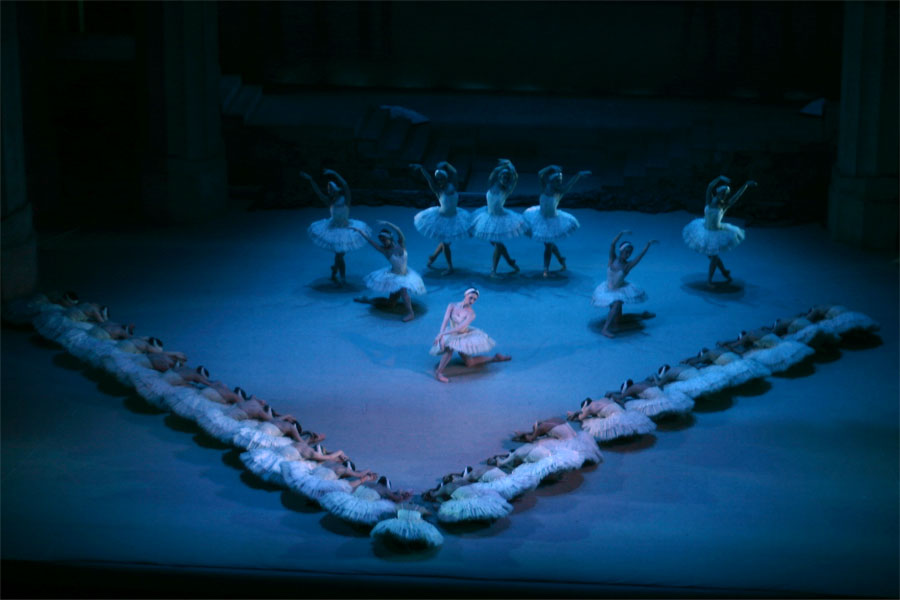 Swan LakeBallet · 1877Same lineage · video
 The NutcrackerBallet · 1892Same lineage · video
 GiselleBallet · 1841Same lineage · video
 IvesianaBallet · 1954Same lineage · video
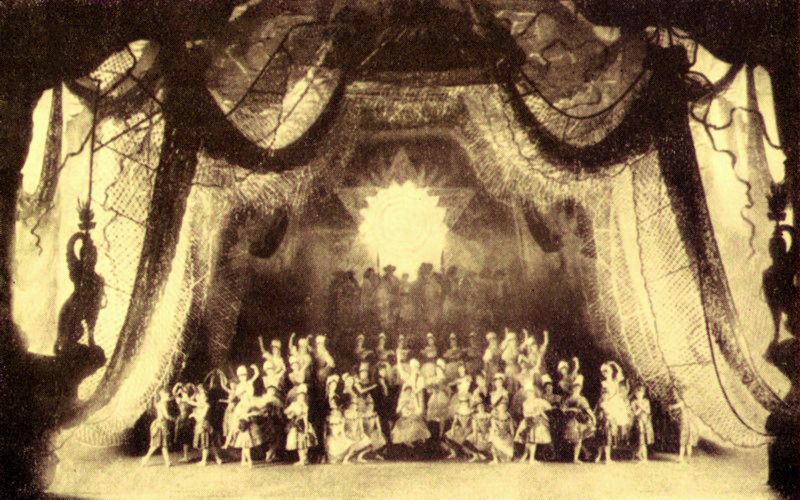 The Magic PillsBallet · 1886Same lineage