Breakdown
Also known as: Break-down, Virginia breakdown
History & Cultural Context
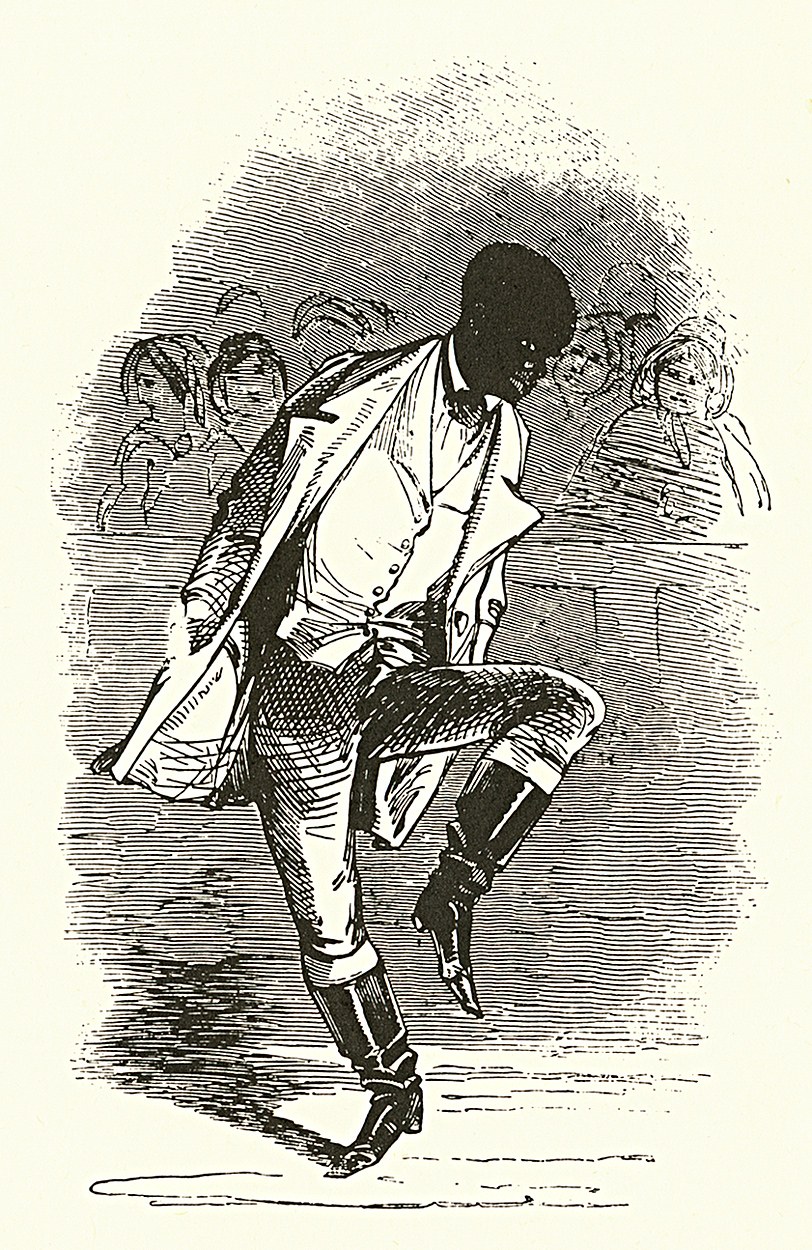
The movement vocabulary is African American, built from West and Central African principles carried through slavery — weight driven down into the floor, flexed knees, an articulated torso independent of the legs, and cross-rhythms produced by the feet against the tune. Enslaved dancers performed it solo on cabin floors and on loose boards, to fiddle and banjo in fast 2/4, with hand-clapping and body percussion filling the role drums had held before drumming was suppressed. In the Northeastern cities of the 1830s and 1840s, particularly the Five Points district of Manhattan, that vocabulary met Irish jig and hornpipe step material and the two traded steps directly; the free Black dancer William Henry Lane, billed as Master Juba, was the outstanding figure of that exchange and beat the leading white minstrel dancers in public challenge matches. From the 1840s white performers in blackface built entire acts on the breakdown and made it a standard minstrel-show finale, which is how most of the country came to see it and why the era's printed sheet music and stage bills carry the name. What survived after minstrelsy receded was the movement itself: buck dancing and flatfooting in the southern mountains, the percussive line of the variety and vaudeville stage, and ultimately tap.
Cultural Significance
For enslaved people it was recreation, contest and one of the few permitted occasions for public display of skill, danced at holidays, corn shuckings and after work. It was also performed under coercion, on demand, for the entertainment of slaveholders and their guests, and that compulsion is part of its history. Once minstrelsy took it up, the same steps became a mass commercial product controlled by white performers, while Black dancers who could get onto a stage at all were often required to perform inside the same caricature.
Characteristic Movement & Technique
The weight stays low and forward, knees bent, heels and toes both used for sound rather than the toes alone. The torso is loose and moves against the footwork instead of being held still, and the arms swing freely, sometimes for balance and sometimes for comic emphasis. Sound comes from heel drops, toe taps, shuffles, scrapes and slides across a resonant wooden surface, with the dancer building rhythmic figures that answer or cut across the fiddle. Improvisation within a known stock of steps is the point; a dancer was judged on invention as much as on execution.
Partnering Dynamics
A solo form. It was frequently danced as a head-to-head challenge, one dancer at a time with onlookers judging, and it also appeared as a massed group finale on the minstrel stage.
Competitive Context
Challenge dancing for wagers and for standing was central to it, and the contests between William Henry Lane and the white minstrel dancer John Diamond in the early 1840s were reported in the New York press at the time. The competitive habit did not die with the form: buck dancing and flatfoot competitions are still held at Appalachian fiddlers' conventions, judged on timing, clarity of sound and invention. Modern tap challenges and cutting contests descend from the same practice.
Regional Variations
Plantation-era versions differed by region and by what music was available, with banjo-and-fiddle accompaniment in the Upper South and more hand percussion where instruments were scarce. In the southern mountains the vocabulary settled into flatfooting, with the feet kept close to the floor, and buck dancing, which is looser and more upright. On the urban stage it was formalised into set routines with fixed step sequences designed to read from a distance.
Common Misconceptions
The most common error is treating the breakdown as an invention of the minstrel stage, or as an Irish step dance performed by Black dancers. The stage version was a commercial appropriation of an existing African American form, and while Irish step material genuinely entered the mix in Northern cities, it entered a vocabulary that already existed. A second error is reading breakdown only as a fiddle-tune category; the tune type is named after the dance, not the other way round.
Signature Figures
- Patting juba
- Double shuffle
- Pigeon wing
- Buzzard lope
- Cutting a step
Breakdown Playlists
Curated collections on the LODance YouTube channel — performances to watch, lessons to learn from, and the right music to practice with. Tap a collection to play.
▶ Performances · Open on YouTube →
Breakdown Music & Tempo
Drawn from 25 Breakdown tracks in the LODance music library.
Example tracks at practice tempo
- Blackberry Blossom — John Hartford
- Peaches 'N' Cream — Mark O'Connor
- Wild Fiddler's Rag — Mark O'Connor
- Arkansas Traveler — Don Richardson
- Brushy Fork of John's Creek — John Hartford
- Ida Red — John Hartford
Sources & Further Reading
Where This Dance Is Documented
Oral tradition; minstrel show and plantation accounts
An editor's note on where the technique for this dance is actually written down — sometimes a named book, sometimes the fact that no such book exists. A judgment, not a count of what we hold.
Cultural & Historical Context
Breakdown emerged from Plantation South of the United States, with later exchange in Northeastern cities during the 1820s—1860s. Understanding the cultural roots, musical traditions, and social circumstances of this era enriches appreciation for the dance's characteristics and significance.
Formative Influences
Signature Movement Vocabulary:
Patting juba, Double shuffle, Pigeon wing, Buzzard lope, Cutting a step
Primary Source Documents
The Library of Dance contains public-domain primary sources for dance history. Copyrighted modern syllabi are indexed with purchase links to their respective copyright owners. Search by dance name or codifier to discover primary source documents.
Last reviewed: October 2026 — This dance profile synthesizes historical research, cultural documentation, and contemporary practice knowledge to provide authoritative context.
Related Dances
More in Tap Dance
Soft Shoe
The smooth, light, low-volume tap idiom—historically sometimes danced on a sanded floor—that precedes and underlies both rhythm and Broadway tap.
Rhythm Tap (Hoofing)
The grounded, weighted, jazz-rooted tap style in which the dancer is a percussive musician improvising complex syncopation 'into the floor.'
Broadway Tap
The lighter, more upright, presentational tap style of musical theater, oriented to line, travel, and choreography for the proscenium stage.
Buck-and-Wing
A fast, vernacular late-19th-century precursor of modern tap, combining flat-footed 'buck' rhythms with springing 'wing' steps on the minstrel and vaudeville stage.
Clog
A percussive step dance performed in wooden-soled clogs, developed among mill and mine workers in northern England and built largely on hornpipe rhythms. It moved onto the music-hall stage as a championship solo turn in the nineteenth century and crossed to North America, where it fed both Appalachian step traditions and the variety stage. With African American percussive dance it is one of the two roots of American tap.
Tap Dance in art
Browse the gallery →Works from the wider Tap Dance tradition — we have not yet identified enough that depict Breakdown specifically.
Master Juba
Hans Nathan · 1848
Public Domain
Continue Exploring
Lineage of Dance
500 years of dance evolution
Champions of Dance
Winners of marquee national & world titles
Language of Dance
161 dance terms & translations
Listening of Dance
Tempo, timing & musicality tools
Gallery of Dance
5,700+ artworks from museum collections
Attire of Dance
Evolution of dance dress across eras
Keep the thread going
Dance history, technique, and the occasional rabbit hole — in your inbox. Thoughtful, infrequent, unsubscribe anytime.
Free. No spam. One click to leave.