44 works in this view — arrow keys or swipe to move between them.
Dance in Art · 1848
Master Juba
Hans Nathan
- Medium:
- Oil Painting
- Era:
- Mid 1800s (Polka Era)
- Source:
- Wikimedia Commons
- Rights:
- Public domain — free to use, share and adapt.
- Recorded as:
- Public Domain
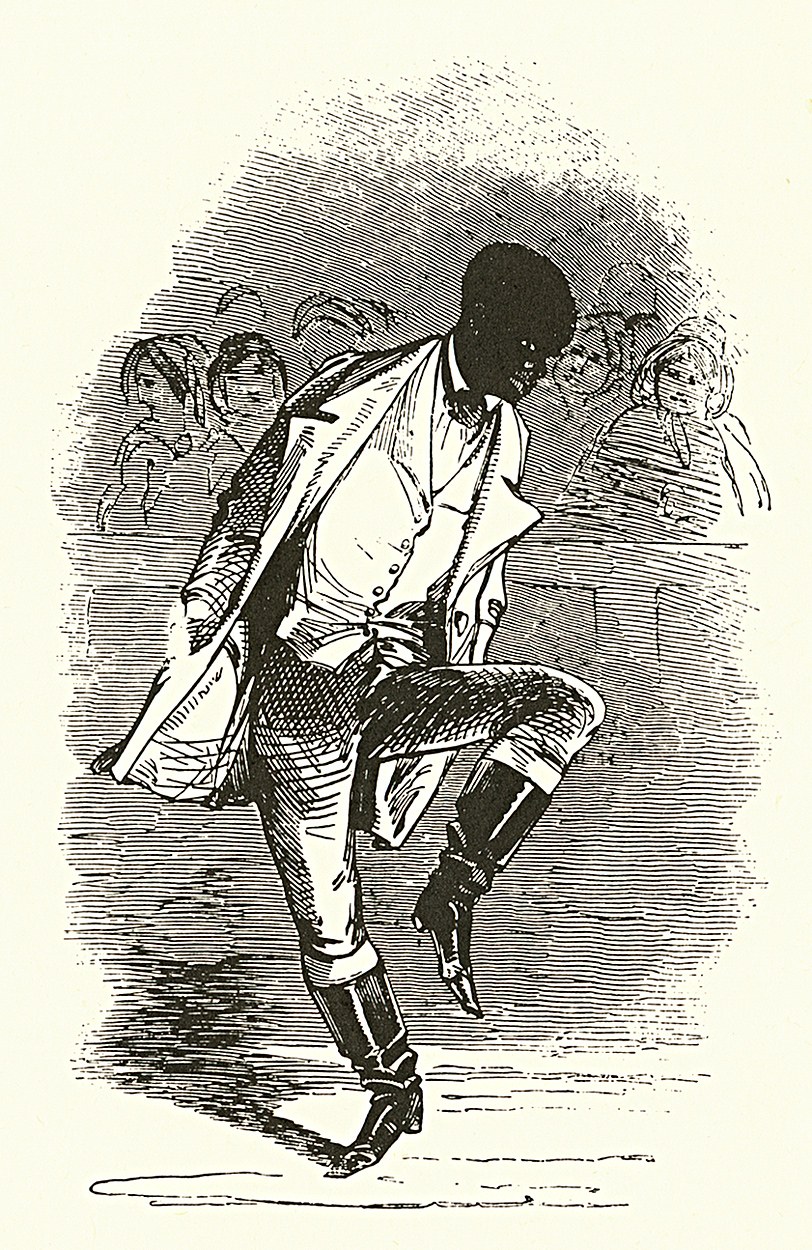
Master Juba was the first African American male dancer to achieve star status in American theater and one of the few performers of the period whose dancing technique was sophisticated enough to be recognized and celebrated across racial barriers. This engraving is one of the only contemporary images that attempts to capture his distinctive style—the rapid footwork and dynamic torque that made him famous and that influenced tap dance and American vernacular performance for generations. For dance historians, it is a rare artifact of pre-Civil War Black performance excellence and visual evidence of a dancer whose influence far exceeded his historical recognition.
What you are looking at
A male dancer in mid-performance, captured in a wood engraving that emphasizes dynamic movement and virtuosic footwork. He wears light-colored breeches and a white shirt with dark jacket, the costume of a mid-19th-century performer. His body is sharply angled, weight thrown forward onto one leg in a characteristic jig or breakdown position, the other leg extended or lifted behind him. His posture conveys speed and propulsive energy—the moment of a leap or a rapid weight shift rather than a poised stillness. The background is rendered in dense parallel lines suggesting stage lights or a theatrical interior, with shadowy figures of other performers barely visible, locating this as a stage performance before an audience. The engraver's technique—crisp parallel hatching for depth and shadow—gives the figure sculptural definition and emphasizes the musculature and tension of the body in motion.
The dancing
A single male dancer dominates the composition, his frame twisted into an athletic posture that reads as a moment of propulsion rather than balance. His weight is clearly committed to one leg while the other is lifted or extended; his torso leans forward from the hips, and his arms are in motion—one held up for balance or style, the other less clearly defined. This is the body language of competitive footwork: rapid weight transfer, explosive articulation from the ankle and knee, the kind of movement that prioritizes speed and complexity of foot patterns over line or extension. The posture is unmistakably that of a male vernacular dancer, not a ballet performer.
The dance depicted
This depicts Master Juba (William Henry Lane), the most celebrated African American dancer of the 1840s–50s, performing what would have been called a jig or breakdown—the competitive solo footwork traditions that emerged from African American, Irish, and English vernacular dance and were central to minstrelsy and traveling shows of the period. Lane was famous for his rapid footwork, rhythmic complexity, and ability to make the lower body dance independently of the torso—exactly what the forward-leaning, dynamic posture here suggests. The engraving captures not a set step but a moment of execution, the explosive athleticism that made him a star performer in integrated audiences when segregation was the norm. This was stage dance, not social dance—a showcase for individual skill and virtuosity.
How it was made
This is a wood engraving, a technique that uses the end grain of a hardwood block and fine engraving tools to produce high-contrast, finely detailed images suitable for letterpress printing and mass reproduction. The parallel-line hatching visible throughout—dense in the background and shadows, sparse in the lit areas of the body—is characteristic of wood engraving and allows the artist to model form and suggest movement through tonal gradation. The technique was ideal for theatrical and popular imagery: relatively cheap to produce, reproducible, and capable of capturing nuanced detail. This work would have circulated as a book or periodical illustration, making Juba's image accessible to readers across the United States and beyond.
About this work
This wood engraving portrays Master Juba, the nineteenth century's most virtuosic African American male dancer, captured in a moment of explosive footwork during a stage performance. The image preserves not his appearance alone but his kinetic signature—the forward drive, the concentration of energy in the lower body, the theatrical athleticism that made him famous. Juba performed at a moment when African American performers were largely confined to minstrel shows and segregated venues, yet he achieved recognition across racial lines as a technical innovator and star. This engraving is one of the few contemporary visual records of his dancing and represents the emergence of a distinctly American performance tradition grounded in African diasporic, Irish, and English vernacular movement.
The work belongs in any history of American dance because it documents a performer who shaped the direction of American theater and footwork traditions—his influence visible later in tap dance, in jitterbug, in the rhythmic sophistication of vernacular male performance. It also documents a moment of racial complexity in American entertainment: a Black performer achieving stardom in a form (minstrelsy) that was also deeply implicated in racism, making Juba's legacy as complicated as it is significant.
How to look at it
Look first at the dynamic tilt of the body—the lean forward, the lifted leg, the sense that this is motion captured rather than a posed moment. Notice where the engraver placed the weight: it is committed, off-center, athletic rather than balletic. Observe the detail of the lower leg and foot: the engraver has carefully defined the calf and ankle even at small scale, signaling that this is where the action is, where the virtuosity lies. The facial expression is obscured (rendered as a dark mass), shifting focus to the body as instrument. The background performers are barely sketched, isolating Juba as the subject of fascination. This is a performance image, not a portrait—the artist was interested in movement, not likeness.
The artist
Hans Nathan (1810–1879) was a German-born artist and lithographer who worked in England and later became known for his historical and theatrical subjects. He produced illustrations of contemporary performers and popular entertainments, often focusing on working-class and theatrical life. His interest in capturing dancers and performers in motion suggests familiarity with stage conventions and an eye for the kinetic moment rather than static portraiture. Little is known of Nathan's intentions or personal relationship to the subject, but his choice to engrave Juba during the height of his fame suggests recognition of the performer's significance.
The period
The 1840s–50s were the height of American minstrelsy, a form in which white performers in blackface dominated the stage, yet which also created space for exceptional Black performers like Juba to achieve recognition. This was the era before the Civil War, when segregation was law and custom, yet when theatrical performance was one of the few arenas where African Americans could reach integrated audiences and achieve fame (however constrained). Simultaneously, this was the period when European romantic ballet—characterized by pointe work, ethereal costuming, and female-centered spectacle—was dominant in high culture, making vernacular male footwork traditions invisible to genteel audiences. Juba's dancing belonged to a different tradition entirely: competitive, rhythmically complex, and rooted in African diasporic and working-class movement vocabularies. The engraving's circulation in printed form made his image part of popular visual culture, even as his actual performances were confined to theaters and venues available to audiences willing to pay for popular entertainment.
Where it lives
The source is listed as Wikimedia Commons; the catalogue record notes no current holding institution or accession number. The work is held as a historical print, likely from a mid-nineteenth-century publication, and may exist in multiple impressions given the reproducibility of the wood engraving medium.
Dance in this work
Questions about this work
Who was Master Juba?
William Henry Lane, known professionally as Master Juba (c. 1825–c. 1852), was an African American dancer and the most celebrated male dancer of the 1840s–50s. He was famous for his virtuosic footwork, rapid rhythmic complexity, and ability to perform in integrated theaters at a time of severe racial segregation. He performed extensively in minstrel shows and traveling companies and toured internationally, achieving recognition that crossed racial lines—a remarkable achievement in antebellum America.
What dance form is he performing?
He is dancing a jig or breakdown—competitive solo footwork traditions that blended African American, Irish, and English vernacular movement styles. These were characterized by rapid, complex foot patterns, rhythmic intricacy, weight shifts, and the isolation of lower-body movement from the torso. This tradition fed directly into tap dancing, which emerged later in the nineteenth century.
Why is this image historically important?
It is one of the few contemporary visual records of Juba's dancing and one of the earliest documented images of African American male vernacular performance excellence. It captures the kinetic signature of a performer who shaped American theatrical dance traditions and achieved stardom despite systemic racism. The image is evidence of both Juba's significance and the racial complexity of mid-nineteenth-century American entertainment.
How do we know this depicts Juba and not another dancer?
The catalogue record identifies it as 'Master Juba' and attributes it to Hans Nathan. Without seeing the original print or a signature/caption on the block itself, we rely on the catalogue and historical record. The image's style and period dress are consistent with Juba's era and known images.
More dance artwork