49 works in this view — arrow keys or swipe to move between them.
Dance in Art · 2013
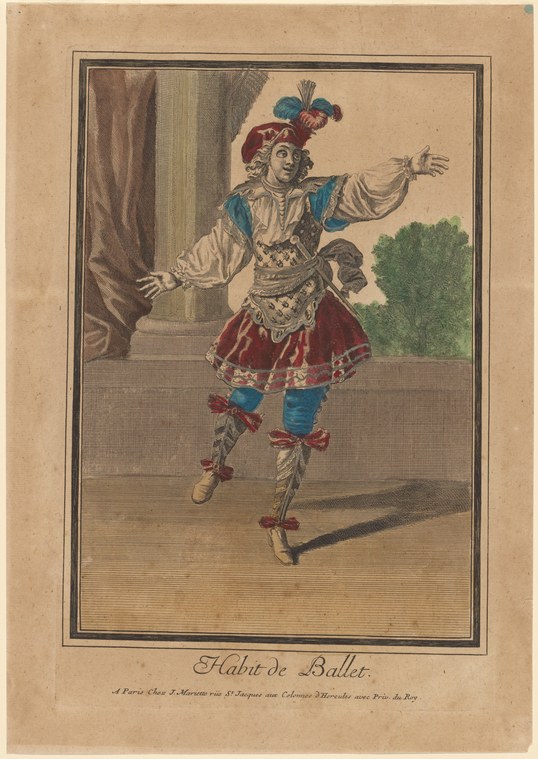
Habit de ballet
Unknown artist
- Medium:
- Dance:
- Ballet
- Source:
- New York Public Library
- Rights:
- Public domain — free to use, share and adapt.
- Recorded as:
- public_domain
This image preserves a moment of standardized male court ballet technique and costume as it was codified and circulated in the 18th century—a window into how dancers learned, how they were trained to appear, and what counted as proper carriage and movement in an aristocratic context. For dance historians, it is evidence of how ballet technique, fashion, and courtly ideology were inseparable; for artists, it shows how printmakers documented and legitimized dance practice through precise, elegant representation.
What you are looking at
A solo male dancer in elaborate 18th-century court dress performs on a shallow stage against a draped backdrop. He wears a richly embroidered coat in cream and blue tones, a burgundy skirt with decorative trim, blue hose, and heeled shoes—costume typical of the French ballet de cour tradition. His posture is upright and formal, weight lifted, with both arms extended in an open, welcoming gesture. The figure is caught mid-movement, one leg bent and raised, suggesting a moment of elevation or a petit allegro step. The composition is portrait-like in its isolation: a single performer framed against minimal scenery, with strong attention to the ornamental detail of the costume. The print's hand-coloring gives the fabric a jewel-like quality. The inscription below identifies this as a "habit de ballet"—a costume study or performance document of the kind widely circulated in the 17th and 18th centuries.
The dancing
A single male dancer stands in an upright, aristocratic posture with both arms extended asymmetrically—the nearer arm raised and open, the farther arm back. His torso is vertical and stable; the supporting leg appears straight or nearly so while the other leg is lifted and bent at the knee, suggesting a small jump or a rond de jambe en l'air. The carriage is that of a trained court dancer: turned out, lifted through the spine, with an ease of bearing that reads as aristocratic grace. There is no partner; the openness of the arm positions suggests either a soloist's flourish or the moment just after a figure where he might address an audience.
The dance depicted
This is a theatrical costume study, not a narrative scene, and depicts the fashion and training conventions of 18th-century French court ballet. The figure's posture, turnout, and arm positions align with the vocabulary of ballet de cour—the formalized court dance that preceded classical ballet. The lifted leg position and the upright frame suggest basic principles of port de bras and petit allegro that were central to male court dancing of the period. The absence of a partner and the direct, demonstrative arm gesture suggest this is either a male soloist's moment or a costume plate meant to display the proper attire and carriage of a male dancer of this era. The term "habit de ballet" on the inscription indicates this is a documentation of dance costume and deportment, possibly from a published series showing proper dress and technique for different dance roles.
How it was made
This is a hand-colored engraving or etching, a reproductive print made from an inked plate. The line work is precise and controlled, using fine parallel lines (hatching) to suggest fabric texture and shadow, particularly in the draped backdrop. Hand coloring in watercolor or gouache—applied after printing—gives the costume its jewel tones and subtle modeling. This technique was the standard method for circulating fashion and dance documentation in the 18th century: reproducible, portable, and affordable enough for distribution among dancers, patrons, and dance masters. The combination of careful engraving and selective coloring suggests this was made for a educated audience—choreographers, aristocratic patrons, or aspiring dancers—rather than the mass market.
About this work
This is an 18th-century costume study of a male dancer in full theatrical dress, presented as a single elegant figure in formal pose. The inscription "Habit de ballet" indicates it is part of a tradition of dance costume documentation that combined fashion illustration with a record of proper deportment and technique. The work sits at the intersection of fashion history, dance history, and courtly performance culture: it documents not just what dancers wore, but how they carried themselves and what bodily standards they aspired to. It is a primary source for understanding the physical culture of the French court ballet tradition and the transition toward classical ballet vocabulary.
How to look at it
Observe the lifted spine and turned-out frame: this is not naturalistic movement but a trained, aristocratic carriage. Look at the leg position—neither fully extended nor entirely relaxed, but bent and raised—which shows a moment of petit allegro (small jumping steps) or a transitional position between steps. The arm gesture is deliberately open and demonstrative, framing the body and addressing an imagined audience or partner. Note how the costume supports this: the heeled shoe, the fitted coat, and the structured skirt are all designed to emphasize line, lift, and turnout. The artist has frozen a moment of control and elegance rather than effort or transition—a pose that displays both the dancer's body and his proper dress.
The period
This print dates from the 18th century, an era when French court ballet was transitioning from its 17th-century roots toward the theatrical ballet of the 19th century. The vocabulary visible here—upright carriage, turned-out legs, lifted frame, formal arm positions—shows the codification of ballet technique that would be systematized in treatises like Kellom Tomlinson's *Art of Dancing* (1735) and Pierre Rameau's *Le Maître à danser* (1725). The circulation of such costume studies as engravings reflects the growing professionalization of dance and the expansion of ballet from court ritual to theatrical spectacle. Male dancers of this period were trained as virtuosos expected to master petit allegro, elevation, and a precise vocabulary of arm positions—all readable in the posture and gesture shown here.
Where it lives
This work is held in the New York Public Library collection and is a print from their holdings. It is catalogued as a hand-colored engraving or etching, typical of the documentary and instructional prints that were widely produced and distributed in 18th-century France to circulate knowledge of dance technique and fashion.
Dance in this work
Questions about this work
What does "habit de ballet" mean?
"Habit" is French for "costume" or "dress," and "ballet" refers to the theatrical and court dance tradition. The term denotes both the physical garment and the proper appearance and carriage expected of a dancer performing in that style. This inscription indicates the print is a costume study, showing proper attire for a male court ballet dancer.
Is this dancer showing me an actual dance step?
He is showing a trained posture and a moment of movement—likely a petit allegro step or a position between steps—but the primary purpose is to display the costume and proper deportment of a court ballet dancer. The pose is demonstrative rather than narrative; it aims to instruct viewers on how such dancers should carry themselves and appear.
Why are these prints in a dance collection?
Costume studies like this are primary sources for dance history. They document the physical training, vocabulary, and standards of beauty that defined a dance tradition. For historians and dancers, they reveal what movement looked like, how bodies were trained, and how dance was valued and transmitted in a particular time and place.
What was male ballet dancing like in the 18th century?
Male dancers were highly trained virtuosos expected to master elevation, small rapid footwork (petit allegro), and a formal vocabulary of arm and leg positions. They danced in heeled shoes, costumes that emphasized line, and within a strict courtly aesthetic. This print shows the carriage and technique expected: upright, turned out, precise, and aristocratic.
More Ballet artwork