45 works in this view — arrow keys or swipe to move between them.
Dance in Art · 1918
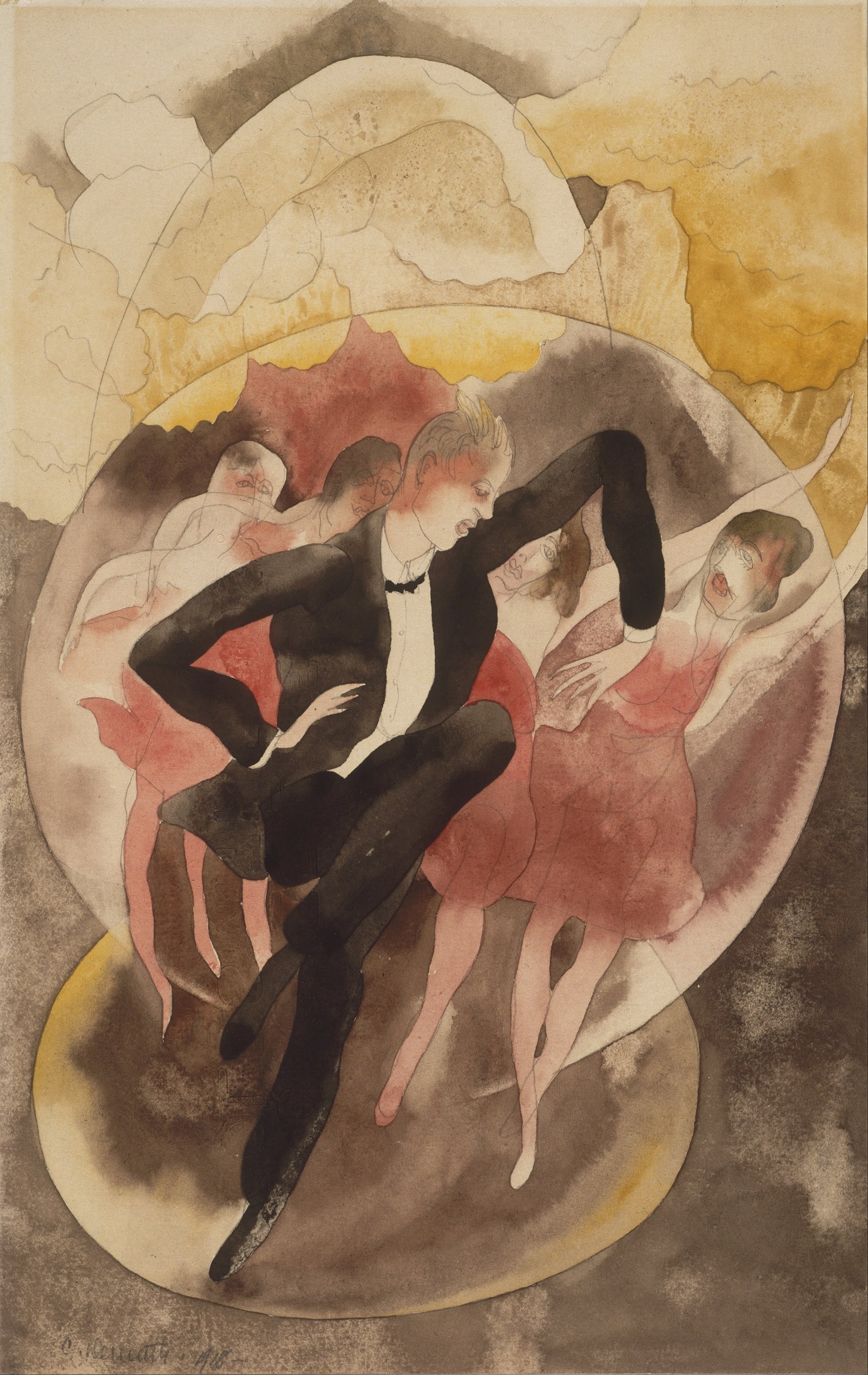
Charles Demuth, American - In Vaudeville (Dancer with Chorus)
Charles Demuth, American, 1883 - 1935 (1883 - 1935) – Artist/Maker (American) Born in Lancaster, Pennsylvania, United
- Medium:
- Oil Painting
- Era:
- 1900-1920 (Ragtime/Early Jazz)
- Source:
- Wikimedia Commons
- Rights:
- Public domain — free to use, share and adapt.
- Recorded as:
- Public Domain
Demuth was among the first American modernist painters to treat vaudeville and popular theatre as subjects worthy of fine-art attention, elevating commercial entertainment to the status of gallery practice. The work documents both a specific performance tradition and a moment when American dance history was expanding beyond ballet to include theatrical and vernacular forms. For dancers and choreographers, it offers a rare visual record of how the body moved in vaudeville performance and how that movement was perceived and abstracted by a serious visual artist.
What you are looking at
A theatrical vaudeville scene depicts a male dancer in formal black evening dress—tailcoat, white shirt, and dark trousers—executing a high leg kick or extension while three female dancers in rose-pink dresses watch or accompany him from behind. The composition is tightly framed within an organic, cloud-like border rendered in warm ochres, browns, and cream tones that suggest stage lighting or theatrical atmosphere. The male dancer's body is sharply delineated in black, creating strong visual contrast; his raised leg is nearly horizontal, the torso tilted back in a dynamic, energetic pose. The three women cluster together, their forms softer and less defined, wearing simple sleeveless dresses with their hair styled in the bobbed fashion of the 1910s–20s. The background washes of color—burnt sienna, ochre, deep brown—evoke both stage space and the warm glow of period theatrical lighting. The overall effect is one of kinetic energy and sophisticated entertainment, with the male dancer as the focal point and the chorus as supporting presence.
The dancing
The lead dancer's pose shows a high extension with a dramatically arched back, weight evidently on the supporting leg while the other leg rises sharply upward in what appears to be a kick or développé. His arms are positioned with some asymmetry—one raised, one lower—suggesting mid-movement momentum. The three women stand in close formation, their bodies more passive, their postures upright but not rigidly formal; they appear to be watching or witnessing rather than executing matching steps. The contrast between the sharp, linear definition of the male figure and the softer, more atmospheric rendering of the women suggests a hierarchy of attention and possibly different roles in the performance—soloist and chorus.
The dance depicted
This is a vaudeville dance scene, most likely depicting a moment from early 20th-century American entertainment theatre. The male dancer's high kick, tailored evening dress, and the formal staging suggest the kind of solo performance or leading-man role common in vaudeville shows, musical comedy, and early Broadway revue entertainment of the 1910s–1920s. The three female attendants or chorus members in simpler dress suggest the supporting ensemble typical of such productions. The pose itself—a high, dynamic extension—was a staple of both ballroom exhibition dancing and theatrical jazz/vernacular performance of the era, though the formal tailcoat indicates this is theatrical rather than social dancing. The image captures a moment of virtuosic display rather than partner interaction.
How it was made
This is an oil painting, as stated in the catalogue record. Demuth's technique here combines precise linear drawing in pen or ink (visible in the outlines of the figures and the organic border) with watercolor-like washes of pigment, creating a hybrid approach that blurs the distinction between drawing and painting. The soft, atmospheric color fields in the background and the sharp contours of the figures suggest the influence of both modernist draftsmanship and decorative theatrical design. This technique—economical in its means, expressive in its effect—was well-suited to commercial reproduction and gallery circulation, and speaks to Demuth's broader practice of translating theatrical and commercial subjects into fine-art materials.
About this work
Demuth's *In Vaudeville (Dancer with Chorus)* captures a moment of early 20th-century American popular entertainment: a male soloist in formal dress executing a dramatic high kick while three women in chorus dress observe or support the action. The painting combines precise draftsmanship with atmospheric color to evoke both the kinetic energy of the performance and the theatrical lighting that surrounded it. Created in 1918, during the height of vaudeville's popularity and at a moment when American modernists were beginning to take theatrical and commercial subjects seriously as sources for fine art, this work sits at the intersection of documentary observation and stylistic abstraction.
For historians of dance, the image provides valuable evidence of how vaudeville performance was understood and valued by the visual arts establishment of its time. The formal tailcoat, the high extension, and the chorus formation all document conventions of the era; Demuth's choice to paint this subject—rather than a classical ballet or concert dance—reflects the period's growing interest in vernacular American performance as worthy of serious artistic attention.
How to look at it
Attend to the contrast between the sharp black outline and dynamic pose of the male dancer and the softer, more diffuse rendering of the chorus figures. This contrast is not accidental: it tells us where Demuth wanted the eye to go and what role each figure plays in the narrative. Notice also the high energy of the pose—the leg extension, the arched back, the forward momentum—and consider what moment in the movement Demuth chose to freeze. This is not a moment of repose or symmetry, but of maximum extension and theatrical display. Finally, observe the frame itself: the soft, organic border suggests the glow and containment of stage lighting, making the picture plane itself read as a theatrical space. This framing device was a modernist innovation, but it also captures something real about how vaudeville performance was lit and experienced.
The artist
Charles Demuth (1883–1935) was a Pennsylvania-born modernist painter and watercolorist known for his precise draftsmanship, his engagement with commercial and popular subjects, and his development of an American Precisionist aesthetic. In the 1910s and 1920s, Demuth painted theatrical scenes, cabarets, circuses, and entertainment venues with the same seriousness he applied to still life and landscape. His work on vaudeville and theatrical subjects was part of a broader modernist interest in performance, motion, and the visual energy of American commercial life. Demuth was also a close observer of contemporary dance and theatre, and his theatrical paintings often convey both documentary accuracy and formal abstraction—a balance between capturing what he saw and translating it into modernist visual language.
The period
In 1918, when this painting was made, vaudeville was at the height of its popularity in the United States, representing the dominant form of live popular entertainment. The First World War was in its final year, and American culture was in transition. In the visual arts, European modernism—Cubism, Futurism, Expressionism—had recently reached American artists and galleries, creating new possibilities for how to represent contemporary life and movement. At the same time, American painters and writers were beginning to take vernacular and commercial culture seriously as subjects; the 1920s would see the emergence of the Precisionist movement, which Demuth helped define. In dance, this was the era of ragtime and early jazz dance, the rise of the Broadway musical, and the consolidation of tap dance as a theatrical form. Vaudeville performers were the celebrities and trendsetters of the day, and Demuth's decision to paint them reflects both the cultural vitality of the medium and the modernist appetite for new, vital, non-academic subjects.
Where it lives
The work is sourced from Wikimedia Commons, suggesting it is in public or accessible collection, though the catalogue record does not specify a current institutional holding. The painting is documented as an oil painting from 1918, now part of the historical record of American modernism and early 20th-century theatrical art.
Dance in this work
Questions about this work
What is vaudeville and why does it matter for dance history?
Vaudeville was a form of variety entertainment popular in America from the 1880s to the 1930s, featuring short acts of music, comedy, acrobatics, and dance performed in rapid succession. It was the dominant form of live popular entertainment before radio and film, and it created a demand for skilled dancers and choreographers who could develop new styles quickly and entertain large, diverse audiences. Vaudeville performers innovated in tap dance, jazz dance, acrobatics, and partnering, making it a crucial but often overlooked chapter in American dance history.
How does the formal dress of the male dancer relate to the performance style?
The tailcoat and evening dress indicate that this is a formal solo or 'specialty' act—the kind of refined, virtuosic performance that was a staple of vaudeville and early Broadway revue. Formal dress was standard for male leads in theatrical performance of the era, conveying sophistication and skill. The high kick and dynamic pose suggest that formal dress did not constrain the virtuosity of the movement; rather, the contrast between formal attire and athletic, extended movement was part of the appeal and the comedy or thrill of the act.
What do the three women in pink represent?
They are almost certainly the chorus or supporting ensemble of the act. Their simpler dress, passive poses, and secondary placement in the composition suggest they are there to frame or support the male soloist's performance. In vaudeville and Broadway shows of this era, chorus lines and supporting performers were essential to the visual spectacle and the narrative structure of the act, even when the spotlight (literally and figuratively) was on a single star.
Why would a modernist painter like Demuth paint a vaudeville scene?
In the 1910s and 1920s, European and American modernists were hungry for new subjects that reflected contemporary life, energy, and motion. Vaudeville was vibrant, popular, and visually dynamic—everything academic art was not. By painting vaudeville performers, Demuth was asserting that American commercial entertainment was as worthy of serious artistic attention as classical ballet or European high culture. This was part of a broader American modernist project to value vernacular and popular subjects.
More dance artwork