46 works in this view — arrow keys or swipe to move between them.
Dance in Art · 1917
Cute little wigglin' dance 1917
André De Takacs
- Medium:
- Oil Painting
- Era:
- 1900-1920 (Ragtime/Early Jazz)
- Source:
- Wikimedia Commons
- Rights:
- Public domain — free to use, share and adapt.
- Recorded as:
- Public Domain
This is primary evidence of how early-twentieth-century social dance appeared to its contemporary audience, and specifically how novelty ragtime dances—with their emphasis on hip and body movement—were visualized in popular media. It documents the tension between the formal ballroom tradition and the looser, more physically expressive movement that characterized modern social dance, a shift that scandalized conservative society but would ultimately reshape American dance culture.
What you are looking at
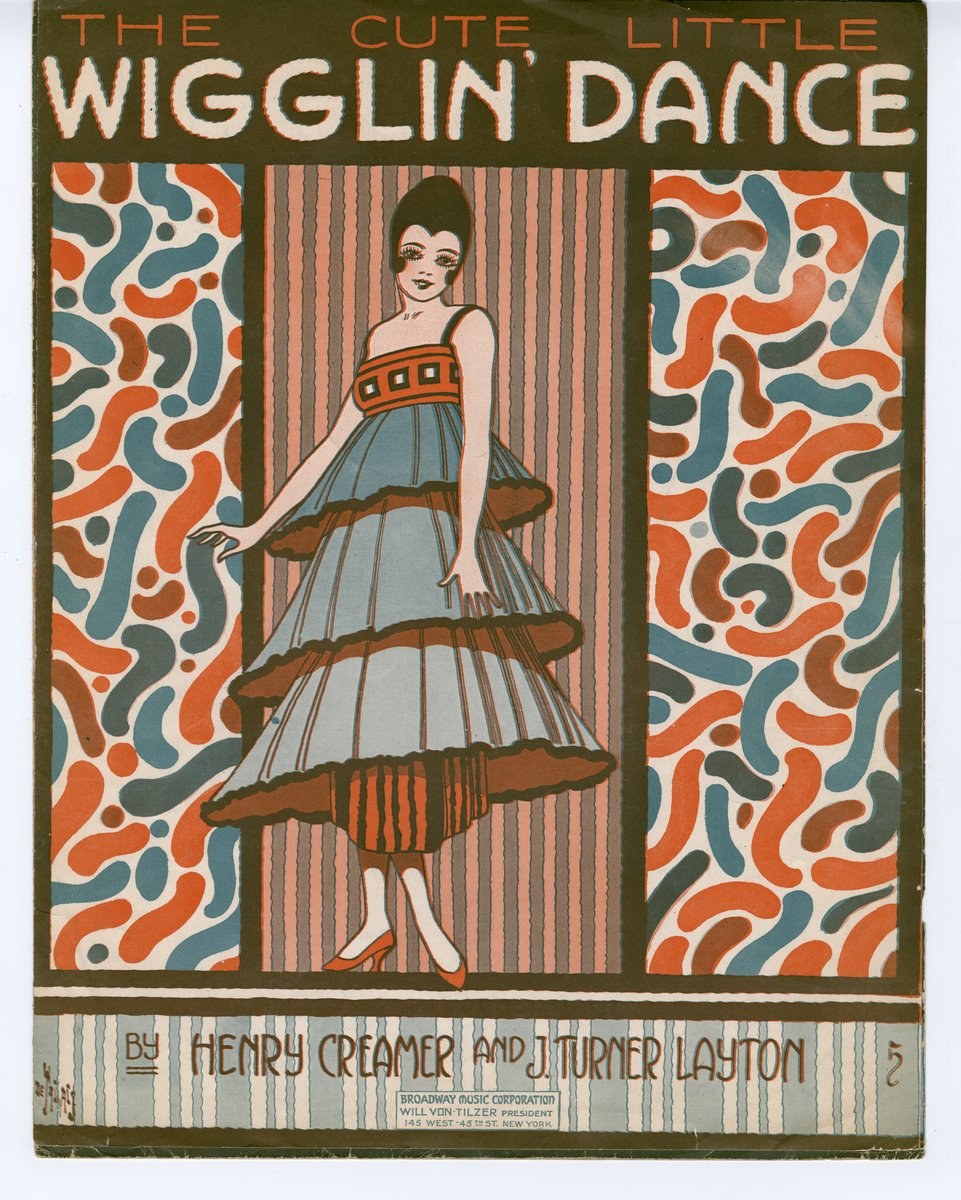
This is a sheet music cover for a popular song, rendered in the colorful Art Deco style of the 1910s. A single female figure dominates the composition, posed against a background of bold geometric patterns in rust, teal, and cream. She wears a pale blue dress with horizontal brown ribbon trim that creates distinct tiers across the skirt—a silhouette characteristic of the period's fashionable dancing dress. The figure stands in a three-quarter pose with her body angled and her arms extended in a relaxed, playful gesture. Her posture suggests movement; one leg appears to bear more weight while the other is slightly bent, suggesting the slight hip-swivel or shimmy motion the title references. The background comprises two geometric patterns: striped vertical panels behind the figure, flanked by abstract curvilinear shapes in orange and teal that evoke Art Deco ornamentation. The entire composition is framed by a dark green border.
The dancing
The dancer is shown as a single figure in a relaxed, unpartnered stance. Her upper body is held upright but loose, with both arms extended at roughly mid-chest height in a casual, open position—not a formal dance frame. Her legs suggest a slight knee bend and hip rotation rather than a structured weight shift. The asymmetry of her weight distribution and the gentle curve of her torso suggest the kind of gentle shimmy or wiggling motion that would have been considered playful and modern in 1917, distinguishing it from the stiff posture of earlier social dances.
The dance depicted
This depicts the social dancing of the 1910s ragtime and early jazz era, almost certainly a popular 'novelty' dance rather than a codified ballroom form. The title 'Cute Little Wigglin' Dance' directly references the hip and body motion that characterized early-twentieth-century popular dances influenced by African-American vernacular movement—a style that shocked more conservative observers. The dress, posture, and the energy suggested by the composition align with dances like the Turkey Trot or other animal dances that briefly swept ballrooms in the 1910s, though the title's emphasis on 'wiggling' points more broadly to any of the ragtime social dances of the period. The image captures not a performance or exhibition dance but a social dance meant for the ballroom—or more likely, the sheet music audience who wanted to imagine themselves dancing it.
How it was made
This is a chromolithograph, a color printing technique that allowed mass production of richly colored images. The design employs the bold, high-contrast color palette and geometric patterning characteristic of Art Deco printmaking, with careful separation of color layers to create sharp boundaries and vibrant hues. Chromolithography made this image affordable and widely distributed as sheet music cover art, placing it in the hands of amateur musicians and dancers across America. The technique required skilled registration and color separation, indicating this was professional commercial art intended for a substantial print run.
About this work
This sheet music cover captures a moment of social dance in the early twentieth-century American ballroom, rendered in the fashionable Art Deco style of 1917. It documents not a formal dance technique but the playful, body-centered movement of ragtime-era popular dances—the 'wiggling' social dances that represented modernity and a break from Victorian restraint. The image is significant both as evidence of how dancing bodies were imagined in commercial popular culture and as a record of the fashionable dress and bodily attitudes of the period's most contemporary dancers.
Sheet music covers were the mass media of dance in this era, reaching far more people than theatrical performances and shaping how ordinary Americans understood what modern dancing looked like. This cover is typical of how dance was marketed to the general public: playful, visually exciting, and positioned as accessible fun rather than elite entertainment.
How to look at it
Attend first to the posture: this is not the upright, centered stance of classical ballroom dance but a figure who leans slightly, with bent knees and a suggestion of lateral hip motion. The artist has frozen a moment of relaxed movement, not a held position. Notice also the dress: the horizontal bands of trim on the skirt are positioned to emphasize hip and leg movement, and their placement suggests the garment would move and ripple with a shimmy or wiggle. The background pattern, while decorative, uses vertical and wavy forms that echo the sense of undulating motion the dance itself embodied.
The artist
The catalogue attributes this work to André De Takacs, a commercial artist working in the Art Deco period. However, the image appears in reproductions credited to other designers, and the true attribution may be uncertain; sheet music covers were often collaborative commercial products with unclear individual authorship. The design exemplifies the high quality of commercial illustration produced for major music publishers in this era.
The period
The 1910s were a moment of rapid change in American social dance. The ragtime-influenced dances—the Turkey Trot, the Bunny Hug, the Grizzly Bear, and many others—represented a break from the controlled, vertical posture of nineteenth-century ballroom dance. These dances emphasized hip movement, body contact, and playful energy in ways that appalled moral authorities and delighted young dancers. At the same time, Art Deco style was emerging as the visual language of modernity, with its geometric forms and bold colors signaling a break from the ornate aesthetics of the previous century. This cover sits at the intersection of both revolutions: visual modernism and dance modernism, both rooted in a rejection of Victorian constraint.
Where it lives
This is a sheet music cover, reproduced from Wikimedia Commons. Sheet music covers from the Tin Pan Alley era (1890s–1920s) are abundant in archives and collections, as they were mass-produced popular merchandise. The specific holding collection for this example is not recorded.
Dance in this work
Questions about this work
What does 'wigglin'' mean in the context of 1910s dance?
The term refers to the swaying or shimmying motion of the hips and torso that characterized ragtime social dances and shocked conservative observers. It was considered modern and risqué because it emphasized the pelvis and lower body in ways that ballroom tradition had carefully suppressed. The term became synonymous with the newfound freedom and sexuality of Jazz Age social dancing.
Is this a real dance or just a catchy song title?
It almost certainly refers to a real social dance, likely one of the many novelty dances that swept ballrooms between 1910 and 1920. However, 'wigglin'' was general enough to describe several different dances of the period. The title was more important for marketing than anatomical specificity—any dance emphasizing hip movement could be called a 'wigglin'' dance.
Why are sheet music covers important for dance history?
Sheet music was the dominant way dance fashions spread before recorded music and film. A popular song's cover art shaped how millions of people imagined dancing, even if they never saw a professional performance. These covers are primary evidence of how dance was visualized, marketed, and understood in popular culture.
What does the Art Deco style tell us about this dance?
The modernist aesthetic—geometric, bold, energetic—positioned this dance as contemporary and forward-looking, not traditional. Art Deco design was the visual language of the Jazz Age, and its use here signals that this dance was part of a broader cultural moment of rupture from the past.
More dance artwork