42 works in this view — arrow keys or swipe to move between them.
Dance in Art · 1620
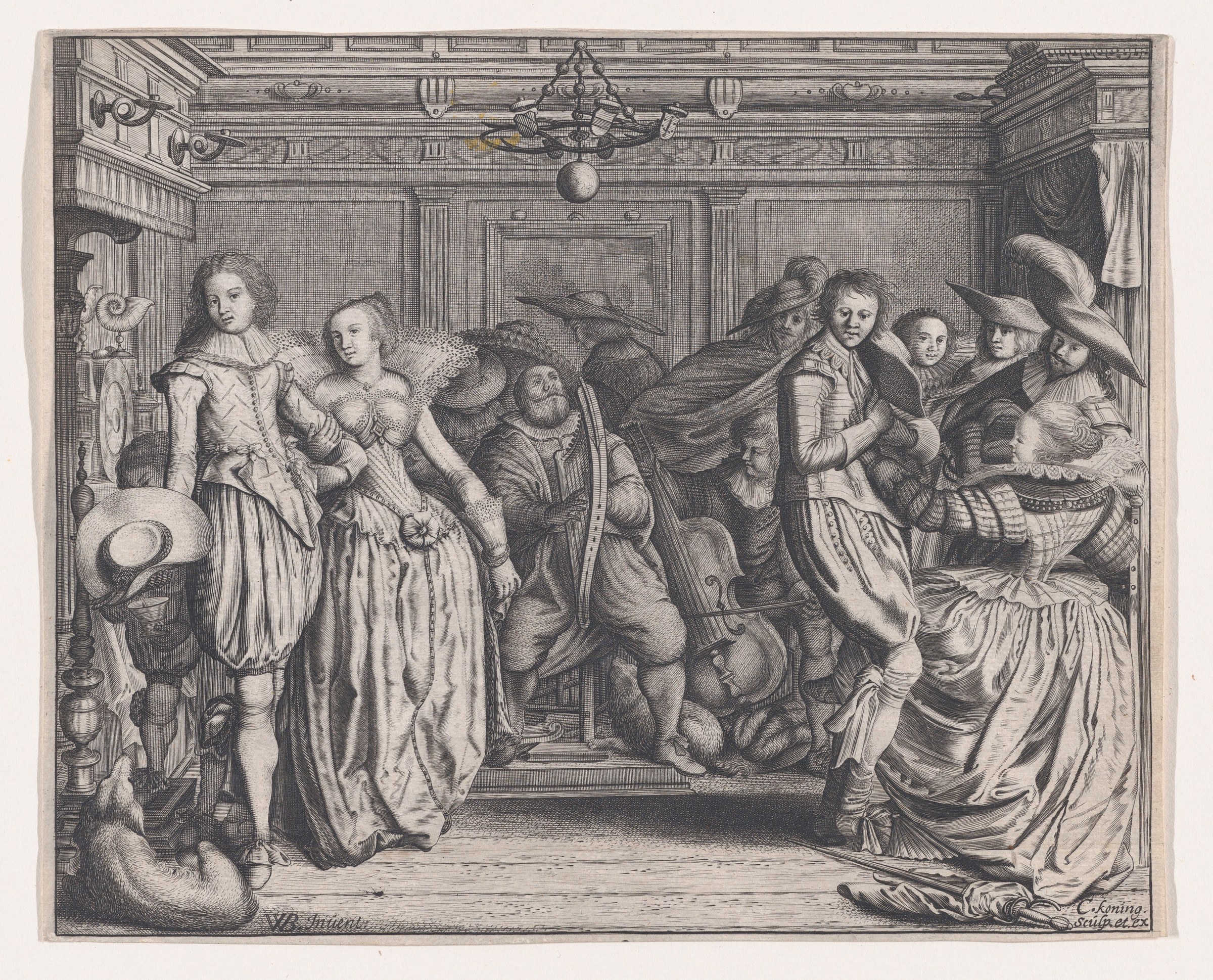
Interior with Dancing Couples and Musicians MET DP871798
Willem Pieterszoon Buytewech / Cornelis Coning
- Medium:
- Oil Painting
- Era:
- Pre-1700 (Renaissance/Baroque)
- Source:
- Wikimedia Commons
- Rights:
- Public domain — free to use, share and adapt.
- Recorded as:
- CC0
This engraving is a rare contemporaneous record of how courtly dance was actually performed and how artists observed it. It shows the body positions, holds, and spatial arrangement of early 17th-century social dance in precise detail, offering historians and dancers a credible visual source for reconstructing movement. The combination of mythological figures with everyday dance observation also reveals how Renaissance courts used dance as a form of entertainment that bridged the real and the allegorical.
What you are looking at
A formal indoor scene set within a richly decorated Renaissance or early Baroque hall, with coffered ceiling, ornamental fixtures, and classical architectural details. At least twelve figures occupy the space: on the left, two elegantly dressed women in flowing gowns and elaborate collars converse with a bearded man in rich costume and a winged helmet—evidently a figure of mythological or allegorical significance. In the center and right, three couples are actively dancing, their bodies in motion with skirts swirling and arms raised or extended. Behind them stand several observers, some in wide-brimmed hats and period dress, watching the proceedings. A dog rests in the foreground left. The scene captures a moment of courtly leisure and entertainment, with the dancers dominating the composition's energy while onlookers create a frame of social hierarchy and observation.
The dancing
The dancing couples show extended arm positions typical of Renaissance courtly dance, with partners facing or side-by-side in a rising, buoyant carriage. The women's bodies are lifted through the torso, their long gowns creating sweeping silhouettes as they turn; the men's frames are open and receptive to their partners. The nearest couple (center-right) show what appears to be a promenade or traveling step, with the woman's skirt caught in mid-swing. Hand holds vary between couples—some show clasped hands at shoulder height, others a lighter contact. The overall quality suggests the artist observed or understood the upright, processional quality of the period's social dances.
The dance depicted
This depicts social courtly dance of the early 17th century, most likely a galliard, courante, or similar fashionable dance of the Renaissance-to-Baroque transition. The setting and dress place it within the aristocratic entertainments of the Dutch or Flemish court circle. The presence of mythological or allegorical figures (the winged-helmeted man may represent Mercury or a similar figure) suggests this could be part of a courtly spectacle or masque-like entertainment, where dance and theatrical allegory were combined. The mix of active dancers and watchful courtiers reflects the social function of dance as both participation and display.
How it was made
This is an engraving (not an oil painting as the record states), executed with fine hatching and cross-hatching to create tonal depth and fabric texture. The technique allows precise rendering of architectural detail, costume, and the freeze-frame clarity essential to dance imagery. The crisp line work and small scale suggest this was a print made for circulation among educated patrons—a form that would have reproduced easily and reached a wider audience than a painting. The signature 'C Koning Sculpsit' (or similar) at bottom right indicates the engraver's hand, consistent with Northern European printmaking practice of the period.
About this work
A finely detailed engraving of a courtly dance scene set within an aristocratic interior, combining mythological allegory with the social observation of dance practice. The work records the form, dress, and social structure of early 17th-century elite dance entertainment, capturing both the physicality of the dancers and the ceremonial context in which they performed. It stands as evidence of how dance was understood and valued in the cultured circles of the Dutch or Flemish Renaissance—as a marker of refinement, courtship, and social status, and as a subject worthy of sophisticated artistic attention.
How to look at it
Attend to the moment of lift and turn captured in the nearest dancers' bodies—the engraver has frozen the instant of suspension and rotation that defines the galliard and courante. Notice how the women's gowns create a swirling spiral around their bodies, showing the speed and height of the movement. Observe the hierarchy of the scene: the active dancers occupy the centre and right, while the mythological or allegorical figure on the left anchors the composition in a higher order of meaning. The architectural frame and the watching courtiers establish this as a formal, documented occasion rather than informal merriment.
The artist
Willem Pieterszoon Buytewech (c. 1591–1624) was a Haarlem-born painter and printmaker known for lively genre scenes of courtly life, music, and social entertainment. He specialized in capturing moments of leisure and conviviality among the Dutch and Flemish gentry, often depicting musical performances, meals, and dances. His work is characterised by keen observation of costume, gesture, and social interaction, rendered with elegance and fine detail. Cornelis Coning is credited as engraver here, translating Buytewech's design into the print medium.
The period
In the early 17th century, courtly dance was at a peak of elaboration and cultural prestige in Northern Europe. The galliard and courante were among the most fashionable dances, and the ability to dance well was essential to aristocratic identity and courtship. Dance was often depicted in prints and paintings as a subject of moral significance (courtship, virtue, pleasure) and as a marker of social rank. Engravings of such scenes circulated among patrons who could not attend court entertainments, serving both as records and as idealised models of refined behaviour.
Where it lives
The work is recorded from Wikimedia Commons and appears not to have a specified holding institution in the catalogue. It is an engraving, likely produced in the early 17th century in the Netherlands for circulation among educated patrons and collectors of prints.
Dance in this work
Questions about this work
What dance are they doing?
Most likely a galliard or courante, the two most prestigious social dances of the early 17th-century court. The lifted carriage, the turning motion, and the buoyant rhythm visible in the skirts and bodies are typical of these dances. Without music or further context, it is difficult to be certain, but the setting and dress confirm this is elite courtly dance of the Renaissance-to-Baroque transition.
Why is there a man with wings in the scene?
He is likely an allegorical figure—possibly Mercury, Cupid, or another mythological character—introduced to give the dance scene a layer of meaning beyond simple entertainment. This practice was common in courtly spectacles and masques, where dance was often framed within a narrative or allegorical framework. His presence suggests this was a formal, designed occasion rather than casual social dancing.
Who made this print?
Willem Pieterszoon Buytewech, a Haarlem painter and printmaker, designed the scene; Cornelis Coning engraved it. Buytewech specialised in genre scenes of courtly life and entertainment. The engraving allowed the design to be reproduced and circulated among a wider audience than a painting could reach.
Is this what actual court dances looked like?
Yes, broadly speaking. The artist has clearly observed courtly dance and understood its characteristic features—the upright posture, the hand holds, the turning motions, the flowing gowns. However, the engraver has also composed the scene for visual effect, so not every figure may be in a historically accurate position. It is a stylised record rather than a documentary photograph, but a credible one.
More dance artwork