44 works in this view — arrow keys or swipe to move between them.
Dance in Art · 1921
Sakharoffs les (2)
George Barbier
- Medium:
- Watercolor
- Era:
- 1920-1950 (Swing Era)
- Source:
- Wikimedia Commons
- Rights:
- Public domain — free to use, share and adapt.
- Recorded as:
- Public Domain
The Sakharoffs were pioneering figures in modernist dance, and their influence on theatrical movement vocabulary and aesthetic philosophy extended across Europe and into the mid-twentieth century. This image preserves the appearance of their partnership and the visual grammar of their dance language at a moment when modern dance itself was still being defined and debated. For researchers studying early modernism in dance, design, and theatre, Barbier's watercolor is an important primary source: it shows what their work looked like to a cultivated observer, how it was promoted to the public, and how intimately dance, fashion, and visual art were intertwined in the 1920s avant-garde.
What you are looking at
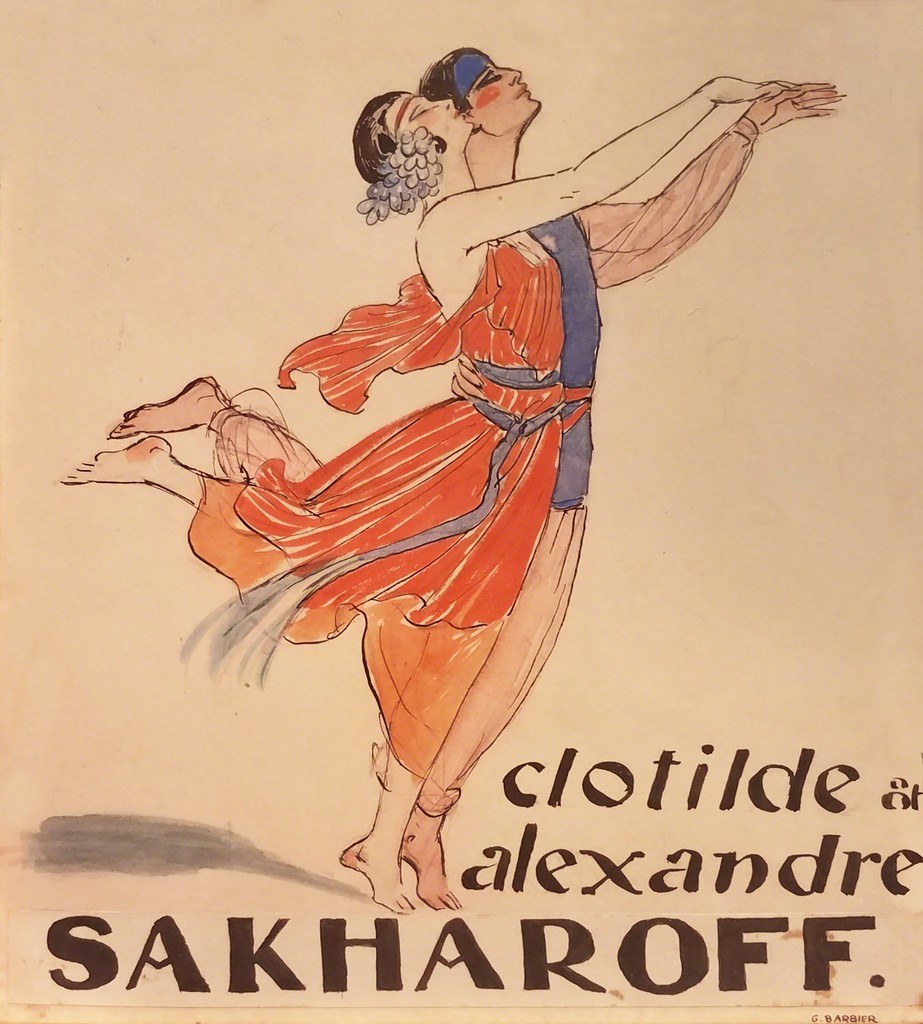
A young woman and man are depicted mid-dance in a buoyant, upward-lifting pose. The woman, positioned slightly forward and higher, arches her torso backward with her left arm extended outward and upward in an open, expressive line. Her right arm reaches toward her partner. She wears a vivid red and orange draped garment—possibly a tunic or loose overdress—that billows dramatically around her legs and trails in flowing curves. A blue headwrap or cap sits atop her dark hair, and large white cluster earrings hang at her neck. Her partner, wearing blue shorts and a sleeveless or minimal top, supports her from behind and below in an embrace, his face tilted upward, his right arm cradling her torso. The composition is set against a plain cream background with minimal setting details. The drawing style emphasizes fluid, graceful lines and warm watercolor washes—reds, oranges, and flesh tones dominate, with blue accents for the costume trim and headpiece. The overall effect captures a moment of joyful, almost weightless elevation, with both figures' bodies angled upward as though lifted by the dance itself.
The dancing
The pair are locked in a close partnership hold with the woman supported at hip and torso by the man, who stands slightly lower and behind. The woman's upper spine curves dramatically backward in extension; her right arm wraps around the man's shoulders while her left arm sweeps open to the side at shoulder height, with the hand relaxed and palm-downward. The man's posture is stable and upright, grounding the composition while appearing to generate lift. Both faces are tilted skyward. The woman's weight appears to rest on her partner rather than on her own feet, suggesting either a sustained lift or a moment of apparent weightlessness within the choreography. The overall frame is one of mutual support and upward momentum rather than the structured holds typical of ballroom dance.
The dance depicted
This image documents the Sakharoff dance aesthetic of the 1920s—a form of expressive, barefoot theatrical movement developed by Alexander and Clotilde Sakharoff. The painting captures the distinctive qualities of their work: fluid, modernist interpretations of classical and mythological themes, characterized by elongated lines, organic curves, and an emphasis on emotional expression over technical virtuosity. The dramatic backward arch, the open port de bras, and the ethereal quality of the pose suggest influences from classical ballet vocabulary reimagined through a contemporary, avant-garde lens. The exotic costume and the theme of uplifted, almost floating movement are hallmarks of the Sakharoffs' eclectic visual and movement language, which drew on diverse cultural sources while remaining firmly situated in early twentieth-century European modernism.
How it was made
This is a watercolor on paper, executed with a combination of transparent washes and opaque gouache. The artist, George Barbier, was a prominent Art Deco illustrator and designer known for his fashion and theatrical subjects. Barbier's technique here emphasizes luminosity and movement through the flowing application of warm hues—the reds and oranges of the fabric dominate, while the pale background and the clean line work of the figures allow the composition to read clearly at small scale. The medium was well-suited to theatrical illustration and fashion design of the period; these watercolors were reproducible and circulated widely as prints and in design publications, reaching audiences interested in modern dance, theatre, and fashion. The inscription at the bottom suggests this was a finished artwork intended for publication or display rather than a preliminary study.
About this work
This watercolor by George Barbier commemorates the Sakharoff dance partnership, one of the most innovative and influential avant-garde dance acts of the 1920s. Clotilde and Alexander Sakharoff performed a repertory of original choreography that fused classical ballet training, modernist aesthetics, and eclectic visual design; their work bridged the world of early twentieth-century experimental theatre and the emerging international modernist avant-garde. Barbier's image captures not a narrative moment but a signature pose—the lifted, arched frame and the open emotional expression that defined their movement vocabulary. The work is both a document of their actual practice and a promotional artifact; such illustrations were circulated among artistic circles, published in design and theatre journals, and helped establish the visual identity and international reputation of the Sakharoffs' work.
How to look at it
Attend to the upward trajectory of the composition: both figures' bodies angle skyward, their faces tilted, their limbs reaching outward and upward. This was a deliberate formal choice by Barbier, emphasizing the Sakharoffs' aesthetic of weightlessness and emotional transcendence. Note the contrast between the woman's fluid, extended spine and the man's grounded, supportive frame; this relationship encapsulates their partnership vocabulary. Observe how the bright red fabric is rendered with flowing brushstrokes that follow the movement of the body beneath it; the watercolor technique itself enacts the fluidity and grace of the dance. The pose itself—a sustained arch with open arms—represents a moment of elongation and vulnerability rather than the controlled symmetry or display typical of classical ballet; this signals the modernist reimagining of the body that the Sakharoffs pioneered.
The artist
George Barbier (1882–1932) was a French illustrator, painter, and designer who became one of the defining visual artists of the Art Deco movement. He specialized in fashion illustration, theatrical design, and society portraiture, and his elegant, stylized figures and sophisticated color sense made him a favored illustrator for Vogue, Harper's Bazaar, and other publications. Barbier was deeply engaged with the theatrical world of Paris and beyond; he designed costumes and sets, illustrated dance and performance imagery, and moved in circles that included many of the era's most innovative choreographers and performers. His watercolors and drawings of dancers, performers, and fashionable society figures are now recognized as important documents of 1920s visual and material culture.
The period
The early 1920s saw an extraordinary flourishing of experimental dance and theatre in Europe. The aftermath of World War I brought a period of cultural reinvention; the Ballets Russes continued to dominate international dance, but numerous independent choreographers and companies were developing alternative aesthetics. The Sakharoffs emerged in this context as figures who rejected narrative ballet spectacle in favor of intimate, emotionally intense movement chambers and small-scale productions. Concurrently, Art Deco visual design was crystallizing as the dominant aesthetic of the period, and illustration—particularly fashion and theatrical illustration—was becoming a primary vehicle for documenting and promoting avant-garde performance. Barbier's work sits at the intersection of these currents: his images made experimental dance visible and legible to a wider public, translating three-dimensional movement into elegant graphic form.
Where it lives
The work is identified here as a watercolor from 1921 based on the catalogue record and inscription. The source is given as Wikimedia Commons, though the holding collection is not recorded in the documentation provided. Barbier's dance illustrations were widely circulated as independent artworks, in publications, and as designs for theatrical use; the status of this particular work—whether it was a commission for the Sakharoffs, a preparatory study for a published illustration, or an independent artistic response—is not established by the available record.
Dance in this work
Questions about this work
Who were the Sakharoffs?
Clotilde and Alexander Sakharoff were a dance partnership of Russian and Italian origin who became major figures in avant-garde European dance during the 1920s and beyond. They performed together as a duo, developing an innovative movement language that synthesized classical ballet training with modernist aesthetics and drew on diverse cultural and artistic influences. Their work emphasized emotional intensity, sculptural body shapes, and intimate chamber-scale productions rather than spectacle. They were highly influential on the development of modern dance and experimental theatre.
What is Art Deco, and what does it have to do with dance?
Art Deco was the dominant visual design movement of the 1920s and 1930s, characterized by geometric forms, bold colors, stylization, and elegance. In the realm of dance and theatre, Art Deco visual language—graphic design, costume design, set design, and illustration—helped define how modernist performance was presented and perceived. George Barbier was one of the era's foremost practitioners of Art Deco illustration, and his dance images helped establish the visual identity of modernist performance for contemporary and international audiences.
What was George Barbier's role in documenting dance?
Barbier was a prolific illustrator of theatrical and dance performance, and his watercolors and drawings constitute an important visual archive of 1920s-30s avant-garde theatre and performance. He created costume designs, set designs, and promotional images for performances; his illustrations appeared in major fashion and design publications; and he worked closely with performers and choreographers. His images shaped how contemporary audiences understood and remembered modernist performance, and they remain among the most valuable visual records of the era's experimental dance practice.
Is this a record of an actual performance or a stylized interpretation?
This is almost certainly both: a stylized artistic interpretation grounded in observation of the Sakharoffs' actual movement practice and partnership. Barbier worked from live performance or from close knowledge of their work, but he rendered it through the elegant, simplified, and geometricized visual vocabulary of Art Deco illustration. The pose and the relationship between the figures reflect their actual choreography and aesthetic, but the image is not a documentary photograph—it is a designed and composed artwork meant to convey the essence and elegance of their dance to a viewer who may never have seen them perform.
More dance artwork