49 works in this view — arrow keys or swipe to move between them.
Dance in Art · 1915
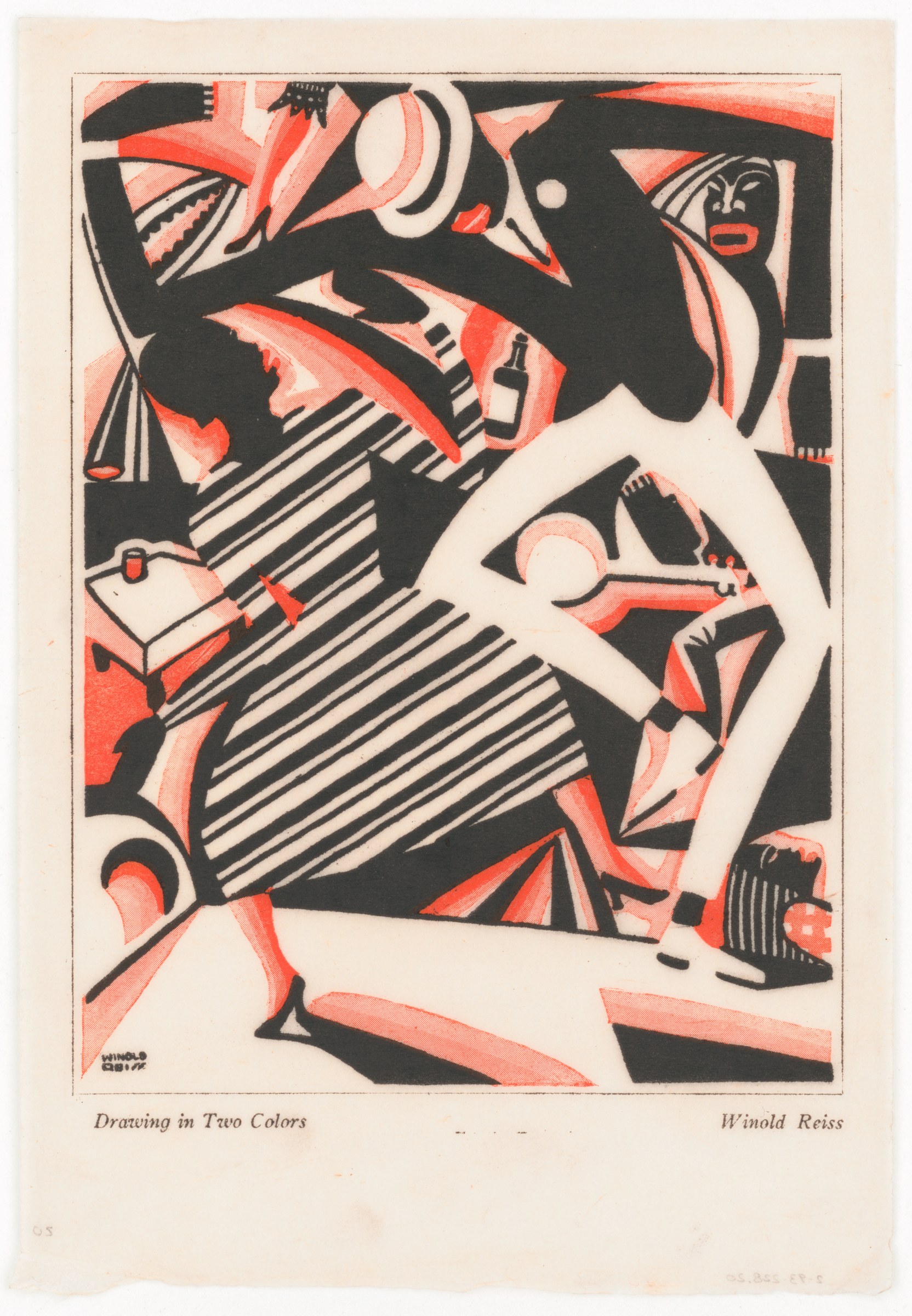
Weinold Reiss - Drawing in two colors
Winold Reiss
- Medium:
- Drawing
- Era:
- 1900-1920 (Ragtime/Early Jazz)
- Source:
- Wikimedia Commons
- Rights:
- Public domain — free to use, share and adapt.
- Recorded as:
- Public Domain
This work is one of the earliest and most sophisticated artistic attempts to visualize jazz dance as a modernist subject, doing so before jazz was widely canonized in fine art. It records the moment when African American vernacular dance began to be recognized by avant-garde artists as formally generative, worthy of abstraction and serious compositional treatment. For dancers and historians, it is evidence that the formal innovations of jazz were visible—and artistically urgent—from the 1920s forward.
What you are looking at
This lithograph compresses and abstracts the energy of Harlem jazz into a densely packed composition of overlapping geometric and curvilinear forms in red, black, and cream. The image does not depict a single legible moment but rather a visual simultaneity—multiple figures suggest dancers caught in fragmented, angular postures that spiral and intersect across the composition. Faces appear in profile and three-quarter view with sharp, cubist-influenced geometry; limbs extend and contract in staccato diagonals. A figure in white occupies the lower right quadrant with one leg extended, while red-tinted forms—some legible as arms, torsos, or fabric—thrust upward and outward around it. Parallel hatching in black suggests movement, shadow, or the vibration of sound itself. The overall effect is kinetic chaos rendered as controlled formal design, collapsing spatial depth so that foreground and background occupy the same visual plane.
The dancing
At least four to six human figures are suggested, though their boundaries often blur into the abstract scaffold of the composition. Bodies are fragmented and recombined: an arm appears separated from its torso, a leg extends into void, a head rotates at an impossible angle. Weight is distributed in sharp, asymmetrical poses—one figure appears to lunge or twist at the waist, while another seems to spring upward. The white figure in the lower register holds a clear contrapposto stance with one leg extended and the torso tilted, the only moment of relative anatomical coherence. Most limbs are shown in sharp flexion or extension rather than smooth, continuous movement, suggesting staccato, syncopated action rather than flowing, sustained motion. There is no ballroom hold or partnered embrace; figures exist in isolation even when overlapping.
The dance depicted
The work depicts jazz dance as rhythmic abstraction rather than representational narrative. The title 'Interpretation of Harlem Jazz I' makes clear the artist's intent to visualize not a specific dance or moment but the essence of early 1920s Harlem jazz culture as movement and sound. The fragmented, angular postures suggest the vernacular jazz vocabulary emerging in that era—weight shifts, twists, syncopated isolations, and improvisation—rather than codified ballroom or theatrical forms. The compression of multiple figures into one field suggests the crowding of jazz clubs and the simultaneity of collective performance and social dancing. No costume details, instruments, or architectural setting identify a specific venue or formal choreography, positioning this as an interpretation of jazz movement itself: modern, urban, and rooted in African American social and musical culture.
How it was made
This is a color lithograph (offset lithograph and halftone, according to the record) printed on Japanese paper, a combination that suggests deliberate modernist and artistic positioning. Lithography allowed Reiss to work with bold areas of solid color and strong line while maintaining tonal gradation through the halftone process. The use of Japanese paper rather than conventional European stock situates the work within early 20th-century artistic circles engaged with non-Western materials and aesthetic traditions. The technique's capacity for high-contrast graphic clarity made it ideal for the geometric abstraction Reiss pursued, and its reproducibility meant the image could circulate widely in art journals, galleries, and studios. This was not a fine-art one-off but a work designed for cultural circulation and debate.
About this work
This 1915–1920 lithograph by Winold Reiss visualizes Harlem jazz as a composition of angular, fragmented bodies and syncopated forms rather than as literal narrative or representation. Reiss, a German painter working in New York, was documenting the emergence of Harlem as a cultural center and jazz as a modern urban phenomenon. The work sits at the intersection of European modernism (Cubism, German Expressionism) and African American cultural production, using formal abstraction to render the vital, improvisatory character of jazz dance as it existed in clubs and social spaces. Rather than depicting a specific choreography or ballroom position, the print abstracts the essential qualities of jazz movement—discontinuity, syncopation, collective energy, and individual expression—into a visual language that could speak to both avant-garde art circles and the emerging Harlem intelligentsia.
How to look at it
Approach this not as a window into a legible scene but as a formal composition where movement and emotion are rendered through abstraction. Follow the diagonals and curves: the eye is meant to move restlessly across the surface without settling, mimicking the unpredictability and flow of improvised jazz. Notice how red and cream figures pop against the black ground, creating spatial ambiguity—what is foreground, what background? Observe the parallel hatching lines, which suggest both shadow and the vibration or resonance of sound. The white figure in the lower right is legible enough to anchor the composition in the body, but Reiss immediately dissolves bodies into angles and planes, asking you to feel rather than decode. The moment frozen here is not a single step or turn but a *condition*—the state of being in jazz.
The artist
Winold Reiss (1886–1953) was a German-born painter and muralist who emigrated to the United States and became deeply invested in documenting and celebrating African American life and culture. He was not himself African American but approached Harlem with genuine artistic respect and curiosity, producing paintings, murals, and prints that engaged with jazz, vernacular dress, and portraiture. His modernist training in Europe—influenced by Cubism and Expressionism—shaped his approach to figuration and color. Reiss worked as a commercial and fine artist, illustrating for *The Crisis* and other publications, and executing large public commissions. His engagement with Harlem was part of a broader 1920s intellectual and artistic movement that brought modernist formal innovation into conversation with African American cultural production.
The period
This work emerges during the Harlem Renaissance, the 1920s cultural flourishing of African American art, literature, music, and intellectual life centered in New York. Jazz had recently migrated northward from New Orleans and was rapidly becoming the soundtrack of urban modernity, associated with youth, sexuality, modernity, and racial transgression in the eyes of white America. Simultaneously, European modernism—Cubism, Futurism, Expressionism—was fragmenting representational form in the name of capturing sensation, speed, and psychological interiority. Reiss's print sits at the convergence: it applies modernist formal strategies to jazz as subject matter, asserting that African American dance and music possessed the same formal complexity and artistic significance as European high culture. The work predates (or exists alongside) more famous artistic engagements with jazz by artists like Stuart Davis and Aaron Douglas, making it an early instance of a modernist reckoning with jazz.
Where it lives
This print is held in the Wikimedia Commons and is sourced from an institutional collection not specified in the catalogue record. The work exists as an offset lithograph on Japanese paper, likely produced in an edition, and has circulated through print archives, art historical studies of the Harlem Renaissance, and digital repositories.
Dance in this work
Questions about this work
Is this a specific dance, or is Reiss just making an abstract pattern?
The title 'Interpretation of Harlem Jazz I' signals that Reiss is not depicting a named choreography but rather translating the *character* of jazz dance into visual form. He is abstracting the rhythmic, improvisatory, syncopated qualities of the vernacular dances he observed in Harlem clubs—the shifting weight, the isolated twists and jerks, the collective energy—rather than transcribing steps. This was a modernist strategy: other artists were also trying to visualize music and movement through abstraction rather than literalism.
Why is this in a dance collection rather than a fine-art collection?
Because it is explicitly about dance—the title claims it, the forms suggest dancers, and it intervenes in how dance was being represented and valued in the 1920s. This print, and others like it, were part of the artistic conversation around jazz as a modern, formally significant dance practice. It belongs wherever we are studying how artists have seen and represented dance across media and centuries.
What is Reiss doing differently from other modernist artists of the same period?
Reiss is centering African American vernacular practice—jazz and the bodies that danced it—as the subject worthy of modernist formal innovation. Many modernist artists of the 1920s were abstracting from European high-art sources or from non-Western 'primitive' art treated as design inspiration. Reiss is treating contemporary African American dance as a living, complex formal practice that generates its own modernist aesthetic, not as a exotic or naive source material to be mined.
More dance artwork