49 works in this view — arrow keys or swipe to move between them.
Dance in Art · 1914
Xavier Sager Paris pendant la guerre 4
Xavier Sager
- Medium:
- Oil Painting
- Era:
- 1900-1920 (Ragtime/Early Jazz)
- Source:
- Wikimedia Commons
- Rights:
- Public domain — free to use, share and adapt.
- Recorded as:
- Public Domain
This work shows social dancing in wartime as a subject worthy of celebration and mass circulation, and captures the actual movement and dress of ordinary people dancing socially—not trained performers. The postcard format and wide distribution make it evidence of how dance was imagined and remembered by the public during one of the defining moments of early modern Europe.
What you are looking at
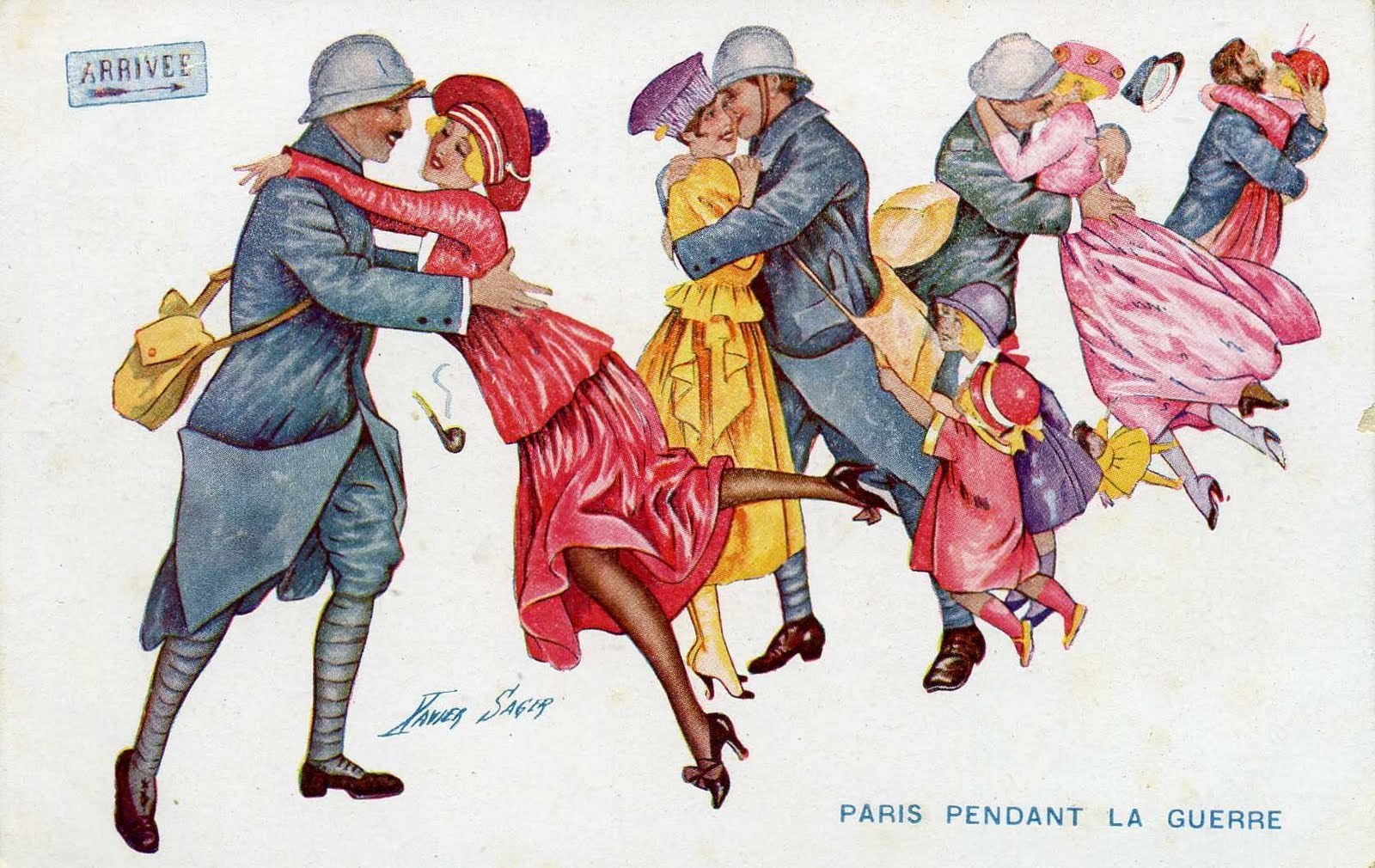
A color postcard from World War I depicting soldiers greeting and dancing with young women in a Parisian street or public space. The composition reads from left to right as a narrative of reunion and celebration: on the far left, a soldier in a steel helmet and blue uniform embraces a woman in a red dress with a red hat; in the center, another soldier dances with a woman in a yellow dress; on the right, a third soldier lifts and spins a woman in a pink dress, her legs flying, while a fourth couple dances in the background. The women wear bright, fashionable dresses in red, yellow, and pink with coordinating hats; the soldiers wear identical military uniforms with steel helmets. The setting is sparse and neutral, emphasizing the human figures. The artist has used bright watercolor tones and emphasized the energy and joy of the moment through exaggerated gesture and the dramatic swirl of fabric.
The dancing
The dancers move in closed and semi-closed holds typical of early 20th-century social dance, with the men leading and the women's bodies responding to the impulse. The couple on the right shows the most dramatic movement: the woman is lifted or spun with her skirt and leg fully extended, her body off-balance and trusting. The other couples show similar tilting frames and the kind of energetic, almost wild movement associated with celebratory social dancing rather than formal ballroom technique. The holds are intimate but not classical—these are not trained dancers but soldiers and civilians caught in an improvised moment.
The dance depicted
This depicts improvised social dancing—likely a waltz or a one-step quickstep—between soldiers and Parisian women during the First World War, probably at or near the end of the conflict when troops were returning to or passing through Paris. The dancing is characterized by exuberance and a lack of formal polish; the couples are not executing ballroom technique but rather moving together in the way soldiers and civilians would in a street celebration. The style is consistent with the popular dancing of 1914–1918, when the one-step and the foxtrot dominated, but the actual step pattern cannot be determined from the image. The postcard genre suggests this represents a widely circulated idea of the Paris reunion.
How it was made
This is a hand-colored or printed color postcard, a commercial popular print made for distribution and collection. The technique appears to be lithography with hand coloring or chromolithography—bright, flat colors that sit on the surface without depth or modeling. The artist has used bold outlines and simplified form to make the image readable at small scale and from a distance. Postcards of this kind circulated by the hundreds of thousands during and after World War I, serving as mementos, messages, and propaganda. The medium guaranteed a wide audience among soldiers, civilians, and international correspondents.
About this work
This is a wartime postcard titled *Paris pendant la guerre* (Paris During the War), created by the French artist Xavier Sager during the First World War. It celebrates the reunion of soldiers and Parisian civilians through the language of social dance, showing multiple couples in the midst of celebratory improvised movement. The postcard documents not a formal dance or a ballroom but a street scene of wartime joy—a moment of relief and reunion captured and mass-produced for circulation across Europe. The work is valuable both as a visual document of early 20th-century social dance practice and as evidence of how dance and celebration were used to represent national recovery and civilian morale during the war.
How to look at it
Notice the moment the artist chose: not the beginning of the dance but the height of energy and abandon, with one couple lifted and spinning. The artist has frozen the moment of greatest movement and joy, using exaggerated gesture and flying fabric to convey abandon rather than grace. The uniforms and bright civilian dresses create a social contrast—these are people from different worlds coming together—and the bright colors and bold outlines make the image readable as a postcard, meant to be sent in the mail and read quickly. The composition moves left to right in a kind of narrative of increasing energy and intimacy.
The artist
Xavier Sager (1874–1950) was a prolific French illustrator and postcard artist specializing in social subjects, fashion, and the everyday life of Paris. He was particularly known for colorful, energetic compositions of women and soldiers, and for capturing contemporary dress and manners. His postcards were widely distributed during and after the First World War and remain common in archives and collections. Sager's style is characterized by bold color, strong outlines, and an emphasis on movement and social interaction.
The period
During the First World War, dance became a symbol of national resilience and civilian morale. Soldiers on leave sought out cabarets and dance halls; women danced with soldiers as an expression of patriotism and civic engagement. The one-step, foxtrot, and other American-influenced dances had become popular in Paris in the years before the war and remained dominant during it, replacing the older waltzes and quadrilles in public favor. Postcards like this one served as visual records of contemporary life and as messages of hope and normality during the conflict. By the end of the war, images of dancing soldiers and civilians had become iconic representations of victory, reunion, and the return to civilian life.
Where it lives
The work is recorded as a postcard in the *Wikimedia Commons* database. The original holding institution is not recorded. It is a commercial color print, one of thousands of similar postcards produced and distributed during the First World War.
Dance in this work
Questions about this work
What dance are they doing?
The image shows improvised social dancing rather than a formal step pattern. Given the date and setting, it is likely a one-step, foxtrot, or waltz—the popular dances of 1914–1918. The artist has emphasized energy and movement rather than technique, so the specific dance cannot be identified with certainty. These couples are dancing in a celebratory moment rather than demonstrating ballroom form.
Why is this a postcard?
Postcards were the dominant form of mass image circulation in Europe during and after the First World War. They could be sent through the mail, were cheap to produce and collect, and allowed soldiers and civilians to share images of home, celebration, and contemporary life with friends and family. Wartime postcards like this one often celebrated patriotic themes and moments of civilian morale.
When was this made?
The title and composition suggest this was made during or immediately after World War I, 1914–1918. The date given in the record is 1914, which may be when the image was first printed, though postcard images often circulated for years after their initial publication.
Is Xavier Sager famous?
Sager was a prolific and commercially successful postcard illustrator whose work was widely distributed across Europe. He is well represented in postcard collections and archives but is not widely known outside that context. His importance lies in his role as a documentary recorder of French fashion, manners, and social life during the early 20th century.
More dance artwork