49 works in this view — arrow keys or swipe to move between them.
Dance in Art · 1745
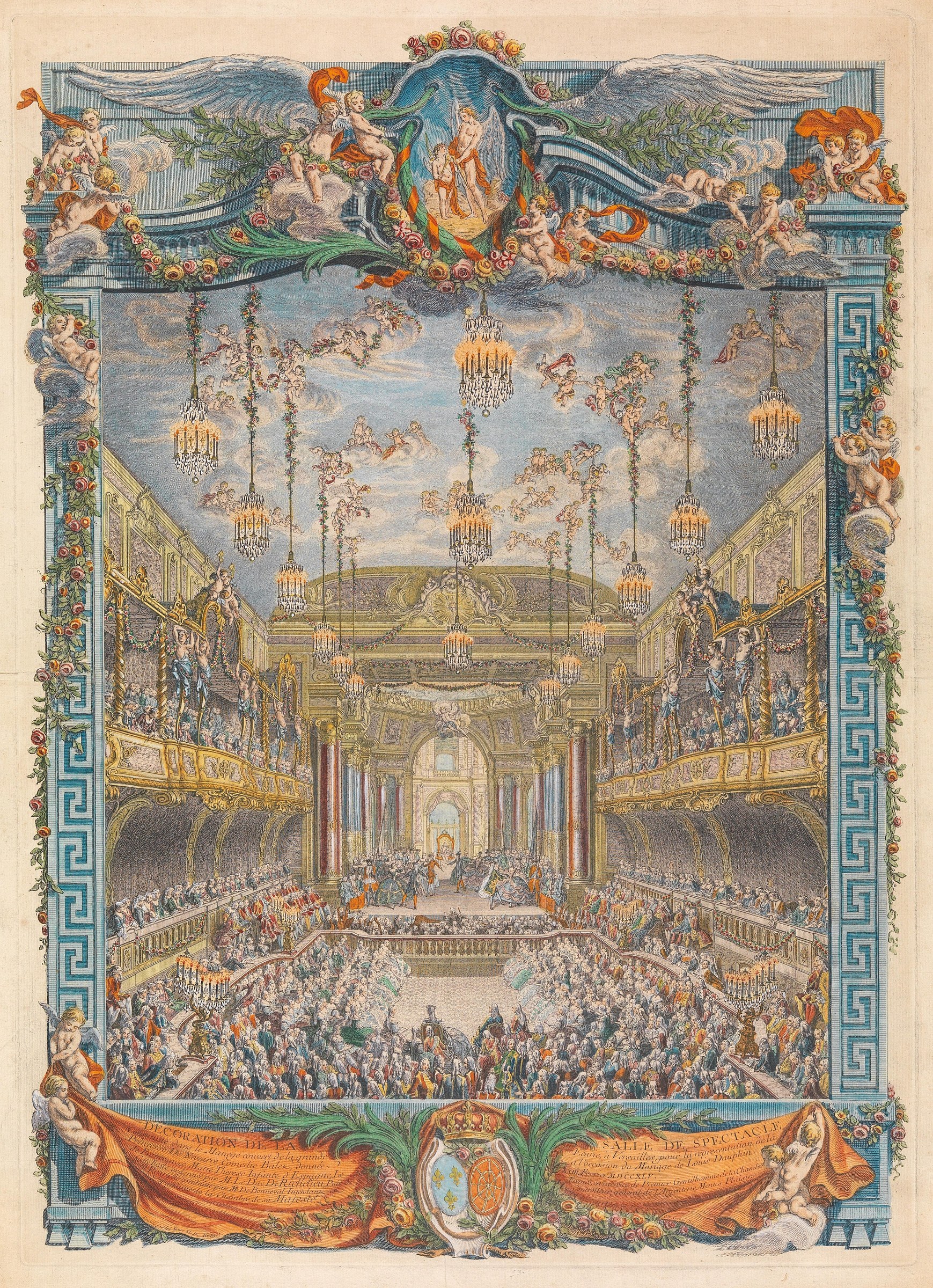
Cochin Décoration des la salle de spectacle Versailles 1745 colorized
Charles-Nicolas Cochin
- Medium:
- Oil Painting
- Dance:
- Ballet
- Era:
- 1700s (Enlightenment/Minuet Era)
- Source:
- Wikimedia Commons
- Rights:
- Public domain — free to use, share and adapt.
- Recorded as:
- Public Domain
This image is one of the few surviving visual records of an eighteenth-century court ballet in performance, and it uniquely documents the spatial and social experience of a Versailles spectacle from the audience's perspective. For historians of ballet, opera, and court ceremony, it is invaluable evidence of the scale, setting, and integration of dance into courtly life. Dancers and choreographers studying the history of ballet can see how the art was framed and consumed in its original context—not as isolated movement, but as one element of an overwhelming sensory and social experience.
What you are looking at
This is a perspectival rendering of an ornate Baroque theatre interior during a performance, rendered as a colored engraving or aquatint. The viewpoint is from the pit, looking toward a distant stage where figures perform before a painted backdrop. The theatre is lavishly decorated with gilt architectural elements—columns, entablatures, and ornamental borders—and hung with enormous crystal chandeliers that glow golden. Two tiers of galleries rise on either side, packed with spectators in the dress of the 1740s: men in coats and wigs, women in elaborate gowns. The floor of the pit is crowded with standing and seated figures; the scale suggests an audience of hundreds. The composition is framed by a decorative border of acanthus scrolls, putti, and floral ornaments in the Rococo manner, with ribbon cartouches at bottom bearing text (legible as Latin dedicatory inscriptions). The entire image is designed to commemorate the occasion and the magnificence of the court spectacle.
The dancing
The performers on stage are too distant to read in anatomical detail, but their silhouettes suggest formal classical postures characteristic of court dancing and theatrical ballet of the period. Figures on stage appear to be in upright, dignified postures; no vigorous jumping or violent movement is visible at this distance. The audience members in the galleries and pit display the static, observing postures of spectators—standing, seated, conversing, attending. The spatial recession and tiny scale of the performers emphasize the architecture and the assembled court rather than the bodies of the dancers.
The dance depicted
The existing catalogue record identifies this as a performance of Rameau's *La princesse de Navarre* on 23 February 1745 at Versailles, part of celebrations for the Dauphin's marriage. Rameau's opera-ballet was a major court spectacle integrating music, dance, and elaborate staging. The distance and scale make it impossible to identify specific dances or steps from the image alone; what is visible is the theatrical convention of the 1740s: court ballet as a component of opera, performed on a raised stage before a formally dressed audience in a purpose-built hall. The work documents how ballet appeared to the court—as a distant, formal spectacle integrated into courtly ceremony and the display of royal magnificence.
How it was made
The catalogue identifies this as an oil painting, but the image is visually consistent with a colored engraving or aquatint—a print hand-colored after printing. The technique is evident in the fine parallel lines used for shading and the precision of the architectural perspective. If this is indeed an oil (as the record states), it is unusual in its graphic, print-like clarity and its commemorative function. The technique allowed for mass production if it is a print, or for the creation of a permanent painted record if it is truly oil on canvas. Either way, the work was designed as a document of the occasion, circulating among the court and posterity as evidence of royal splendor.
About this work
This is a commemorative view of a court ballet performance at Versailles in 1745, showing the theatre, audience, and distant performers as integrated elements of a grand spectacle. It is not primarily a record of the dance itself, but of the social and architectural context in which court ballet existed—the building, the assembly of nobility, the formal occasion. The work belongs in a dance gallery because it documents how theatrical ballet was framed, viewed, and valued by the aristocracy of the Enlightenment: as a component of courtly ceremonial rather than as an autonomous art form, and as a visual spectacle dependent on distance, scale, and architectural grandeur. It shows the viewer what a court ballet looked like to an audience member, and how that audience understood the event as theater, ceremony, and display.
How to look at it
The viewer should attend to the structure of the composition: the artist chose a vanishing-point perspective that collapses distance and emphasizes the architecture, making the performers tiny and the building colossal. This choice reflects the actual experience of watching court ballet from the pit or galleries—the dancers were distant, formal, and framed by ornament. The eye is drawn to the chandeliers, the galleries, and the assembled crowd before settling on the stage. Notice the density of the audience and the formality of their dress: this was not a public theatre but a private royal event, and the image records the attendance of the entire court. The frame of scrolls and putti is typical of commemorative engravings meant for the collector's cabinet, emphasizing that this is a prestige object celebrating a specific occasion.
The artist
Charles-Nicolas Cochin (1715–1790) was a French engraver, draughtsman, and theorist of the arts. He was court artist and engraver at Versailles and a major documenter of court spectacles and ceremonies. He produced numerous engravings of theatrical performances, ceremonial events, and architectural schemes, combining precise perspective with celebratory detail. His work on court performances is among the most reliable visual sources for understanding the appearance and scale of eighteenth-century courtly spectacle.
The period
In the 1740s, court ballet in France was at a transitional moment. The great age of pure court ballet had passed; dance was increasingly incorporated into opera-ballet and theatrical spectacle. Rameau was the leading French composer in this form, and his works for the stage combined Italian opera seria traditions with French courtly elegance. The same decade saw growing interest in documenting and celebrating court performances through engravings, as the aristocracy sought to record and circulate images of royal magnificence. The Rococo aesthetic dominated design and ornament; the theatre shown here is a showcase of gilt, mirrors, chandeliers, and elegant architectural forms. Ballet as a purely aristocratic practice was beginning to professionalize, though court ballet remained a central element of royal ceremonial through the 1780s.
Where it lives
The image is listed as sourced from Wikimedia Commons; no holding collection is recorded. The work is catalogued as an oil painting dated 1745, but the visual evidence suggests it may be a colored print (engraving or aquatint) or a painting made after such a print. The record lacks accession information and current location.
Dance in this work
Questions about this work
Can you see the actual dancing?
No. The perspective places the viewer in the pit or lower galleries, so the performers on stage are too distant to read as individual bodies or to identify specific steps or formations. You see silhouettes and postures, which are upright and formal, but no footwork or detailed movement. This distance reflects the reality of watching court ballet: the spectacle was as much about architecture, costume, and scale as about the movement itself.
Who were the dancers?
The catalogue identifies the performance as *La princesse de Navarre* by Jean-Philippe Rameau on 23 February 1745. Court ballets of this period included professional dancers, sometimes traveling from Paris, and occasionally noble amateurs. The performers are not individually identified in this image or the record.
Is this an accurate record of what happened?
Yes, in broad structure. Cochin was a careful documenter and an eyewitness. The perspective, architecture, scale, and crowds reflect the actual dimensions of the Grande Écurie theatre and the size of the court. However, like all commemorative prints, it emphasizes grandeur and order; it may smooth away crowding, noise, and accident. It shows what the event looked like idealized, not photographically.
What is the text at the bottom?
The ribbons carry Latin dedicatory inscriptions identifying the occasion and the artist. Cochin often included such inscriptions on his prints to establish the authority and importance of the work. The exact text is not legible at this reproduction size.
More Ballet artwork