49 works in this view — arrow keys or swipe to move between them.
Dance in Art · 1673
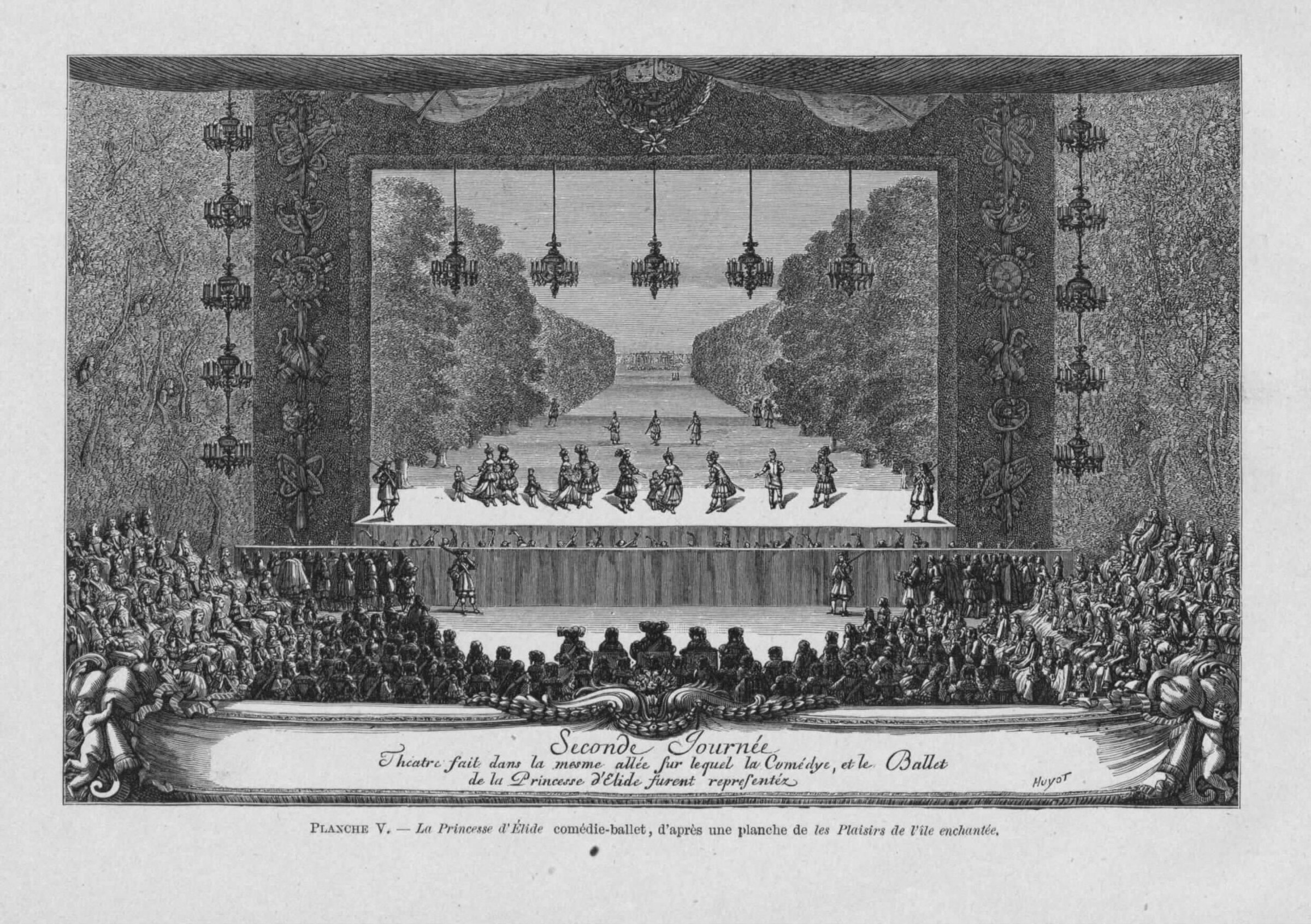
Dictionnaire historique et pittoresque du théâtre et des arts, La Princesse d'Élide, Versailles, 1664 - Gallica bpt6k2043674
Jules Huyot / After Israel Silvestre
- Medium:
- Engraving
- Dance:
- Ballet
- Era:
- Pre-1700 (Renaissance/Baroque)
- Source:
- Wikimedia Commons
- Rights:
- Public domain — free to use, share and adapt.
- Recorded as:
- Public Domain
This is a first-hand record of a pivotal collaboration—Molière, Lully, and Beauchamp created the template for the ballet de cour that would dominate European court entertainment for decades. The image documents the visual apparatus of court spectacle at the moment when dancing was becoming a court art form worthy of architectural investment and printed commemoration. For any student of theatrical dance, Baroque aesthetics, or court culture, this work shows how dancing functioned as spectacle and as social performance in the world's most powerful court.
What you are looking at
This engraving depicts the premiere of Molière's *La Princesse d'Élide* performed at Versailles in 1664, presented here as a theatrical spectacle within a palatial gallery. The stage occupies the middle distance, framed by elaborate architectural elements: trompe-l'oeil backdrop depicting formal gardens receding toward a horizon, flanked by richly patterned walls with ornate gilt details and hanging crystal chandeliers. The stage floor is populated with a corps of dancers in period dress—women in full skirts, men in court attire—arranged in loose formation at various depths, suggesting orchestrated movement through the shallow stage space. The foreground shows a crowded auditorium packed with spectators: elegantly dressed courtiers and their companions occupy tiered seating, their attention focused on the performance. The composition emphasizes both the spectacle and the occasion: this is high entertainment for the court elite, with the dancing inseparable from the architecture, music, and visual machinery surrounding it.
The dancing
The dancers visible on stage are arranged in small groups and couples scattered across the playing space rather than in rigid lines. Several pairs appear to be in intimate proximity, suggesting partner work typical of court dances. The women's full skirts, captured mid-billow, indicate movement through turns and traveling steps; the men's poses vary from active participation to supporting positions. The scale is small enough that individual footwork is not legible, but the overall impression is of controlled, courtly motion rather than athletic display. Some figures appear stationary while others suggest passage across the stage, creating a sense of choreographed spatial pattern.
The dance depicted
This is a theatrical court ballet, a mixed-media spectacle combining dancing, scenery, music, and drama characteristic of the *ballet de cour* tradition. *La Princesse d'Élide* was a comedy-ballet created by Molière, Pierre Beauchamp (the king's dancing master), and Jean-Baptiste Lully; it premiered at Versailles during the royal fête of 1664. The dancers are almost certainly members of the court rather than professionals—the king himself occasionally danced in such entertainments—and the choreography would have emphasized elevation, turning, and the geometric patterns of aristocratic courtship. The fact that this performance is documented in an engraving published nine years later attests to its significance as a court spectacle.
How it was made
This is an engraving, identified as a work after Israel Silvestre (the renowned topographical engraver who documented French court life) and republished by Jules Huyot in 1673, nine years after the original performance. Engraving allowed precise rendering of architectural detail and crowd scenes, making it the ideal medium for documenting the machinery and arrangement of court spectacle. The fine cross-hatching throughout creates tone and depth; the technique permits both legible architectural precision and atmospheric rendering of the crowded hall. The reproduction in Pougin's 1885 dictionary suggests this image circulated as evidence of 17th-century theatrical practice, a function it still serves.
About this work
This engraving documents one of the foundational works of French theatrical dance: a ballet de cour that united Molière's comedy, Lully's music, and Beauchamp's choreography in a single court entertainment. The image shows not just the dancing but the entire machinery of court spectacle—the stage architecture, the trompe-l'oeil scenery, the massed audience, the hanging lights—that made such entertainments legible as high art. For dance historians, it is evidence of how court ballet was embedded in courtly social and visual practice, and how the king's dancing master translated aristocratic social dance into staged spectacle. The work sits at a crucial moment: the professionalization of French dance was already underway, but the court ballet remained the prestige form, a arena where nobility danced alongside professionals to demonstrate courtly virtue.
How to look at it
Attend first to the architecture: the stage is a frame within a frame, its perspective emphasized by the formal gardens depicted on the backdrop. The dancers are small figures distributed across this deep space, which allows them to create patterns the whole room can read at once. Notice how the painter has positioned the chandelier directly above the stage—light as architectural element, not as atmospheric effect. The crowd in the foreground is rendered with the same precision as the stage; this is a documentary image, a record of the *occasion* as much as the performance. Look at the scale: these are courtiers in a room, not trained athletes on a stage, and the engraver has carefully preserved that distinction.
The artist
Israel Silvestre (1621–1691) was the preeminent topographical engraver of the French court, specializing in representations of royal fêtes, architecture, and ceremonies. His meticulous documentary approach made him the visual historian of Louis XIV's court; his engravings of festivals, processions, and theatrical events were circulated as prints and provided the most detailed surviving records of court spectacle. Jules Huyot's republication of Silvestre's work in the 19th century testifies to his historical importance—Silvestre's engravings had become primary sources for the study of 17th-century court culture.
The period
The 1660s were a transformative moment in French dance. Louis XIV, who loved dancing and had been trained by Beauchamp, was consolidating court power through magnificent spectacles. The ballet de cour—a mixed form combining court dances, spoken drama, and instrumental music—was the prestige entertainment form. Molière's creation of the *comédie-ballet* with Lully was a calculated innovation: it democratized court ballet slightly (professionals and courtiers danced together) while maintaining its aristocratic associations. The fact that this performance was documented in print within a decade shows how seriously the court regarded such spectacles as monuments to royal magnificence and cultural sophistication. By the 1680s, the Paris Académie Royale de Danse (founded 1661) was codifying dance technique, and the engraved manual *Chorégraphie* (published 1700) would make notation the standard. This image falls in the middle of that transition: dance as performed courtly spectacle, not yet fully notated or theorized.
Where it lives
The print derives from a 1673 publication, itself a reproduction of documentation by Israel Silvestre of the original 1664 premiere. The version referenced in the catalogue record appears in Arthur Pougin's *Dictionnaire historique et pittoresque du théâtre et des arts* (1885), where it served as historical evidence of 17th-century theatrical practice. This is a secondary engraving, made for a reference work—its purpose was didactic documentation rather than fine-art circulation.
Dance in this work
Questions about this work
Did the king dance in this performance?
The catalogue record does not specify, but Louis XIV was an accomplished dancer and frequently danced in court ballets, including some of Beauchamp's works. The composition of the stage suggests that both courtier-amateurs and trained dancers participated, which was typical of the ballet de cour genre.
What is the scenery on stage?
The backdrop depicts formal gardens in perspective, receding toward a distant horizon—a trompe-l'oeil effect that uses linear perspective to create an illusion of depth. This kind of illusionistic scenery was a technology the French court imported from Italy and displayed as a mark of sophistication. The side borders are draped fabric or panels painted with ornamental designs.
How do we know this is *La Princesse d'Élide*?
The engraving is inscribed with the title and identified as a premiere from 1664 performed in the gardens of Versailles during a royal fête. The catalogue record and the inscription on the print itself confirm the identification. The work has become a canonical example in the history of the ballet de cour precisely because it was documented.
What is a ballet de cour?
A ballet de cour was a theatrical spectacle mixing court dances, music, declaimed text, and spectacular machinery, performed by courtiers and professionals for the king and the court elite. They were vehicles for the display of courtly virtue (grace, wit, obedience) and royal magnificence. By Molière and Lully's time, they were becoming more theatrical and less purely courtly, though still performed in court venues.
More Ballet artwork