49 works in this view — arrow keys or swipe to move between them.
Dance in Art · 1800
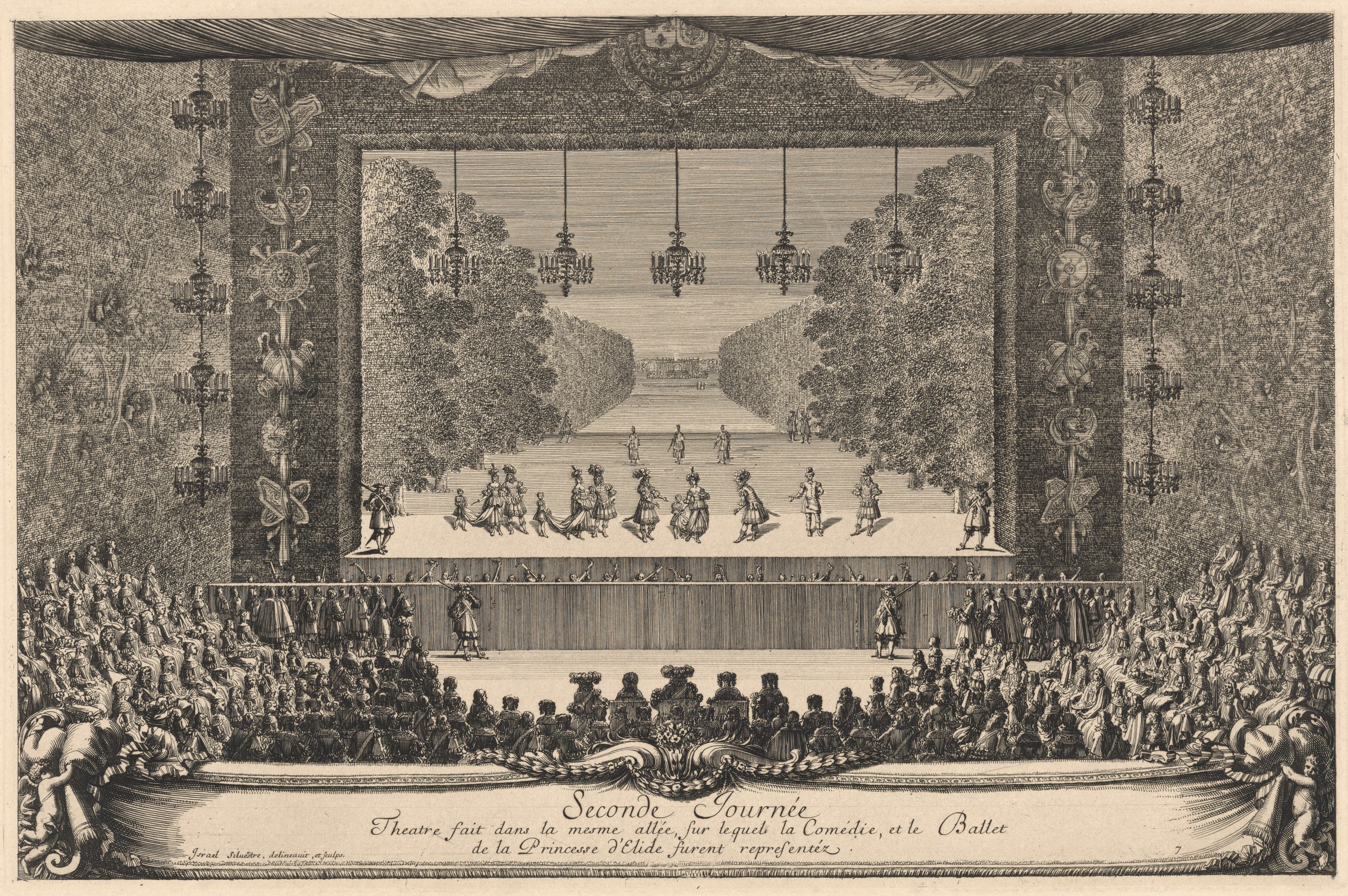
Israël Silvestre, Theatre fait dans la mesme allée, sur le quel la comédie, et le ballet de La princesse d'Elide furent representéz - NYPL Digital Collections (adjusted)
Silvestre, Israël, 1621-1691 (Engraver)
- Medium:
- Oil Painting
- Dance:
- Ballet
- Era:
- Early 1800s (Waltz Revolution)
- Source:
- Wikimedia Commons
- Rights:
- Public domain — free to use, share and adapt.
- Recorded as:
- Public Domain
For historians and dancers, this engraving is one of the rare contemporary images showing how court ballet was arranged in space and how it functioned within court ceremony. It documents a performance in which the king danced, making it a record of royal participation in dance at the height of Louis XIV's power. The formal published engraving also shows that court ballet was considered worthy of official artistic commemoration and wide circulation—an indicator of its cultural prestige and its role as an instrument of state.
What you are looking at
This engraving depicts a grand theatrical performance in a vast palace gallery, likely Versailles. The composition is divided into three receding zones: foreground, a crowded auditorium thronged with spectators in 17th-century court dress; middle ground, an elevated stage with decorated proscenium framing a scene from Molière's *La Princesse d'Élide*; and background, a deep perspective showing the gallery itself extending into shadow. The stage features ornate architectural elements with draped fabric and chandeliers suspended above. The performers on stage are arranged in a formal composition, with figures in flowing costumes dispersed across the space. The left and right borders of the engraving show elaborate decorative elements—carved panels and ornamental sconces—that frame the entire scene as a unified theatrical vision. The light in the engraving is handled to emphasize the stage and its action, while the crowded foreground remains in relative shadow, creating dramatic depth.
The dancing
The dancers on stage maintain the formal, upright carriage characteristic of court dance of the period. Their arms appear extended and graceful rather than contracted; bodies are arranged in small clusters and lines rather than tight couples. The poses suggest stately, processional movement rather than rapid footwork—figures are distributed across the stage in a way that prioritizes visual tableau and symmetry. The costumes are voluminous, with full skirts and draped sleeves that would permit only controlled, dignified movement. The spacing between performers indicates this is courtly display dance designed for visual effect from a distance, not intimate partnered work.
The dance depicted
This depicts the ballet portion of the second day's entertainment at Versailles on 7 May 1644, when Louis XIV himself participated in court dances as part of the celebrations surrounding the production of Molière's *La Princesse d'Élide*. The dance shown is almost certainly a ballet de cour, the formal court ballet of the French Renaissance and early Baroque in which nobility performed elaborate symbolic and allegorical dances in costume. The inclusion of royal and noble dancers in an evening of theatrical entertainment is characteristic of this genre—dance was not professional spectacle but courtly ritual in which the king and his circle demonstrated grace, hierarchy, and cultural refinement. The formal arrangement and dispersed spacing visible in the image are consistent with the branle and grand ballet formations documented in court dance notation from this era.
How it was made
This is an engraving, executed with fine linear hatching and cross-hatching to create tone and depth. The medium's precision allows the artist—Israël Silvestre, a specialist in topographical and ceremonial engravings—to render architectural detail, perspective, and the intricate dress of hundreds of figures. Engravings of theatrical events were widely distributed as prints and served as official records of court performances; they circulated among the European nobility and in print collections. The technique required careful composition and multiple plates or states to achieve the fine gradations visible here. The engraving's status as a reproducible image, not a unique painting, made it a vehicle for disseminating the glory of the French court throughout Europe.
About this work
This is a documentary engraving of a royal ballet performance at the court of Louis XIV, created by the topographical engraver Israël Silvestre. It records not only the spectacle itself—the staging, décor, and arrangement of dancers—but also the social structure of court performance: the distinction between the elevated stage and the assembled courtiers, the integration of dance into theatrical and literary production, and the presence of the king as both organizer and performer. The work belongs in a dance collection because it is evidence of how court ballet was understood, staged, and commemorated in the 17th century, and because the ballet de cour was the ancestor of the ballet d'action and theatrical ballet that followed. It is also one of the few visual documents that shows the actual disposition of dancers in a major court ballet, making it invaluable for understanding the spatial and compositional logic of the form.
How to look at it
Attend first to the spatial arrangement: the way dancers are distributed across the stage in loose formations rather than tight partnering, and the way the perspective of the engraving allows you to see both the elevated stage and the crowded auditorium below. This distribution is not accidental—it reflects the court ballet convention of arranging dances as moving tableaux meant to be viewed from a fixed point, often telling an allegorical story through formation and movement. Notice also the costumes and the upright, open carriage of the figures: the voluminous skirts and sleeves indicate the kind of controlled, processional movement that court dance required. The engraving freezes not a moment of virtuosity but a moment of formal arrangement, emphasizing spectacle and hierarchy over individual dancing skill.
The artist
Israël Silvestre (1621–1691) was the foremost topographical and ceremonial engraver of mid-17th-century France. He specialized in recording royal events, military campaigns, and court spectacles for publication and distribution. His engravings of Versailles, royal processions, and theatrical events are among the most important visual documents of Louis XIV's court. Silvestre worked from drawings and eyewitness accounts to create detailed, precisely composed prints that served both as documentary records and as propaganda for royal magnificence. His work was highly sought after and circulated throughout Europe, making him a primary visual chronicler of the reign.
The period
The 1640s were a pivotal moment for French court culture under Cardinal Richelieu and the young Louis XIV. Ballet de cour had developed over the previous century as a form of courtly entertainment and political ritual; by the 1640s it was at its height, often integrated with spoken drama and music in mixed-genre spectacles. Molière was establishing himself as France's leading playwright and theatrical innovator; his collaboration with ballet and music (often involving Jean-Baptiste Lully) would reshape theatrical entertainment. The performance documented here coincided with the emergence of French court culture as the model for European aristocracy. Engravings like Silvestre's served to project the image of French courtly refinement across Europe and to ensure that even those who could not attend the performance could witness its magnificence.
Where it lives
The source record indicates this work is held in the NYPL Digital Collections, likely part of a larger collection of prints and theatrical documentation. The catalogue record cites this as documentation of the 1644 performance at Versailles.
Dance in this work
Questions about this work
Did Louis XIV actually dance in this performance?
Yes. Louis XIV was an accomplished dancer and regularly participated in court ballets throughout his reign. The record specifies that the ballet shown here was performed on the second day of the celebrations, and the king's participation in such events was standard. Dance was understood as an essential accomplishment of nobility and a form of political display.
What is the difference between this court ballet and later theatrical ballet?
Court ballet was performed by and for the nobility as courtly ritual and entertainment; it was not a profession. Dancers were courtiers, not trained specialists. Later theatrical ballet, beginning in the 18th century, became a profession performed by trained dancers for paying audiences. The movements and techniques evolved; court ballet emphasized processional grace and allegory, while theatrical ballet eventually emphasized virtuosity and narrative pantomime.
Why is this engraving useful as a historical document?
Engravings like this are among the few visual records of how court ballet was actually staged and arranged. Dance notation from this period is sparse and cryptic; paintings of performances are rare. This engraving shows the spatial disposition of dancers, the size and scale of the performance, the relationship between stage and audience, and the integration of dance with theatrical design—information that written records alone cannot provide.
Who was the audience for this engraving?
Engravings of royal performances were distributed among European courts and the educated nobility. They served as both souvenirs and propaganda, allowing those who did not attend the performance to see an official record of it, and projecting the image of French courtly magnificence beyond France. Prints like this were collected in cabinets of curiosities and held as valuable documents of royal power and cultural prestige.
More Ballet artwork