49 works in this view — arrow keys or swipe to move between them.
Dance in Art · 1837
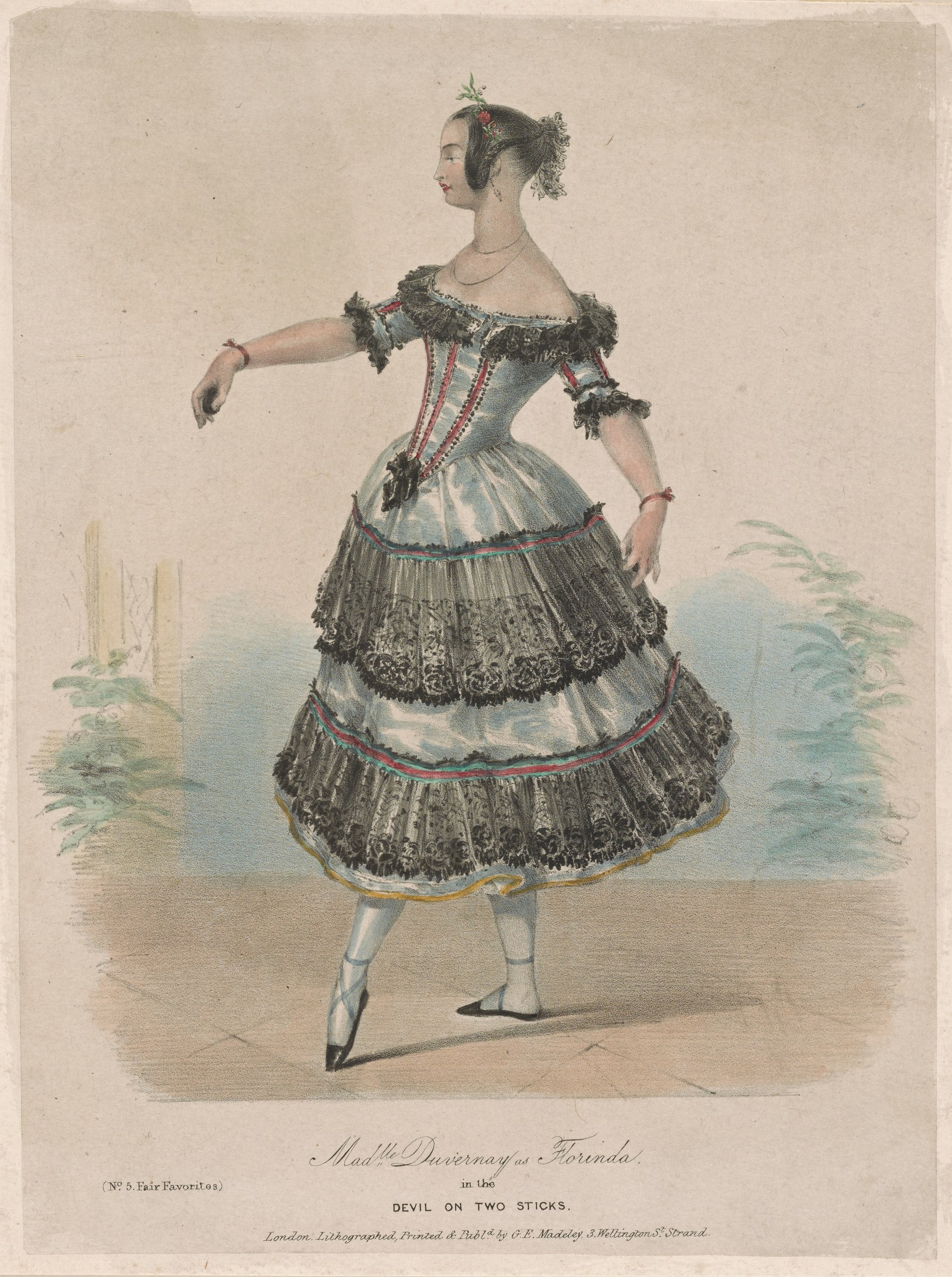
Madlle. Duvernay as Florinda in the Devil on two sticks (NYPL b12147668-5134505)
Unknown (NYPL collection)
- Medium:
- Oil Painting
- Dance:
- Ballet
- Era:
- Mid 1800s (Polka Era)
- Source:
- Wikimedia Commons
- Rights:
- Public domain — free to use, share and adapt.
- Recorded as:
- Public Domain
Duvernay and the Cachucha were central to Romantic ballet's appeal: the dance offered European audiences a taste of Spanish exoticism, rhythm, and technical display. This image is one of the few surviving visual records of exactly how the Cachucha looked on stage, what costume and presence defined it, and what made Duvernay's performance so celebrated that her image was printed and sold to the public.
What you are looking at
A young woman in a pale blue corset and tiered skirt stands in profile, posed on a stage or ballroom floor. Her elaborate costume features black lace trim on each tier of the skirt, red ribboning down the front of the bodice, and matching ribbons at the shoulders from which hang sprigs of artificial foliage—ivy or similar greenery. She wears a decorative headdress with feathers and greenery, and her dark hair is arranged in the romantic style of the 1830s. She holds a pair of castanets in her right hand, lowering her arm gracefully. Her left arm curves at the elbow, held away from her body. The pose suggests a moment of poised, elegant stillness rather than active movement. The background is minimal and atmospheric—pale washes suggesting interior or stage space, with faint suggestions of landscape elements (plants, possibly architectural elements) rendered in soft watercolor tones. The overall effect is of a moment from theatrical performance, specifically a Spanish dance.
The dancing
The dancer stands alone in a three-quarter profile view, weight apparently centered and poised. Her torso is upright, shoulders open, her right arm relaxed with the castanets visible, her left arm held with the elbow bent and raised. The pose is distinctly posed rather than caught mid-action—the kind of theatrical stance that presents the costume and the dancer's form for admiration rather than conveying dynamic movement. The extended standing leg and the positioning suggest a moment of readiness or transition between movements rather than the execution of a step.
The dance depicted
This is Mademoiselle Duvernay in the character of Florinda from *Le Diable boiteux* (*The Devil on Two Sticks*), a popular ballet of the 1830s. The castanets, the tiered skirt with black lace, the ribboning, and the headdress with greenery are all defining features of the Cachucha—a Spanish dance that became one of the defining styles of Romantic ballet. The Cachucha was exotic spectacle for European audiences: a showy, rhythmically driving solo that allowed a principal dancer to display technique, stamina, and stage presence. Duvernay was a celebrated performer of this dance, and the image preserves the exact costume and moment that made her famous on London and Paris stages.
How it was made
This is a hand-colored lithograph, as confirmed by the printed credit line at the bottom ("London. Lithographed, Printed & Published by C.F. Madeley & Maddington S.t Strand"). The technique allowed rapid, affordable reproduction and mass circulation—this image was a commercial print, likely sold as a souvenir or theatrical keepsake. Hand coloring gives it the delicate finish and the subtle watercolor gradations in the background and flesh tones. The medium's popularity for theatrical portraiture in the 1830s-40s made such prints central to how dancers' images and fame circulated among theatre-going audiences.
About this work
This is a hand-colored lithographic portrait of the Romantic-era ballet dancer Mademoiselle Duvernay, documented in a signature role from *Le Diable boiteux*. The image is both a performance record and a theatrical souvenir—it preserves the exact costume (the Cachucha dress) that defined a celebrated dance and a celebrated dancer, and it circulated among audiences as a commercial print. The pose is characteristically theatrical: the dancer is not caught in action but presented to the viewer, poised and elegant, in a moment that announces the performance and the performer rather than analyzing the movement itself.
The work belongs to the rich tradition of Romantic-ballet portraiture, when lithography made it possible to publish dancers' likenesses widely and quickly. Such prints were often sold in the theatre foyer or by print shops, and they shaped public taste and celebrity. This image is evidence of how the Cachucha became the signature Spanish dance of Romantic ballet, a brief phenomenon that fascinated audiences and became visually synonymous with exotic theatricality.
How to look at it
Attend to the costume: the black lace trim and red ribboning were not decorative but functional elements that made the Cachucha visually distinctive and readable from a distance in a theatre. The castanets are the signature prop; notice how the artist shows them clearly in her hand. The pose itself is instructive—the dancer is not in mid-step but standing upright and poised, which is how such theatrical portraits typically present performers. Compare this image to other Cachucha prints or costume descriptions from the period to see how standardized the look became. The delicate coloring and the theatrical minimal background are typical of 1830s lithographic practice: these prints were made to be beautiful, affordable, and instantly recognizable as theatrical souvenirs.
The artist
Unknown artist, but the print was published by C.F. Madeley & Maddington, a London lithographic firm active in the 1830s-40s. Theatrical portraiture was their specialty, and such prints were standard commercial products—affordable, colorful, and reproducible. The style and hand-coloring are consistent with other theatrical prints of the same publisher and period.
The period
This is a document of the height of Romantic ballet, when the genre was defined by ethereal females in tutus, magical narratives, and exotic dances. The Cachucha was a craze: a Spanish dance integrated into European ballets (it also appears in *La Gitana*, *Paquita*, and other works) that gave dancers a chance to perform rhythmic, often sexually charged material in a framework that was technically demanding and visually spectacular. Lithography made theatrical portraiture mass-producible by the 1830s, so images of celebrated dancers like Duvernay reached far beyond theatre audiences—they shaped taste, advertised performances, and created public celebrity. The print is dated 1837, which places it in the period when Duvernay was at the height of her fame.
Where it lives
This work is held in the New York Public Library (NYPL b12147668-5134505) and was accessed via Wikimedia Commons. It is catalogued as an oil painting in the library's record, though the printed credit line and visual evidence confirm it is a lithograph.
Dance in this work
Questions about this work
What is the Cachucha?
The Cachucha is a Spanish character dance that became one of the signature styles of Romantic ballet in the 1830s-40s. It is rhythmic, often showy, and typically performed as a solo for a principal female dancer. The dance involved footwork, castanets, and dramatic arm gestures, and it was often costumed to suggest Spanish identity. It was exotic spectacle for European audiences and gave dancers a chance to display virtuosity and stage presence.
Who was Mademoiselle Duvernay?
Duvernay was a celebrated French-Italian Romantic-era ballet dancer, known especially for her performances of the Cachucha and other character dances. She performed in London and Paris in the 1830s-40s and was famous enough that her image was printed and sold as a theatrical souvenir. The Cachucha became synonymous with her performance.
What is a hand-colored lithograph?
A lithograph is a print made using a chemical process (grease and water on a flat stone); it was faster and cheaper to produce than engraving. Hand-colored lithographs were hand-painted after printing, which made them more expensive than plain prints but still affordable for mass circulation. In the 1830s, theatrical portraits like this one were standard commercial products, sold to audiences as souvenirs.
Why does the catalogue say oil painting when this is clearly a print?
The NYPL catalogue record incorrectly lists the medium as oil painting. The printed credit line at the bottom of the image ("London. Lithographed, Printed & Published by C.F. Madeley & Maddington S.t Strand") confirms it is a hand-colored lithograph. This kind of cataloguing error is common with older prints that are hand-colored and may have acquired a patina resembling paint.
More Ballet artwork