49 works in this view — arrow keys or swipe to move between them.
Dance in Art
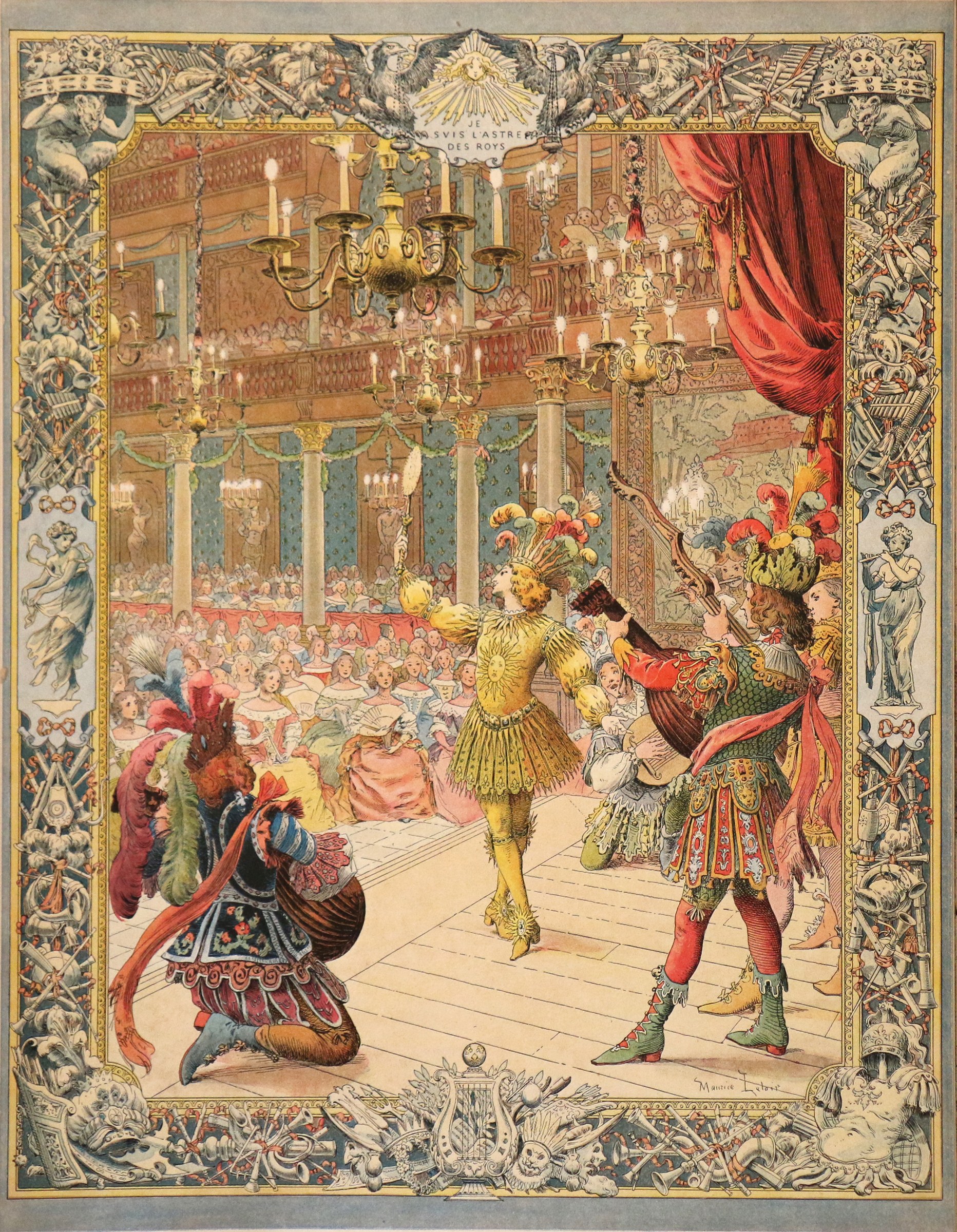
Maurice Leloir-Le Roy soleil - Le ballet de la nuit
Gustave Toudouze, Maurice Leloir
- Medium:
- Aquarelle
- Dance:
- Ballet
- Source:
- Wikimedia Commons
- Rights:
- Public domain — free to use, share and adapt.
- Recorded as:
- Public Domain
Court ballet was foundational to the development of European theatrical dance; understanding how it looked and was staged illuminates the origins of classical ballet technique and the relationship between dance, power, and spectacle in the ancien régime. This image documents one of the most significant performances in that tradition, one that established Louis XIV's personal investment in dance and performance as instruments of monarchy.
What you are looking at
A grand theatrical performance unfolds in a lavishly decorated indoor space with multiple tiers of galleries packed with spectators. The architectural setting features ornate gilded columns, elaborate carved ceiling decoration, and rich red velvet drapery. At stage level, several figures in ornate costumes execute a formal dance. The dominant figure is a dancer in a yellow-gold richly embroidered coat with striped stockings and decorative heeled shoes, posed in a graceful attitude with raised arms. Nearby stand attendants and courtiers in equally sumptuous dress—deep reds, greens, and jewel tones with gold brocade detailing. The composition radiates outward from the central dancing figure toward the watching crowd, emphasizing the ceremonial nature of the performance. The ornamental border framing the entire image, rendered in a baroque engraving style with allegorical figures and scrollwork, reinforces the grandeur and artificiality of court spectacle.
The dancing
The central male dancer stands in a classic balletic pose with one leg extended in an attitude or arabesque, the upper body held upright with arms positioned expressively overhead. His frame is lifted and elongated, suggesting trained technique. Supporting courtiers flank him in more static poses, suggesting his prominence. The female attendants nearby wear the fitted bodices and full skirts of court dress, their postures formal and composed. All figures maintain the vertical alignment and restraint characteristic of courtly movement rather than folk or peasant dance.
The dance depicted
This depicts a scene from *Le Ballet de la Nuit*, the famous spectacle of 1653 at the court of Louis XIV in which the young king himself danced. The image likely represents one of the key dance entries (entrées) from that production. The singular prominence given to the central male dancer, combined with the opulent court setting and formal ceremonial atmosphere, aligns with the court ballet tradition where nobility performed elaborate, highly codified movement before a watching court audience. The dancer's technique and the careful staging suggest trained courtly dancing rather than spontaneous entertainment.
How it was made
The work is a chromotypogravure (color typographic engraving) of watercolor compositions. This hybrid process allowed for the reproduction of detailed hand-colored designs at reasonable scale and cost, making it suited for commercial distribution of grand theatrical scenes. The technique combines the precision of engraving with chromatic richness, evident in the careful gradation of color, the fine linework defining architectural detail, and the capacity to render both intimate gesture and grand spatial perspective. The decorative border engraved in a classicizing baroque style suggests this was a published work of some prestige, likely a commemorative print or book illustration meant for educated viewers with interest in court spectacle.
About this work
This is a record of a legendary moment in European dance history: the court ballet *Le Ballet de la Nuit* of 1653, where the young Louis XIV danced alongside professional dancers and nobility. The image captures the formal splendor of mid-17th-century court dance, a genre that combined elements of music, poetry, and intricate geometric movement into a totalized courtly experience. Court ballet represented the apex of aristocratic leisure and artistic patronage; dance was a language of rank, allegiance, and refined taste. The print preserves not just a visual record but an assertion of the event's cultural importance—the ornate framing and technical sophistication of the reproduction itself mirrors the elaborateness of the performance it documents.
How to look at it
Observe the frozen moment of the central dancer's movement—the artist has chosen a balletic attitude that reads as both graceful and formally constrained, capturing an instant of controlled virtuosity. Notice how the perspective draws the eye from the intimate gesture of the dancing figure outward toward the masses of spectators, emphasizing that court ballet was fundamentally about being seen and about the gaze of the assembled courtiers. The ornamental border frames and aestheticizes the scene, treating the dance as an object of historical and artistic reverence rather than as a spontaneous act.
The artist
Maurice Leloir and Gustave Toudouze were both 19th-century French historical illustrators and designers known for lavish period reconstructions and theatrical imagery. They specialized in recreating grand historical and courtly scenes with archaeological attention to costume, architecture, and social detail. Their work circulated among educated audiences with interest in history, theatre, and the decorative arts.
The period
This chromotypogravure was produced in the 19th century, long after the 1653 performance it depicts. By the 1800s, court ballet had become a subject of historical fascination and romantic revival. The mid-19th century saw intense scholarly and artistic interest in the Renaissance and ancien régime as sources of visual and cultural authority. *Le Ballet de la Nuit* specifically had become legendary as the moment of Louis XIV's apotheosis (he danced the role of the Sun King). The print belongs to a broader 19th-century project of historical reconstruction through elaborate illustration—a visual equivalent to the romantic historicism of the period.
Where it lives
The work comes from Wikimedia Commons, indicating it is in the public domain or under open license. It is a published print or book illustration, likely from a mid-to-late 19th-century historical or theatrical publication. The chromotypogravure technique and decorative framing suggest it was a quality art print intended for circulation among educated audiences rather than a documentary ephemera.
Dance in this work
Questions about this work
Did Louis XIV really dance in ballets?
Yes. The young king was trained in dance and performed regularly in court ballets from the 1650s through the 1660s, appearing in elaborate allegorical spectacles where nobility danced alongside professional dancers. He eventually withdrew from performing as he aged and the Sun King mythology crystallized around his image rather than his live presence. Court ballet was an essential courtly practice for aristocrats, especially those close to the king.
What is a court ballet?
Court ballet was a form of theatrical spectacle performed at European royal courts from the Renaissance through the 18th century. It combined dancing, poetry, music, and elaborate scenic design into evenings-long entertainments where nobility performed for one another and the court. Unlike later theatrical ballet, court ballet emphasized courtly manners and allegorical meaning; the dancing was formal and restrained by modern standards, though technically demanding.
Why would an artist in the 1800s paint a scene from 1653?
By the 19th century, the ancien régime and the court of Louis XIV held intense romantic and historical appeal. Publishers and collectors valued elaborate illustrated reconstructions of grand historical moments. This print was likely made as a commemorative illustration for a historical or theatrical book, allowing educated Victorian and later audiences to visualize a legendary moment in European cultural history.
More Ballet artwork