49 works in this view — arrow keys or swipe to move between them.
Dance in Art · 1745
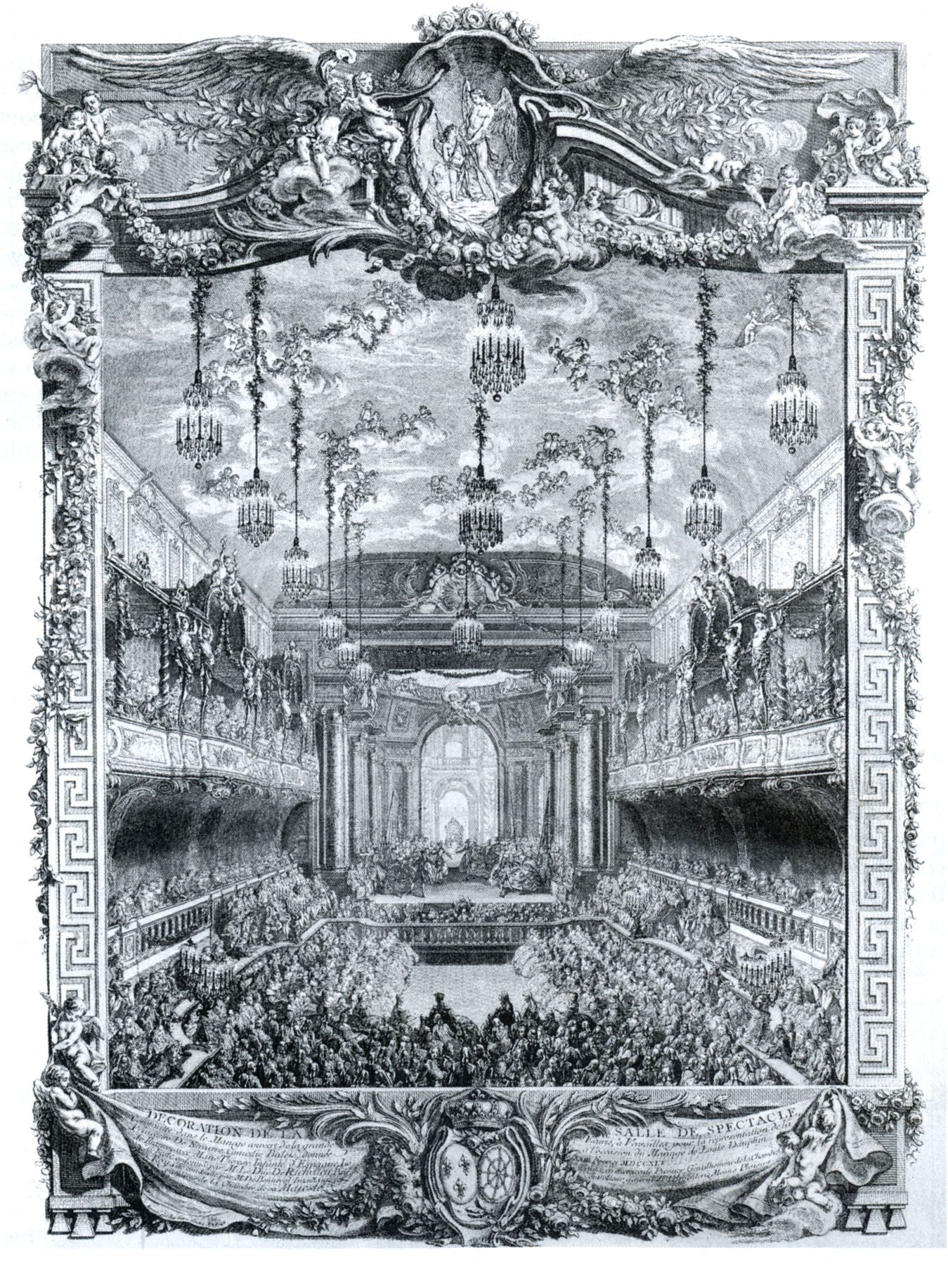
Performance 1745 of La princesse de Navarre by Rameau - NGO3p859
Charles-Nicolas Cochin (1715–1790), engraver
- Medium:
- Oil Painting
- Dance:
- Ballet
- Era:
- 1700s (Enlightenment/Minuet Era)
- Source:
- Wikimedia Commons
- Rights:
- Public domain — free to use, share and adapt.
- Recorded as:
- Public Domain
This engraving is invaluable evidence of the scale, architecture, and social context of 18th-century French court dance, showing the theatre, the spectating crowds, and the distance between the audience and the performers—details that written descriptions of the ballet cannot convey. For historians of Baroque theatrical practice, it documents the integration of dance, music, and spectacle in Rameau's works, and for students of court culture, it shows how dance functioned as an instrument of state ceremony and dynastic celebration.
What you are looking at
This is an engraved prospect of a grand court theatre during a performance, viewed from the auditorium looking toward the stage. The theatre is a cavernous, columned interior with tiers of spectators crowding every level—the parterre below is packed with standing and seated courtiers in formal dress, while balconies ring the walls above, filled with more observers. The stage itself is distant but legible: a proscenium frames a shallow playing area where dancers in light costumes move against an elaborate painted backdrop depicting a landscape with architecture. Multiple crystal chandeliers hang by chains from the ceiling, their candles lit, and garlands or swags of vegetation drape vertically from the ceiling to the floor, dividing the space into bays. The entire composition is symmetrical and processional. The print's ornate frame includes allegorical figures in the upper margin and a cartouche at the base.
The dancing
The dancers on stage are too distant to discern individual positions clearly, but their bodies appear light and upright, consistent with the formal, turned-out carriage of court dance. Groups seem to be arranged in the shallow stage space in formation rather than scattered; some figures appear to be in motion while others hold positions. The mass of spectators in the auditorium—hundreds of courtiers in brocade, silk, and formal coats—dwarfs the dancers and conveys the hierarchical, ceremonial nature of the event. The density and orderly arrangement of the crowd suggests a state occasion rather than an entertainment.
The dance depicted
This is a performance of Rameau's *La princesse de Navarre*, a tragédie-lyrique or court ballet composed for the dauphin's wedding festivities in 1745. The genre was court ballet (ballet de cour), the primary form of theatrical dance in the French court, which combined sung recitatives, instrumental music, and choreographed movement by courtiers and professional dancers. The style would have been based on the five positions and the turned-out, upright aesthetic of the 18th-century French academic tradition, with movements emphasizing elevation, precision, and courtly grace. The distance and scale of the engraving prevent identification of specific choreography, but the symmetry and formation visible suggest the processional, geometric patterns typical of Baroque court dance.
How it was made
This is an engraving, not an oil painting as the catalogue record states. The technique—fine hatching, careful cross-hatching for shadow and texture, the precision of the line work—is characteristic of mid-18th-century French reproductive engraving. The elaborate decorative border, allegorical emblems in the upper margin, and the cartouche with legible text at the base are all typical of the presentational engraving as a form of court documentation and circulation. As an engraving (likely after a drawing or painting by Cochin), it would have been produced in multiple impressions and distributed among the court and to collectors across Europe, making it a powerful tool for documenting and commemorating state spectacles.
About this work
This engraving documents a celebrated court ballet performed at Versailles on 23 February 1745 as part of the royal wedding festivities. It captures not the dance itself in detail, but the entire theatre—the architecture of the performance space, the hierarchy of the viewing public, the scale and formality of the event. Cochin was one of the leading court engravers of mid-century France, and this work exemplifies the tradition of the documented court spectacle: a visual record created for memory and distribution. The work belongs in a dance gallery because it is evidence of how court dance was framed, witnessed, and monumentalized in the imagination of the ancien régime.
How to look at it
Attend first to the structure: the deep recession into the stage, the tiers of spectators, the symmetrical arrangement of lights and decoration. This shows you the theatre as an architecture of hierarchy and witness. Then turn to the stage itself and the distant dancers: the artist chose a moment of ordered grouping rather than a climactic leap or lift, emphasizing the formal, geometric beauty of court dance. Notice how small and composed the dancers appear against the vast crowd—this is not about individual virtuosity but about collective ceremony and the state's control of spectacle.
The artist
Charles-Nicolas Cochin (1715–1790) was among the most accomplished engravers and draughtsmen of 18th-century France. He was trained in his father's workshop, became a court artist, and documented many of the major spectacles and ceremonies of Louis XV's reign. He was also a theorist and critic of the arts, writing influential treatises on engraving and taste. His works combine technical precision with a narrative sense of occasion, making him one of the most valuable visual witnesses to court life and theatrical practice in the Enlightenment.
The period
In 1745, court ballet was at the height of its formal grandeur but also at a point of transition. Rameau, the leading composer of the day, had been writing tragédies-lyriques and court ballets for decades, and his works represented the apotheosis of the French Baroque theatrical tradition. At the same time, the spectacles were becoming more elaborate in their machinery, scenery, and orchestration. The dauphin's wedding was a major state occasion, and the arts were mobilized to celebrate it. The engraving was created in the context of a culture that treated court spectacles as documents of state power and courtly civilization, worthy of being recorded and circulated in print.
Where it lives
The work is known from Wikimedia Commons and appears in the standard reference sources for 18th-century French court spectacles. It is one of a series of engravings documenting the 1745 festivities at Versailles, and copies exist in major print collections including the Bibliothèque Nationale de France.
Dance in this work
Questions about this work
What is a court ballet (ballet de cour)?
Court ballet was the dominant form of theatrical dance in the French court from the 16th to the 18th century. It combined sung recitatives, instrumental music, and choreographed movement, often performed by courtiers and professional dancers as part of royal ceremonies and celebrations. Unlike later ballet, which emphasized the professional dancer and the demi-character, court ballet was an amateur aristocratic art form in which participating was itself a display of courtly accomplishment and grace.
Who was Charles-Nicolas Cochin?
Cochin (1715–1790) was a leading French engraver, draughtsman, and art theorist of the Enlightenment. He documented many of the major court spectacles and ceremonies of Louis XV's reign, and was influential in shaping taste through his writings on the arts. His engravings are primary sources for the history of 18th-century French theatre, dance, and ceremony.
Why does the catalogue call this an oil painting when it is clearly an engraving?
This is likely a cataloguing error. The image is unambiguously an engraving—the technique, the line work, the border, and the cartouche are all characteristic of reproductive engraving in the 18th-century French tradition. The record should be corrected.
What can we learn about the dance from this image?
The distance and scale of the engraving mean we cannot see footwork or arm detail, but we can see that the dance was arranged in formal groups on a shallow stage, with an emphasis on symmetry and processional order. This is consistent with what we know of court ballet aesthetics: precision, geometric patterning, and the subordination of individual virtuosity to courtly decorum.
More Ballet artwork