49 works in this view — arrow keys or swipe to move between them.
Dance in Art · 1676
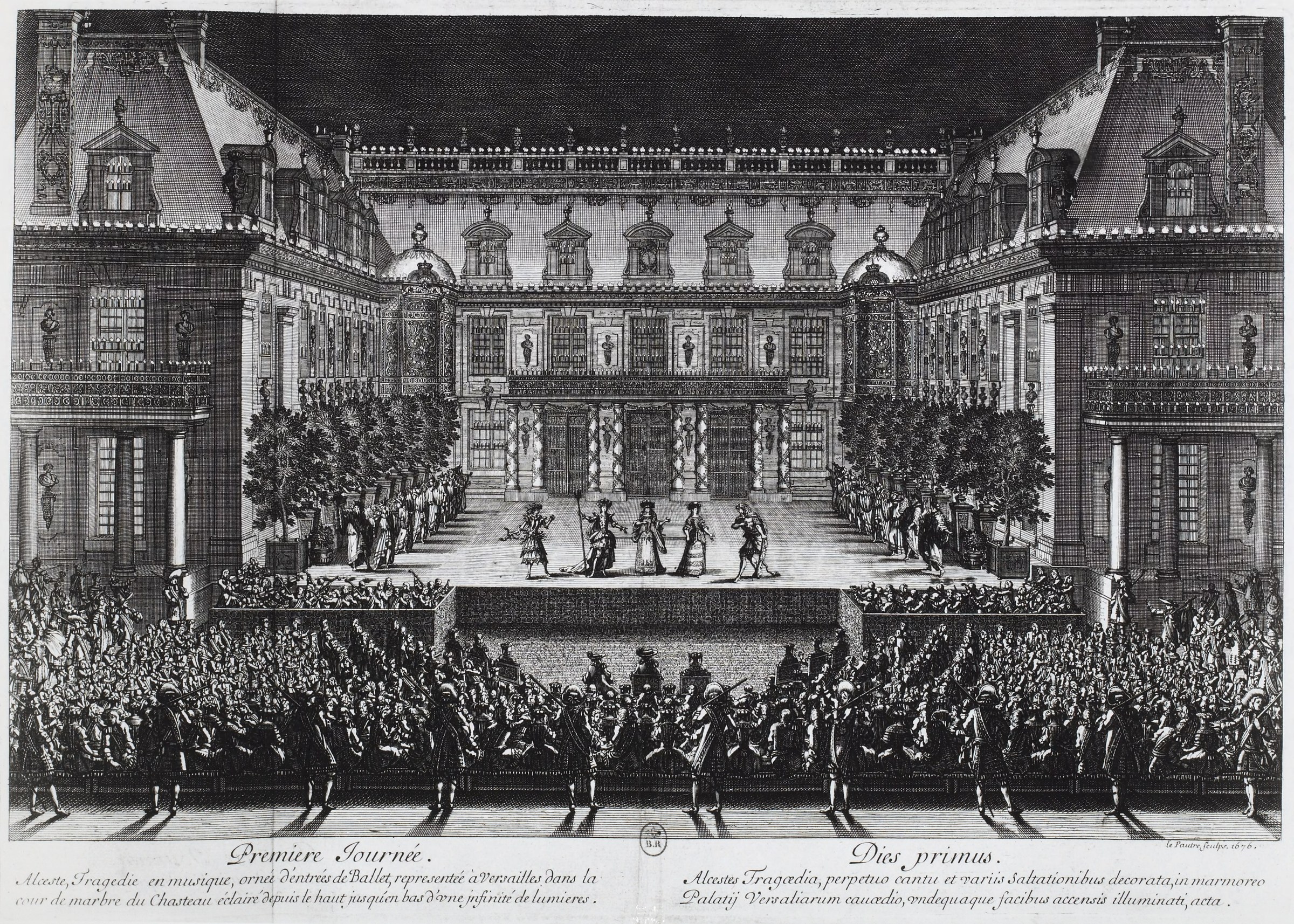
Représentation d'Alceste de Lully-Quinault, Versailles, fête de 1674, Le Pautre - Gallica
Jean Le Pautre
- Medium:
- Oil Painting
- Dance:
- Ballet
- Era:
- Pre-1700 (Renaissance/Baroque)
- Source:
- Wikimedia Commons
- Rights:
- Public domain — free to use, share and adapt.
- Recorded as:
- Public Domain
This image is one of the few reliable visual records of how baroque court ballet was actually staged and performed at the height of Louis XIV's reign. It demonstrates that ballet in this period was not an autonomous art form but an ornament to opera and court ceremony, performed in formal dress by aristocrats and professionals in a context saturated with political meaning. For anyone studying the origins of classical ballet or the relationship between dance and state power in early modern Europe, this engraving is essential.
What you are looking at
This is an engraving depicting a performance in the marble courtyard (cour de marbre) of the Palace of Versailles. The view is taken from within the colonnade, looking toward a grand palace façade with mansard roofs, dormer windows, and elaborate architectural ornament. In the center foreground, on a raised stage or performance platform, a group of elaborately costumed figures enacts a scene—likely from Lully's opera Alceste. The performers wear dramatic baroque dress with full skirts, plumed headdresses, and theatrical armor. The courtyard is densely packed with spectators arranged in formal tiers: courtiers and nobles fill the sides and foreground, while soldiers in uniform stand in rigid formation at the very front, creating a visual frame for the performance. The composition emphasizes the hierarchical nature of court spectacle: the performance is the pivot around which rank, costume, and spatial order converge. Torches or light sources suggest this is an evening entertainment, and the density of the crowd conveys the scale and prestige of the occasion.
The dancing
The central performers stand on an elevated platform in formal, upright postures typical of baroque court dance and theatrical performance. Their bodies are arranged in loose groupings rather than tight formations; the women's voluminous skirts and the men's long coats and decorative armor create silhouettes that read as dignified and stately. The gestures appear decorous and controlled—arms are held at mid-height or extended in gestures of address or supplication—rather than vigorous or athletic. The weight appears to be held vertically rather than shifted fluidly through the body. The crowd of spectators frames them visually but does not participate; the boundary between performer and viewer is absolute. The soldiers standing in the foreground are in strict military formation, creating a visual and social contrast with the theatrical figures behind them.
The dance depicted
This engraving documents a ballet integrated within a court spectacle—specifically Lully's tragédie-lyrique Alceste, which combined sung recitative, instrumental music, and choreographed dances called entrées de ballet. The catalogue record confirms this is the performance of 4 July 1674 at Versailles. The figures visible on stage represent the embedded ballet sequences rather than the full operatic narrative; such ballet entrées were a hallmark of French baroque opera and were typically danced by members of the court or professional dancers in costume aligned with the scene's dramatic context (in this case, mythological figures). The upright carriage, formal spatial arrangement, and absence of rapid footwork visible in the image are consistent with baroque court dance conventions, where nobility and gravity were paramount. The presence of the soldiers and the royal courtiers indicates this was a state occasion and a demonstration of Louis XIV's power and refined taste.
How it was made
This is an engraving—likely a copper-plate engraving based on the fine linear detail and the inscription visible at the bottom. Jean Le Pautre, the artist named in the catalogue, was a celebrated engraver and draftsman known for recording court ceremonies, architecture, and festivities. Engravings of this type were created from detailed drawings made either from life or from memory shortly after the event, then laboriously transferred to a copper plate and printed by hand. The technique allowed for wide circulation among the court and the educated public across France and Europe, making the spectacle knowable beyond those present. The high level of architectural and sartorial detail suggests the artist had access to the venue and considerable knowledge of the event's pageantry. The inscription at the bottom (partly legible) would have documented the occasion, performers, and occasion for contemporary and future readers.
About this work
This engraving is a historical document of baroque court spectacle at its apex—the integration of opera, ballet, and pageantry in the service of royal propaganda under Louis XIV. The work shows us not only the performance itself but the social machinery that framed it: the hierarchy of space, the division between performers and spectators, the military and civic presence that underwrote the event. For scholars and dancers alike, it is invaluable evidence of how ballet was embedded within larger theatrical forms, how the court consumed dance as part of its self-representation, and what the physical vocabulary of that moment looked like—the carriage, the spacing, the relationship between individual dancers and the stage. The engraving is as much a document of power and social order as it is of dance technique.
How to look at it
The engraving presents the moment of performance rather than any single movement or step. Look at the scale relationships: the performers are tiny against the monumental architecture and the vast crowd, which is precisely the point—the individual dancers matter less than the order and spectacle they collectively create. Note how the composition uses the colonnade as a frame within the frame, drawing the eye through ranks of spectators to the stage. The soldiers in the foreground are rigid and immobile; the performers on stage are upright but less severely so, suggesting the subtle choreography within formality. The women's full skirts would have been deployed in court dances such as the courante or menuet, where the skirt's movement is as important as the dancer's steps—a detail Le Pautre captures by rendering the fabric with visible weight and volume.
The artist
Jean Le Pautre (c. 1618–1682) was a prolific draftsman, engraver, and designer who documented the architectural, decorative, and ceremonial life of the French court under Louis XIV. He produced detailed engravings of festivals, processions, architectural projects, and court ceremonies, serving as a visual chronicler of absolutist spectacle. His work circulated widely in print form and established conventions for how such events were recorded and disseminated. Le Pautre's engravings are among the most reliable visual sources for understanding baroque French court culture and the appearance of major festivities.
The period
In 1674, Louis XIV was at the height of his power, and court spectacle was a central instrument of his rule. The performance of Lully's Alceste during the fête of July 1674 celebrated recent military victories in Franche-Comté and was one of several days of elaborate entertainments. Jean-Baptiste Lully had established French baroque opera as a form uniquely suited to court display, with ballet entrées as essential components. The 1670s saw Lully and his collaborators (including librettist Quinault) perfecting the tragédie-lyrique, which combined French declamatory singing, instrumental music, and formalized court dances. At the same time, professional dancing masters were beginning to codify the technique of what would become classical ballet, though the court ballet of this period was still performed in heeled shoes and formal dress rather than specialized dance attire.
Where it lives
The source is recorded as Wikimedia Commons, with reference to Gallica (the Bibliothèque Nationale de France digital collection). The engraving appears to be in a public collection or widely accessible archive, consistent with Le Pautre's work being used for print distribution in the seventeenth century.
Dance in this work
Questions about this work
Who were the dancers in this performance?
The catalogue record does not name individual dancers. Court ballets of this period were performed by a mix of professional dancers and members of the nobility; the identity of performers in this specific 1674 performance of Alceste is not recorded in the available sources. Such information, if it existed in contemporary documents, has not been preserved.
What is a ballet entrée?
A ballet entrée was a self-contained choreographed sequence performed within a French baroque opera. These dances were not narrative in themselves but thematic—they might represent followers of a mythological character, soldiers, or attendants—and were danced between the acts or scenes of sung drama. They were a convention of the French tragédie-lyrique and showcased the court's taste for formalized, aristocratic movement.
Why was military presence so prominent at a dance performance?
The soldiers visible in the foreground are not incidental. Royal spectacles served to display the power of the state, and the presence of the military was part of that display—a visual assertion of order, hierarchy, and the king's command. The juxtaposition of soldiers and performers reinforced the message that all elements of court and state served the monarch.
What can we learn about how ballet was performed from this image?
The upright carriage, formal spacing, and elaborate costumes tell us that baroque court ballet prioritized decorum and visual splendor over virtuosity or rapid footwork. Dancers moved within a narrow range of acceptable gestures and positions, constrained by their clothing and by the need to maintain dignity. The ballet was ornamental—a frame for looking and being looked at—rather than a space for extreme physical display.
More Ballet artwork