49 works in this view — arrow keys or swipe to move between them.
Dance in Art · 2023
Tension en fa fa en Código Somma
Italo somma
- Medium:
- Oil Painting
- Dance:
- Ballet
- Source:
- Wikimedia Commons
- Rights:
- Public domain — free to use, share and adapt.
- Recorded as:
- CC0
For historians of contemporary ballet and body practice, this work documents a twenty-first-century engagement with ballet as pure formal and physical exploration, freed from narrative or spectacle. For painters, Somma's development of a consistent method ('Código Somma') for rendering dance offers insight into how visual systems can be built around movement and how the artist's eye can train itself to read the body.
What you are looking at
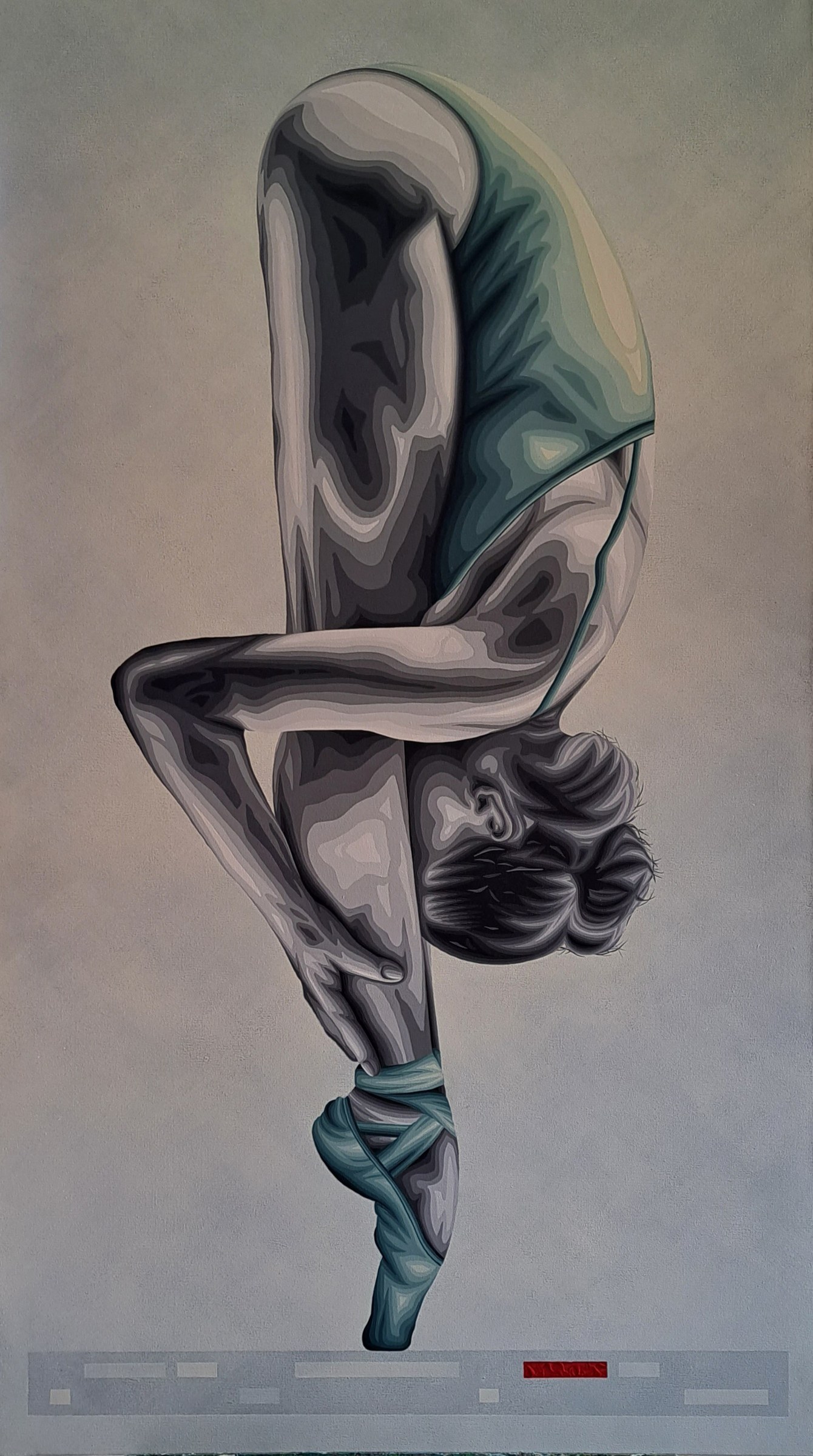
A single figure in an inverted vertical pose dominates this composition, rendered in soft oils with careful attention to musculature and form. The dancer's head and upper torso hang downward while the legs extend upward in a controlled arch, the body creating an elegant curved line against a neutral ground. Teal-green fabric—possibly a scarf or shawl—wraps around the upper arms and shoulders, providing color contrast to the predominantly grey, white, and black tonal palette. The figure appears to be balanced or suspended in this inversion, the weight supported through the arms and upper body. The painting is executed with fluid brushwork that emphasizes the three-dimensional volume of the form, using layered tones to suggest depth and musculature beneath the skin.
The dancing
One dancer, female, positioned in a nearly vertical inversion with the head pointed downward and legs extended upward. The torso is arched backward with arms positioned to support the weight, suggesting either a controlled handstand or a partner-supported balance. The shoulders are engaged and active; the frame is elongated and stretched. The musculature is anatomically rendered with attention to the extension through the spine and legs. This is a highly disciplined position requiring significant strength and control.
The dance depicted
This appears to be a contemporary or neoclassical ballet image, possibly depicting a moment of partner acrobatics or adagio work. The inversion could suggest either a solo adagio technique exploration or a pause within a partner lift sequence. The controlled, architectural quality of the pose and the emphasis on line and extension are consistent with classical ballet training and contemporary ballet practice. Without clear iconographic markers of a specific named style or school, the work sits most securely within theatrical-ballet as a genre, though the extreme inversion and focus on physical architecture suggest influence from acrobatic or contemporary approaches.
How it was made
Oil painting on canvas (as recorded). The artist has employed a fluid, impressionistic approach with soft edges and atmospheric blending, particularly in the background and the modeling of form. This technique allows subtle exploration of light and shadow across the body's surfaces, creating a sense of dimensionality and weight. The loose brushwork suggests the work is intended as a finished exhibition piece rather than a study, circulating within gallery and exhibition contexts rather than as preparatory material.
About this work
This 2023 oil painting by Italo Somma presents a single dancer suspended in an inverted vertical balance, rendered with anatomical precision and formal attention to line and extension. The work sits within a contemporary practice that explores the body as sculptural form and the ballet vocabulary as a site for investigating balance, strength, and the mechanics of movement. The title *Tension en fa fa en Código Somma* suggests the work is part of a series or named system of practice; the artist has stated that all works in his dance painting series are executed using 'Código Somma,' a personal method or code for depicting movement.
The painting belongs to the lineage of twentieth- and twenty-first-century figurative painting engaged with dance as a subject—a tradition that includes artists such as Degas, Matisse, and Lucian Freud—while maintaining a distinctly contemporary sensibility. The inversion is neither narrative nor theatrical but architectural, emphasizing the body's capacity to sustain impossible-seeming geometries.
How to look at it
Attend first to the extraordinary elongation of the spine and the precision of the inversion—the artist has chosen to freeze the moment of maximum extension and control, not a moment of dynamic motion but of sustained geometric hold. Notice how the teal fabric anchors the composition spatially and prevents the image from feeling purely abstract; it grounds the inversion in a body that has a material existence. Observe the rendering of musculature and weight, the sense of effort conveyed through tonal modulation rather than gesture or expression. The neutral background and the absence of props or setting focus all attention on the body's capacity to sustain this extraordinary form.
The artist
Italo Somma is a contemporary artist whose primary practice centers on the representation of dance and the human form in motion. According to the existing documentation, all works in his series of dance paintings are executed according to a personal system or code ('Código Somma'), suggesting a systematic and methodical approach to translating bodily movement into paint. The 2023 date places this work within a recent and ongoing body of work. Limited information is currently available about Somma's training, exhibition history, or critical reception.
The period
This work emerges in the 2020s, a period marked by intense critical interest in the somatic practices of contemporary ballet and in the representation of the body in high art. In contemporary ballet practice, inversion and acrobatic vocabulary have become increasingly integrated into classical technique, particularly following the influence of artists such as William Forsythe and the expansion of neoclassical and contemporary ballet vocabularies. In visual art, figurative painting remains a vital if contested mode, with many artists returning to anatomical study and the figure as a site for exploring technique and form.
Where it lives
The work is recorded as held in an unspecified collection and was accessed via Wikimedia Commons. No current institutional location, acquisition history, or exhibition record is available.
Dance in this work
Questions about this work
Is this a partner lift or a solo balance?
The image does not clarify this unambiguously. The position of the arms and the axis of the body suggest that support is coming through the upper body, but whether this is self-supported (handstand, forearm stand) or partner-supported cannot be determined from the image alone. The architecture of the pose is the subject; its execution is secondary.
What is 'Código Somma'?
According to the artist's statement on the painting series, 'Código Somma' is the artist's personal method or system for depicting dance and movement in paint. Specific details of the method are not currently documented. The artist appears to apply this code consistently across all works in the dance painting series.
What dance style is this?
The work sits most securely within theatrical-ballet as a genre, but the specific style is difficult to pinpoint. The emphasis on inversion and acrobatic balance suggests contemporary ballet or neoclassical influence, possibly with reference to adagio or partner work traditions. The formal, architectural quality of the pose suggests a vocabulary drawn from classical ballet extended through contemporary practice.
More Ballet artwork