49 works in this view — arrow keys or swipe to move between them.
Dance in Art · 1910
Léon Bakst 001
Léon Bakst
- Medium:
- Oil Painting
- Dance:
- Ballet
- Era:
- 1900-1920 (Ragtime/Early Jazz)
- Source:
- Wikimedia Commons
- Rights:
- Public domain — free to use, share and adapt.
- Recorded as:
- Public Domain
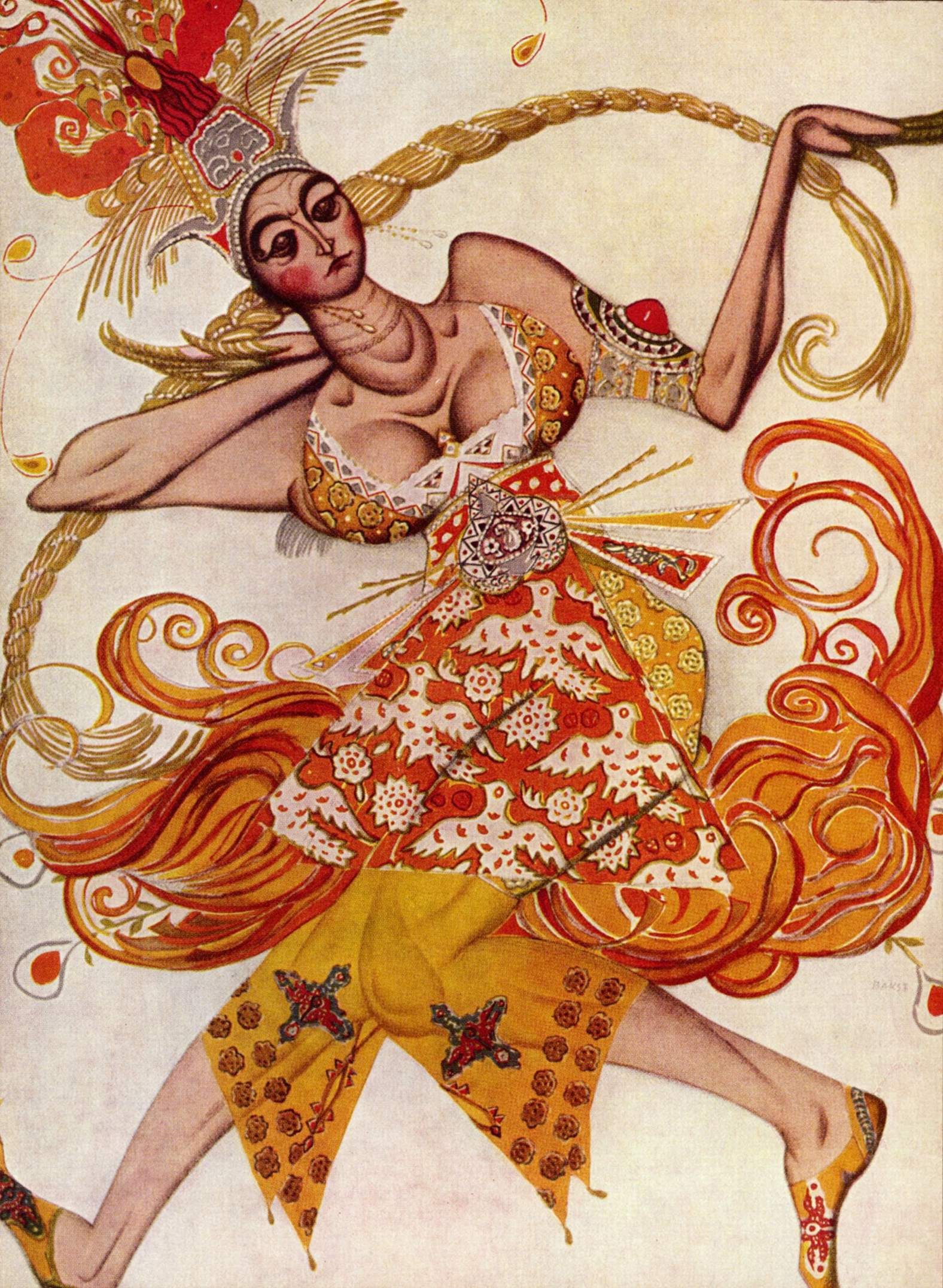
This work is essential evidence for how early 20th-century ballet was designed, staged, and imagined as a visual spectacle. Bakst's costume designs fundamentally shaped what ballet looked like in the era of the Ballets Russes, influencing not only dance itself but European modernist visual art more broadly. For historians of dance, this image records the integration of costume design and choreographic line that defined the period.
What you are looking at
A single dancer dominates the composition, posed in a dynamic mid-movement attitude against a cream ground. The figure is depicted with stylized facial features—a pale mask-like face with exaggerated eyes and mouth rendered in dark red and purple tones—characteristic of theatrical or ritualistic makeup. The dancer's upper body is bare except for ornamental collars and bands in gold, red, and patterned fabrics. The lower body is wrapped in voluminous patterned skirts in deep reds and golds with intricate floral and geometric designs, and the garment extends into dramatic fanned or pleated panels that fill the lower half of the canvas. A long braided rope or cord element swings upward across the composition. The dancer's limbs are elongated and arranged with one leg extended and the upper torso arched backward in a spiral twist. The background contains abstracted curled foliate motifs in gold and red, suggesting a theatrical backdrop or decorative frame rather than natural space.
The dancing
A single figure shown in three-quarter view, head tilted back with one arm raised and curved overhead, the other arm positioned across the torso. The weight appears shifted onto a single supporting leg while the other extends in space. The spine is deeply arched in a backward lean or spiral twist. The pose suggests extreme flexibility and a moment of suspension or weightlessness rather than grounded, weight-bearing movement. The elongated proportions and exaggerated joint angles are stylized beyond naturalistic anatomy.
The dance depicted
This appears to depict a character dancer from Russian Imperial Ballet, most likely a role from the Ballets Russes repertory. The stylized facial makeup, elaborate costume with Asian or Eastern-inflected design, dynamic pose, and theatrical presentation are consistent with the orientalist or exoticist character roles that dominated early 20th-century ballet spectacle. The spiral twist and raised-leg extension suggest classical ballet vocabulary executed with the dramatic line and extension characteristic of that era. However, the specific ballet cannot be determined from the image alone. The figure resembles costume and character studies associated with Léon Bakst's designs for productions such as *Schéhérazade* (1910) or other Ballets Russes works that featured character dancers in elaborate, non-Western-inspired costumes.
How it was made
The work is an oil painting on paper or light ground, executed with the precision and decorative flatness typical of theatrical costume and character design studies from the early 20th century. The artist has used opaque paint to render the figure and background elements with careful attention to ornamental detail—the patterned fabrics, gold outlines, and stylized curled motifs are clearly delineated. The technique is compatible with preparatory design work for stage production, though it is executed with sufficient finish to function as an independent artwork. The style reflects the modernist graphic sensibility of the period, with strong outlines, flattened perspective, and heightened chromatic intensity.
About this work
This is a character study for Russian Imperial Ballet, created during the first decade of the 20th century when Léon Bakst was designing costumes and sets for theatrical dance. The painting captures a single dancer mid-arabesque or spiral turn, rendered with the hyper-decorative intensity and orientalist aesthetic that defined the Ballets Russes. The figure's extreme pose—arched spine, extended leg, raised arm—and the elaborate costume suggest a moment of virtuosic display designed to showcase both the dancer's technique and the designer's visual imagination. The work sits at the intersection of fine art and applied design, functioning simultaneously as a costume study and as a complete artistic composition.
Bakst's designs for Russian ballet were revolutionary in treating the dancer's body and costume as a unified, decorative whole rather than as figure-over-background. This study exemplifies that principle: the body's line echoes and completes the rhythms of the fabric, and the architectural ornament of the costume extends the geometry of the pose. The painting documents not just a moment of dance, but a specific historical moment when European modernism and Russian theatrical innovation converged.
How to look at it
Observe the way the dancer's pose spirals upward from the planted foot through the twisted spine and raised arm, creating a single continuous line of movement. Notice how the costume does not sit *on* the body but becomes an extension of it—the fanned skirts complete the spiral, and the raised arm resolves into the upward sweep of fabric. Look at the face: the mask-like makeup and exaggerated features are not naturalistic but theatrical, designed to read from the back of an opera house. The dancer's extreme flexibility—the deep backbend, the high extension, the length of the limbs—represents a specific moment of peak virtuosity, frozen and flattened for visual effect. The ornamental background is not scenery but a framing device that echoes the body's geometry.
The artist
Léon Bakst (1866–1924) was a Russian painter, stage designer, and costume designer whose work for the Ballets Russes fundamentally transformed theatrical dance design. Originally trained as a fine artist, Bakst became the principal visual architect of Sergei Diaghilev's company, creating costumes and sets for landmark productions including *Les Sylphides*, *Schéhérazade*, *L'Après-midi d'un faune*, and *The Rite of Spring*. His designs synthesized European modernism with orientalist imagery and historical pastiche, creating a visually unified theatrical world. Bakst treated the dancer's body as an element within a total aesthetic composition, and his costume designs were inseparable from choreographic intent. His work influenced modernist painting, graphic design, and fashion throughout the 20th century. He was also a prolific easel painter and printmaker, and many of his character studies and costume designs remain as independent artworks.
The period
This study was created at the height of the Ballets Russes' early dominance of European dance (c. 1909–1914). The era was characterized by a radical reinvention of ballet away from the rigid academic conventions of the Imperial Russian tradition and toward integrated theatrical spectacle that engaged with modernist painting, music, and design. Bakst's work epitomized the period's appetite for visual excess, orientalist fantasy, and the integration of fine art with performative spectacle. In the visual arts, this was the era of Cubism, Fauvism, and the avant-garde's engagement with non-Western aesthetics. In dance, it was a moment when costume, set, music, and choreography were being unified under a single artistic vision for the first time at this scale.
Where it lives
This work was sourced from Wikimedia Commons, which indicates it is likely held in a public collection, though the specific holding institution is not recorded in the catalogue. Bakst's costume and character studies were created as working designs for stage production but were also valued as independent artworks, and many entered museum collections.
Dance in this work
Questions about this work
What ballet is this character from?
The image alone does not identify a specific ballet. The style, costume, and makeup are consistent with Ballets Russes productions of the 1909–1914 period, and the work may be related to *Schéhérazade*, *Cleopâtre*, or another orientalist or character role from Bakst's portfolio. The catalogue record lists only the year (1910) and artist. If a title or production name exists, it is not recorded here.
Is this a design study or a finished artwork?
It functions as both. Bakst's costume studies were created as working documents for stage production—showing dancers, costumers, and directors what the finished costume should look like and how it would move on the body. However, they were also executed with sufficient finish and compositional care to function as independent fine artworks. Many were exhibited, collected, and are now held in museum collections rather than archives.
Why does the dancer's face look so stylized?
The exaggerated features, mask-like quality, and bold makeup colors are characteristic of theatrical makeup designed for stage visibility and to support the character's identity. The style also reflects modernist painting's interest in flattening, simplification, and expressive distortion. This is not how the dancer would look in person, but how they would appear to an audience at distance under stage light.
What is the long twisted rope-like element in the dancer's hand?
It appears to be a braided cord, sash, or ornamental element of the costume, possibly a whip, rope, or decorative drapery. Without seeing the full costume or knowing the specific character, it cannot be identified with certainty, but it is clearly an intentional prop or costume element integrated into the pose and design.
More Ballet artwork