49 works in this view — arrow keys or swipe to move between them.
Dance in Art · 1910
Les jolies filles de Gottenberg P-FG-ES-05331
Unknown artist
- Medium:
- Oil Painting
- Era:
- 1900-1920 (Ragtime/Early Jazz)
- Source:
- Wikimedia Commons
- Rights:
- Public domain — free to use, share and adapt.
- Recorded as:
- Public Domain
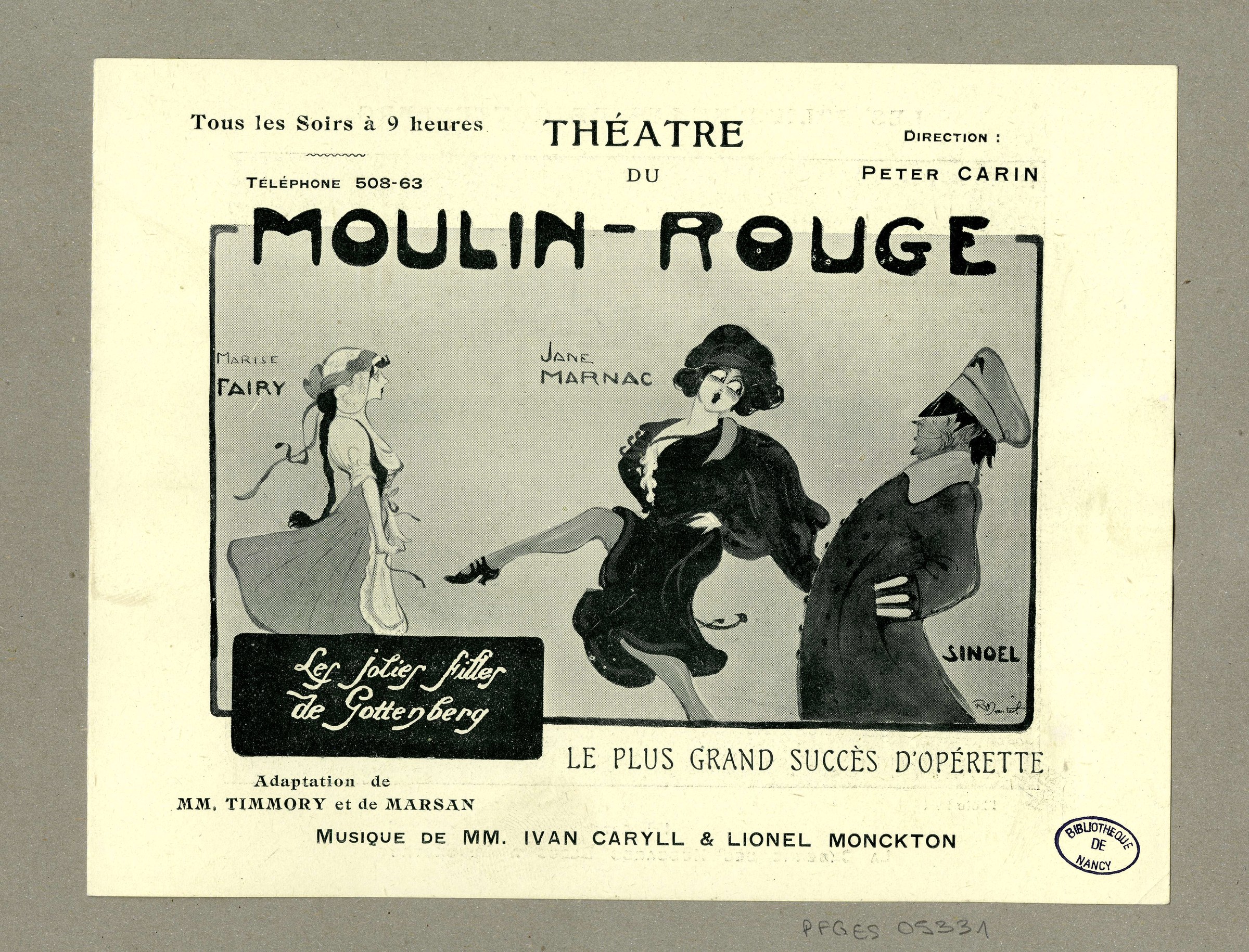
This poster documents how trained dancers were marketed and understood in early-20th-century Paris. It shows that even minor operetta performances featured performers whose names were given prominence and whose dancing ability was highlighted in promotional material, indicating that dance was a central draw. The image also captures the aesthetic conventions of Belle Époque stage dance: the blend of balletic carriage with exaggerated, theatrical gesture designed for comic and dramatic effect.
What you are looking at
This is a theatrical poster for an operetta staged at the Moulin-Rouge in Paris, printed in the early 20th century. The composition shows three figures arranged diagonally across the frame against a cream background. At left, a woman labeled "Marthe Fairy" is drawn in profile, wearing a pale gown and standing en pointe or on tiptoe with one leg raised behind her—a balletic pose. At center, "Jane Marnac" is shown in a dynamic moment, her dark dress caught mid-movement, her body tilted, one leg extended, her posture suggesting a rapid turn or pivot. At right, a military figure (likely a tenor or character role) stands in uniform with an exaggerated profile, wearing a bicorne hat, facing toward Jane. The artist is signed "Sinoel" in the lower right. The poster advertises *Les jolies filles de Gottenberg*, described as "le plus grand succès d'opérette" (the greatest operetta success), with adaptation by Timmory and Marsan, music by Ivan Caryll and Lionel Monckton. The telephone number and direction (Peter Carin) place it as contemporary advertising material for an active theater production.
The dancing
The three figures are arranged to suggest narrative action rather than a formal dance grouping. Marthe Fairy stands in a classically trained balletic stance—weight forward, one leg raised in a lifted position, the carriage upright and controlled. Jane Marnac occupies the dramatic center, her body twisted in what appears to be a moment of rapid rotation or flirtation; her weight is clearly shifted, the knee bent, suggesting she is either mid-turn or mid-stride. The military man stands relatively still, his profile sharp and comic, establishing himself as the male figure in the romantic triangle. There is no closed hold or partner connection; instead, the three bodies are spaced and oriented to suggest theatrical narrative and comedic interaction rather than ballroom technique.
The dance depicted
This appears to document a music-hall or operetta style of dance rather than classical ballet or ballroom. The operetta format—with its music by established composers Caryll and Monckton—suggests a chorus of dancing girls performing in short, snappy scenes interspersed with comic dialogue and character moments. The balletic pose of Marthe Fairy indicates that trained dancers were part of the Moulin-Rouge's roster, but Jane Marnac's exaggerated, theatrical gesture is less about technique and more about character and narrative. This is stage dance in the service of comic storytelling, typical of Belle Époque operetta and music-hall practice, where dancers performed elevated kicks, quick turns, and flirtatious body language designed for legibility at a distance and entertainment rather than virtuosity.
How it was made
This is a lithographed theater poster, a mass-produced format designed for street posting and rapid circulation. The technique of lithography allowed fine tonal gradation and expressive line work; here, the artist (Sinoel) has used bold black outlines to define the figures and simple shading to suggest volume and movement. The poster format—with integrated text, performer names, and house details—made it both advertisement and documentary record of who performed which roles. Lithography was the dominant poster medium in Paris during this period, enabling hundreds or thousands of prints to be struck and distributed throughout the city. The casual elegance of the line and the flattened perspective are characteristic of early-20th-century commercial art rather than fine art reproduction.
About this work
This theater poster documents a moment of operetta performance at the Moulin-Rouge, the Parisian music hall famous for high-kicking chorus lines and spectacular entertainment. The image captures three performers in a scene from *Les jolies filles de Gottenberg*, a successful operetta of the early 1900s, arranged in a theatrical composition that prioritizes storytelling and character over formal dance vocabulary. Two women are shown in balletic or acrobatic positions—one lifted, one mid-turn—framing a comic military figure, suggesting a narrative scene involving romance, military humor, or rivalry.
The work belongs in a dance history collection not because it documents classical ballet or ballroom technique, but because it records the hybrid stage dance of Belle Époque Paris: a commercial, popular entertainment form that blended trained ballet technique, acrobatic skill, comic timing, and chorus-line spectacle. The Moulin-Rouge was a vital site of innovation in performance, and this poster is evidence of how dance was integrated into operetta narratives and marketed to urban audiences.
How to look at it
Observe the pose of each figure and what it suggests about the moment in the scene. Marthe Fairy's lifted leg and upright carriage signal classical training; Jane Marnac's twisted torso and extended leg suggest a moment of rapid action or playful exaggeration typical of music-hall performance. The artist has chosen a narrative moment—not a formal pose—that carries comedy and movement. Note also how the poster integrates advertising copy, performer names, and image into a unified design meant to catch the eye from a distance and summarize the show's appeal in a glance. The composition prioritizes legibility and entertainment value over technical precision.
The artist
Sinoel was a commercial artist and poster designer active in Paris in the early 20th century. The signature on this poster is his only reliable record; he appears to have specialized in theater and entertainment advertising, working in the lithographic style standard to Parisian poster production of the period. Beyond the works themselves, little is documented of his career.
The period
The early 1900s saw the height of operetta as a popular entertainment form across Europe. Parisian music halls, especially the Moulin-Rouge (opened 1889), became famous for spectacular dance numbers featuring trained dancers performing high kicks, acrobatic turns, and elaborate ensemble choreography. This operetta by Caryll and Monckton was part of a transatlantic tradition of light musical theater that combined catchy melodies, comic business, and dancing girls as a major commercial draw. The period saw a democratization of ballet technique: trained dancers no longer performed only in classical ballet at the Opéra, but in music halls and commercial theatrical productions aimed at middle-class audiences. The poster itself is a product of the era's sophisticated mass-marketing of entertainment and celebrity, with performer names and theater details integrated into the design.
Where it lives
This is a theater poster lithograph from the Bibliothèque de Nancy, a municipal collection documenting regional cultural history and commercial printing. It is a primary-source advertising document for a specific production, not a fine-art work, and its value lies in its role as evidence of performance history and period aesthetics.
Dance in this work
Questions about this work
Was the Moulin-Rouge only a cabaret for the can-can?
No. While the Moulin-Rouge was famous for high-kicking chorus lines, it was also a venue for operetta, musical comedy, and theatrical performances featuring trained dancers and singers. This poster shows that operettas with substantial productions and named performers were regular attractions. The venue hosted a mix of entertainment modes, all of which contributed to its reputation as a center of modern, spectacular stage dance.
Who were Caryll and Monckton?
Ivan Caryll (1861–1921) and Lionel Monckton (1861–1924) were prolific composers of operetta and musical comedy, primarily for London and Paris audiences. They collaborated on several international successes. Their music was lightweight, melodic, and designed for easy memorability and rapid production turnover—the commercial popular music of their era.
What does the balletic pose tell us?
The lifted leg and upright carriage of Marthe Fairy indicate that she was a trained dancer, likely with some classical ballet instruction. By the early 1900s, it was common for music-hall and operetta performers to have formal dance training, even if they did not perform full classical ballet. The pose signals to the audience that they will see skilled movement, not amateur entertainment.
Is this a dance scene or a plot scene?
It is both. In operetta, dance is woven into dramatic and comic scenes rather than separated into discrete 'ballet numbers' as in classical ballet. This image captures what appears to be a scene from the plot—involving three characters—but one in which the performers are using their bodies expressively, and their dancing ability is part of what makes the scene legible and entertaining.
More dance artwork