49 works in this view — arrow keys or swipe to move between them.
Dance in Art · 1900
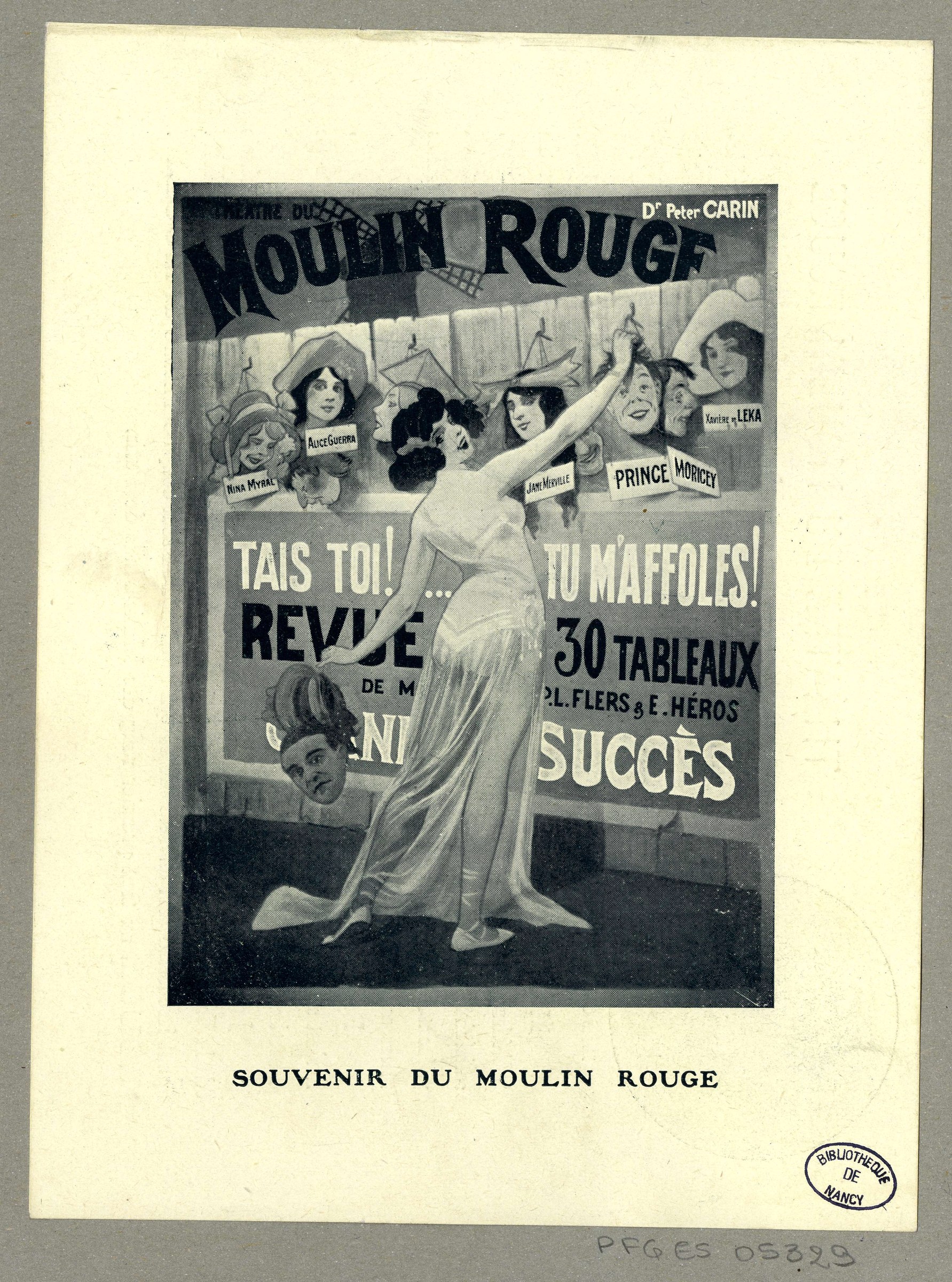
Souvenir du moulin rouge P-FG-ES-05329
Unknown artist
- Medium:
- Oil Painting
- Era:
- 1900-1920 (Ragtime/Early Jazz)
- Source:
- Wikimedia Commons
- Rights:
- Public domain — free to use, share and adapt.
- Recorded as:
- Public Domain
The image documents how early 20th-century cabaret styled itself visually and what dance vocabularies it claimed: the use of classical ballet imagery to advertise a venue famous for acrobatics, singers, and provocative entertainment reveals the period's complex negotiation of respectability and sensation. For historians of entertainment and design, it is a primary document of how Parisian pleasure culture represented itself during a transformative moment in theatrical practice.
What you are looking at
This is a theatrical poster for the Moulin Rouge cabaret, featuring a woman in a classical draped white gown positioned center-stage in a graceful, balletic pose. She stands with one leg extended and arms raised in an attitude of performance, her body oriented in three-quarter view toward the upper right. Behind her, a painted backdrop depicts a row of heads of entertainers (labeled with names including Alice Gierra, Nana Myval, Lena Morisette, Prince Morcey, and Karoly Leka), suggesting the featured performers of the revue. The composition uses a dramatic interplay of light and shadow typical of Belle Époque theater publicity. The poster advertises "Tais toi!... tu m'affoles!" (Be quiet!... you drive me mad!) and promises "30 tableaux" of success, identifying it as promotional material for a multi-scene revue. The typography is bold and assertive, characteristic of early 20th-century French theatrical advertising.
The dancing
The central figure is a solitary dancer whose posture suggests classical training. She holds a graceful, elongated line with her supporting leg straight and the working leg extended in a high développé or attitude derrière, her torso lifted and arms raised in an expressive port de bras. The pose is static rather than captured mid-movement, suggesting a classical ballet vocabulary. Her weight is balanced on the supporting leg, and the overall frame conveys control and refinement rather than the loose-limbed gestural vocabulary of contemporary cabaret. The painted figures in the backdrop are rendered as heads only, flattened into the scenery.
The dance depicted
The image depicts cabaret performance as theatrical entertainment, specifically the Moulin Rouge revue format that dominated Parisian entertainment in the 1900s. The classical ballet pose of the central figure, however, suggests an aspirational aesthetic: the Moulin Rouge employed dancers trained in academic ballet technique alongside acrobats, singers, and specialty performers, and marketed itself with imagery of refined, graceful movement. This reflects the period's tension between the respectable codes of theatrical ballet and the reputation of cabaret as sensational entertainment. The advertising promise of "30 tableaux" indicates the revue structure of multiple short, stylistically varied scenes rather than a coherent narrative.
How it was made
This is a lithographic poster, a medium ideally suited to bold graphic design and rapid reproduction for street advertising. Lithography allowed large-scale theatrical images to be printed inexpensively and distributed widely, making it the dominant format for Parisian entertainment publicity from the 1880s through the 1920s. The image shows the characteristic qualities of Belle Époque lithography: soft tonal modeling achieved through crayon work, dramatic use of shadow, and bold typography integrated into the composition. The technique was well-suited to theatrical publicity because it could reproduce the stylized, idealized figures that cabaret owners wanted associated with their venues.
About this work
This is a Moulin Rouge cabaret poster from approximately 1900, advertising a theatrical revue in the popular multi-scene format of the era. The central image presents a classically trained female dancer in a refined balletic pose, flanked by portraits of featured performers. As theatrical advertising material, the poster occupies a particular moment in French culture when cabaret entertainment was establishing itself as both commercially dominant and aesthetically respectable—the classical ballet vocabulary here signals that aspiration. The work exemplifies Belle Époque poster design and the visual language by which Parisian theaters marketed themselves during the height of the can-can era and the emergence of modern entertainment.
How to look at it
Attend to the pose of the central figure: it is classical and static, held as a complete image rather than a moment within movement. The artist has chosen to present a single refined silhouette rather than capturing the dynamic motion that cabaret dancers actually performed. The contrast between this classical vocabulary and the theatrical setting of multiple performers and scenes reveals the period's visual language for marketing entertainment—the classical ballet pose conveyed aspiration and refinement even in an avant-garde entertainment venue. Note how the background figures are merely heads, flattened into decoration: only the central dancer is fully modeled and anatomically present.
The artist
The catalogue record does not identify the artist. The poster bears a credit for "Dr Peter Carin," though the relationship between this name and the artistic production is unclear—he may be the director, producer, or a credited figure otherwise than the visual designer. The work is characteristic of professional theater poster production in Paris ca. 1900, a highly skilled commercial practice that employed accomplished graphic designers, many of them trained as fine artists.
The period
The Moulin Rouge opened in 1889 and had become the epicenter of Parisian popular entertainment by 1900. The period saw the rise of the revue format—extended shows with multiple brief, stylistically varied tableaux—as a dominant form, in contrast to the narrative structures of operetta. By 1900, cabaret had been largely domesticated into respectable middle-class entertainment, a shift from its earlier associations with working-class bohemia and transgression. The classical ballet imagery in this poster reflects that shift: the refined female dancer asserts cultural legitimacy for the venue. Lithographic poster art itself was undergoing rapid sophistication during this period, with Paris establishing itself as the center of poster design and advertising art.
Where it lives
The work is catalogued as part of the Bibliothèque de Nancy collection and is reproduced from Wikimedia Commons, a digital archive derived from institutional holdings. It survives as a historical artifact of theatrical publicity and holds primary-source value for the study of entertainment advertising and graphic design.
Dance in this work
Questions about this work
What is the Moulin Rouge and why does it matter?
The Moulin Rouge, opened in Paris in 1889, was the most famous cabaret of its era and helped establish the revue format—multiple short, stylistically varied theatrical scenes—as a dominant form of popular entertainment. It was a center of theatrical innovation and a space where working-class, bohemian, and respectable middle-class audiences overlapped. Its visual culture and performance practices influenced entertainment worldwide.
Why does the dancer in the poster look like a ballet dancer?
By 1900, the Moulin Rouge was marketing itself as respectable entertainment rather than transgressive pleasure. Classical ballet imagery conveyed cultural refinement and aspiration. In reality, the venue's dancers performed a mixture of styles—ballet technique, acrobatics, character dances, and provocative novelty acts—but the advertising emphasized the classical vocabulary to attract middle-class audiences.
What does '30 tableaux' mean?
A tableau is a short, self-contained scene, often with a specific theme, costume, or musical accompaniment. Thirty tableaux indicates a multi-hour revue composed of brief sketches, dances, acrobatic displays, and comic scenes performed in rapid succession. This was the standard structure for early 20th-century Parisian cabaret.
What is a lithographic poster?
Lithography is a printing process in which an image is drawn on a limestone or zinc plate using a greasy crayon, then chemically treated so that ink adheres to the image but not the background. The plate can then be printed many times. For theatrical posters, lithography allowed bold, large-scale images to be produced affordably and distributed widely on city streets.
More dance artwork