35 works in this view — arrow keys or swipe to move between them.
Dance in Art · 1926
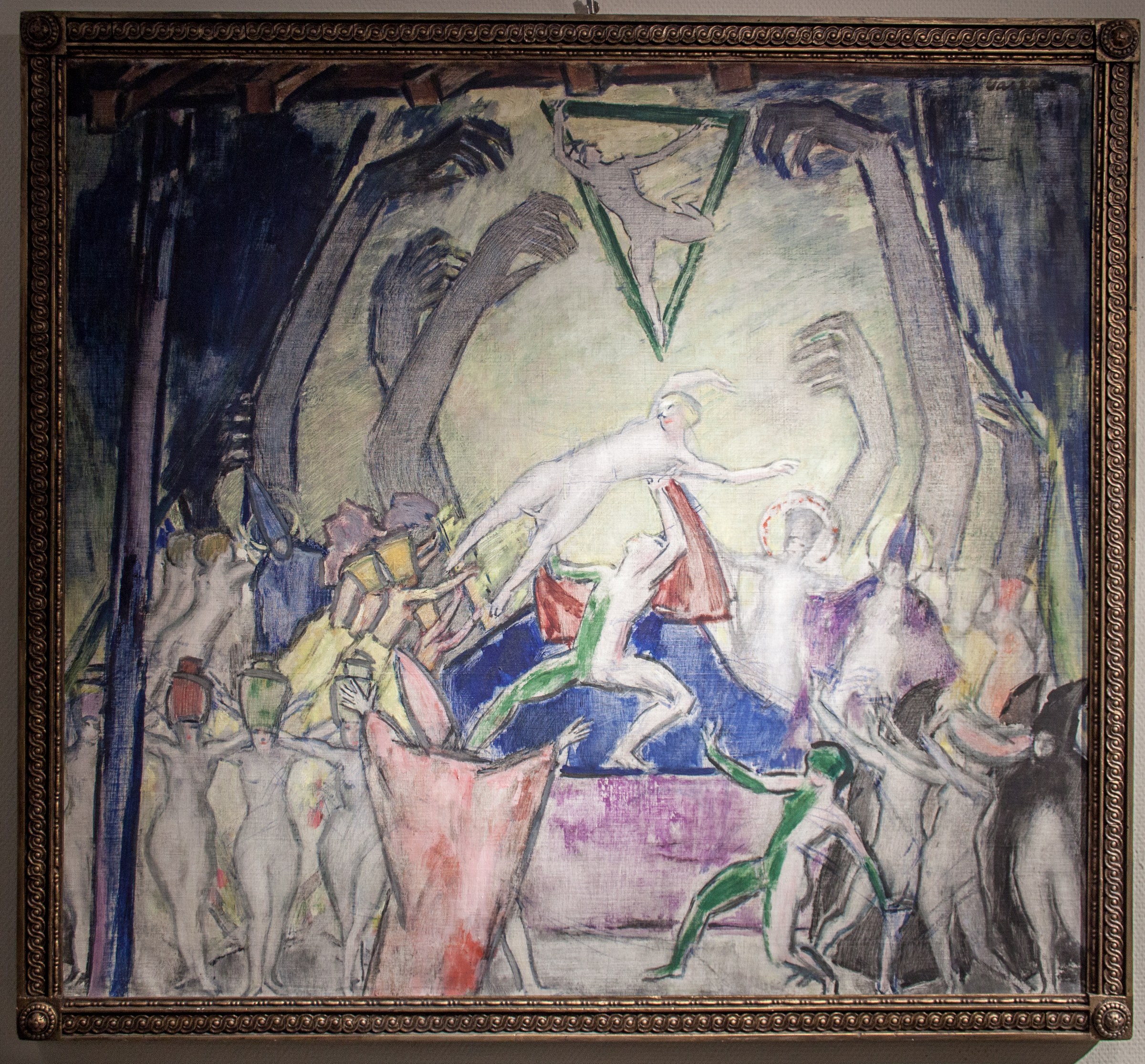
Vaszary - Revue at the Moulin Rouge
János Vaszary
- Medium:
- Oil Painting
- Era:
- 1920-1950 (Swing Era)
- Source:
- Wikimedia Commons
- Rights:
- Public domain — free to use, share and adapt.
- Recorded as:
- Public Domain
This work documents a specific form of entertainment—the Parisian revue and acrobatic spectacle—that shaped early-twentieth-century visual culture and left its mark on modernist art. For historians of dance and entertainment, it provides evidence of the aerial and acrobatic skills that were central to music-hall performance. For art historians, it exemplifies how modernist painters engaged with entertainment venues as subjects worthy of serious formal experimentation.
What you are looking at
A crowded cabaret or revue scene set within a cavernous interior with massive wooden beams and arched ceiling. The composition centers on a pale, elongated female figure in a striking pose—arms and legs extended in an aerial attitude, suspended above a stage or platform rendered in deep blue. She wears a red-and-white costume. Around her swarm dozens of smaller figures in muted grays, blacks, and muted purples, many rendered summarily and sketched with loose, gestural marks. The crowd fills the lower two-thirds of the canvas in a compressed, almost oppressive mass. The treatment is expressionistic: figures are simplified and distorted, the perspective flattened, the color palette subdued except for the brilliant white of the central dancer and the jewel tones of the stage. The scale of the suspended figure dominates and transforms the crowd below into a witnessing collective rather than individual presences.
The dancing
The central dancer displays an inverted or airborne pose—trunk arched, limbs extended as if in mid-leap or suspended by invisible support, rendered in pure white with minimal anatomical detail. The pose suggests extended arabesgue or attitude work but executed with the flat, elongated distortion characteristic of early-twentieth-century Expressionism. Around her, supporting figures and audience members are depicted with rapid, sketchy gestures—thin lines for limbs, simplified heads often shown in profile or three-quarter view. The crowd is undifferentiated; individual bodies blur and overlap, creating a visual syntax of density and visual noise that emphasizes the solitude of the performer above.
The dance depicted
This is almost certainly a Moulin Rouge revue scene, as the title confirms. The Moulin Rouge in Paris was famous for its spectacular dance reviews featuring elaborate choreography, acrobatic performers, and the high kicks of the can-can and similar styles. The elevated, inverted pose of the central figure suggests either acrobatic or aerial performance work—a specialty of early-twentieth-century music-hall and revue entertainment. The expressionistic treatment and fragmented crowd convey the atmosphere of overwhelming spectacle and kinetic energy rather than narrative dance. This is not ballet or social dance but the staged entertainment of a Parisian cabaret at the height of the Belle Époque and early modernism.
How it was made
Oil painting on canvas, executed with loose, expressive brushwork and deliberate stylization. The artist has used transparent and opaque passages, with areas of the crowd treated almost like scumbled or dragged pigment, and the central figure isolated in high-key white. The technique allows for the dynamic distortion and exaggeration of scale—the suspended dancer towers over the crowd not through perspective but through artistic choice. The fluidity of oil paint suited Vaszary's expressionistic approach, permitting rapid notation of the crowd while emphasizing the geometric purity of the central figure.
About this work
This is an oil painting by János Vaszary of a Moulin Rouge revue scene, dated 1926. It depicts the spectacular, almost surreal atmosphere of Parisian cabaret entertainment during the interwar period—a moment when modernist artists were deeply interested in the visual drama and social energy of entertainment venues. The work captures not the technical detail of dance but the emotional and compositional experience of witnessing a suspended, airborne performer surrounded by an intoxicated crowd. Vaszary's expressionistic language—distorted figures, flattened space, chromatic isolation—transforms the revue into a subject worthy of fine art scrutiny.
The painting belongs within the broader modernist fascination with entertainment and spectacle. Artists across Europe were drawn to cabarets, music halls, and theaters as sites of modernity, authentic human experience, and visual experimentation. Vaszary, a Hungarian-born painter active in Paris and Vienna, was part of this milieu. His treatment of the revue is neither documentary nor celebratory in a conventional sense; instead, he uses expressionist distortion to convey psychological and social complexity—the power dynamics, the sensuality, the crowd's collective arousal.
How to look at it
Attend first to the spatial and compositional inversion: the artist has made the performer dominate the canvas not through scale alone but through chromatic isolation (white against muddy surrounds) and suspended defiance of gravity. The crowd below is rendered as texture and gestural mark rather than as individual presences; this choice transforms the collective into an almost abstract surround. The viewer is invited to experience the vertigo and visual disorientation of the performer's inhuman pose and the crowd's barely-contained energy. Notice too the contrast between the meticulous rendering of the central figure's extended limbs and the summary, almost violent handling of the surrounding figures—a formal choice that reinforces the performer's isolation and transcendence.
The artist
János Vaszary (1867–1939) was a Hungarian painter trained in Munich and active in Paris, Vienna, and Budapest. He was associated with modern movements including Impressionism and Expressionism, and was particularly interested in scenes of contemporary life—urban crowds, entertainment venues, leisure culture. His work often combined vivid color and expressive distortion with social observation. Vaszary participated in the Vienna Secession and exhibited widely across Central Europe and France, making him a bridge figure between fin-de-siècle aestheticism and modernist practice.
The period
In 1926, the Moulin Rouge was already a legendary and storied venue, having opened in 1889 at the height of the Belle Époque. By the 1920s, the cabaret and revue scenes of Paris were still vital centers of entertainment, although the energy had shifted with the post-World War I cultural landscape. The interwar period saw intense modernist and avant-garde interest in entertainment and performance as subjects for high art. Artists were drawn to the visceral energy, the crowds, the sexuality, and the technical virtuosity of cabarets, revues, and circus performance. This painting sits at the intersection of that fascination with entertainment and modernist formal innovation—expressionism being a primary vehicle for conveying psychological and social intensity.
Where it lives
Sourced from Wikimedia Commons. The holding collection is not recorded in the catalogue.
Dance in this work
Questions about this work
What is the Moulin Rouge and why did artists paint it?
The Moulin Rouge was a cabaret and music hall in Paris, opened in 1889, famous for spectacular dance revues, acrobatic performances, and the can-can. Modernist artists were drawn to entertainment venues as sites of authentic contemporary experience, visual drama, and social complexity. The Moulin Rouge in particular was associated with modernity, sexuality, and the kinetic energy of urban leisure culture.
What dance form is the central figure performing?
The elevated, inverted pose suggests acrobatic or aerial performance work rather than classical ballet or social dance. Music-hall revues featured virtuosic acrobats, contortionists, and aerial performers alongside dancers. The pose is too extreme and weightless to be conventional dance and likely represents the kind of spectacular physical feat that made revue entertainment distinctive.
Why does the artist distort and simplify the figures so much?
Vaszary employs expressionist technique to convey the subjective, emotional experience of the scene rather than documentary detail. The distortion, flattened space, and gestural handling suggest intensity, disorientation, and the overwhelming sensory experience of a crowded entertainment venue. This formal language was characteristic of modernist approaches to entertainment and spectacle.
Who was János Vaszary?
A Hungarian painter (1867–1939) active in Paris, Vienna, and Budapest. He was trained in Munich, influenced by Impressionism, and developed an expressionist style marked by vivid color and social observation. He was associated with the Vienna Secession and exhibited widely across Central and Western Europe, making him a significant figure bridging fin-de-siècle and modernist aesthetics.
More dance artwork